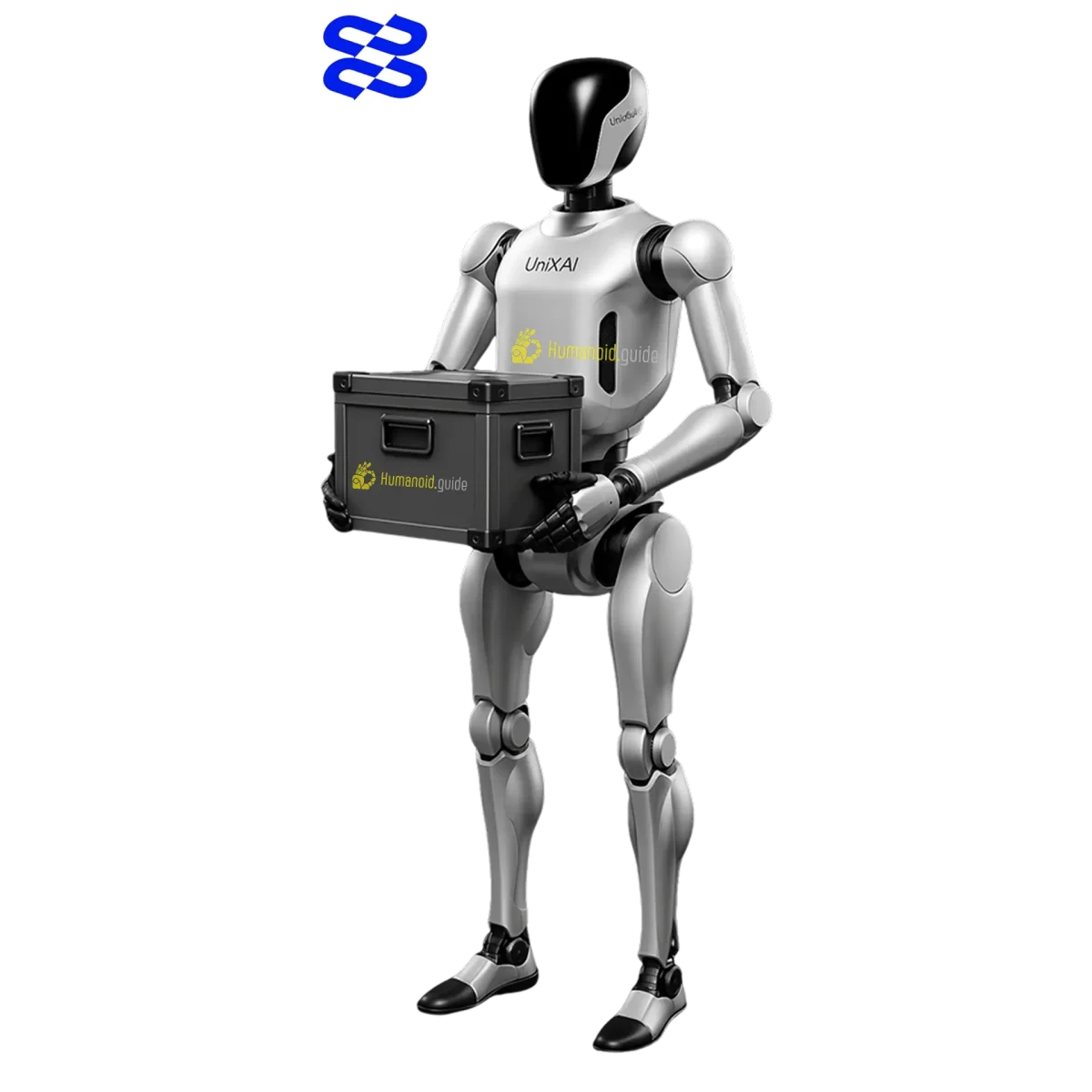
What is the Martian Unix?
The Unix AI Martian is an IP65‑rated off‑road humanoid robot developed by Unix Group, a Chinese robotics company. Standing 160 cm tall and weighing 50 kg, it features all‑terrain legs, a LiDAR‑equipped head, and a 50 kg payload capacity. The robot is designed for autonomous exploration, outdoor patrol, reception, and home‑service tasks in challenging environments. With 16 overall degrees of freedom (7 per arm), a 100‑TOPS computing platform, and 5‑finger dexterous hands, Martian combines ruggedness with advanced AI integration. It runs for up to 9 hours per charge and reaches a top speed of 10 km/h, making it suitable for both indoor and outdoor applications.
Specifications
Here are the full technical specifications.
| Spec | Value |
|---|---|
| Height | 160 cm |
| Weight | 50 kg |
| Degrees of freedom | 16 (7 per arm) |
| Battery life | 9 hours |
| Max speed | 10 km/h |
| Payload | 50 kg |
| Price (new) | Undisclosed (contact manufacturer) |
| Price (used range) | N/A (pre‑order – no used market yet) |
Price & Value
New MSRP: Undisclosed
Used range: N/A
Unix Group has not published an official price for the Martian. As a pre‑order prototype with advanced all‑terrain hardware (IP65, LiDAR, high‑torque motors), it is likely positioned above general‑purpose service humanoids. When available, pricing could be comparable to ruggedized industrial platforms, possibly in the $100 000–$200 000 range, but no verified quote exists. Prospective buyers must contact Unix Group directly for a quotation. Without a public price, depreciation expectations and total cost of ownership remain unclear. Organizations considering this robot should budget for bespoke integration, spares, and potential import costs from China.
Who Is It For?
Best for: - Outdoor security and autonomous patrol fleets (IP65 and LiDAR enable all‑weather operation) - Reception and guiding in semi‑outdoor malls, parks, or large campus environments (rugged legs handle stairs and uneven terrain) - Research labs exploring off‑road legged locomotion and whole‑body AI (50 kg payload, LLM integration)
Not for: - Purely indoor office tasks (over‑engineered for smooth floors; a wheeled service robot would be cheaper) - Budget‑constrained deployments (undisclosed price likely high; no used units available to lower cost)
Alternatives & Comparison
The Martian occupies a niche as a rugged IP65 humanoid, a capability most service humanoids lack. The following table compares it to general‑purpose bipedal robots in a similar class, even though none offer the same off‑road durability.
| Model | Price | Available | Key Difference |
|---|---|---|---|
| Fourier GR‑2 | ~$150,000 (est.) | preorder | Lacks IP65 and LiDAR; primarily lab‑focused |
| UBTECH Walker S | Undisclosed | preorder | Indoor‑oriented; no off‑road legs or IP rating |
| Boston Dynamics Spot (quadruped) | $74,500 | yes | Not a humanoid, but proven rugged outdoor patroller |
Verdict: If your use case demands a bipedal form factor that can work outdoors in rain and dust, the Martian is uniquely suited. For controlled indoor environments, the Fourier GR‑2 or UBTECH Walker S offer more refined lab and service platforms. For pure outdoor patrol without human‑interaction needs, a quadruped like Spot may be a more mature and cost‑effective choice.
Use Cases & Capabilities
Outdoor Security & Patrol
With IP65 weatherproofing, a LiDAR head for navigation in darkness, and a 10 km/h top speed, the Martian can autonomously patrol perimeters, construction sites, and industrial yards. The 50 kg payload allows mounting of additional sensors, spotlights, or communication gear. Its 9‑hour battery covers a full shift, and all‑terrain legs traverse gravel, grass, and shallow mud. The LLM integration can be used to assess situations and issue verbal warnings if needed.
Reception & Guiding in Mixed Environments
Martian can greet visitors outdoors or in open‑air malls, then guide them through uneven pathways, steps, and grassy shortcuts—terrain that wheeled robots cannot handle. The RGB camera array and depth sensor enable face recognition and wayfinding. A large display on the torso (similar to Wanda 2.0) could provide visual directions, while natural‑language processing supports multilingual interaction. Its rugged design ensures reliability despite occasional splashes or dust.
Autonomous Exploration & Mapping
Equipped with 5G, EtherCAT, Wi‑Fi, and a LiDAR head, the Martian can be deployed into disaster zones, mines, or unmapped outdoor areas to build 3D maps and locate objects. The 50 kg payload allows carrying a sensor suite or sample containers. The 100‑TOPS onboard compute handles SLAM and AI‑based terrain assessment in real time. The 9‑hour battery supports extended missions, and the IP65 rating protects against water spray and dust ingress.
Home Assistance with Rugged Capability
In large country estates or farms, the Martian can assist with carrying tools, delivering items between buildings, and performing simple outdoor chores. Its 5‑finger hands with 7 DOF per arm enable manipulation of door handles, tools, and packages. The robot can navigate gravel paths, wet grass, and light snow without damage. The 16 total DOF provides the flexibility needed for bending, reaching, and lifting tasks, while the LLM integration allows it to understand and respond to casual voice commands.
History & Background
Unix Group, a Chinese robotics company, introduced the Martian in 2024 as part of a family of special‑purpose humanoids that includes the service‑oriented Wanda 2.0 and the security‑focused Panther. The Martian was designed from the ground up for off‑road exploration, combining an IP65‑rated shell, all‑terrain legs, and a LiDAR‑equipped head. In 2025, the company launched the improved Wanda 2.0, but the Martian remains the only model in the lineup with full environmental sealing and high‑torque motors (450 N·m). As of 2026, the Martian is available for pre‑order directly from Unix Group via its website, though no commercial shipments have been confirmed. The company has not disclosed a manufacturing partner or a roadmap for full‑scale production.
Buying Used — What to Check
Confirm IP65 integrity The sealing is critical for outdoor reliability; inspect gaskets and connectors for any damage or wear.
Verify payload rating Payload is central to the robot's utility. Test with a 50 kg load on off‑road terrain to ensure motor torque and battery life match specs.
Check battery health The 9‑hour runtime claim needs validation on used units. Request cycle count and a live outdoor endurance test before purchasing.