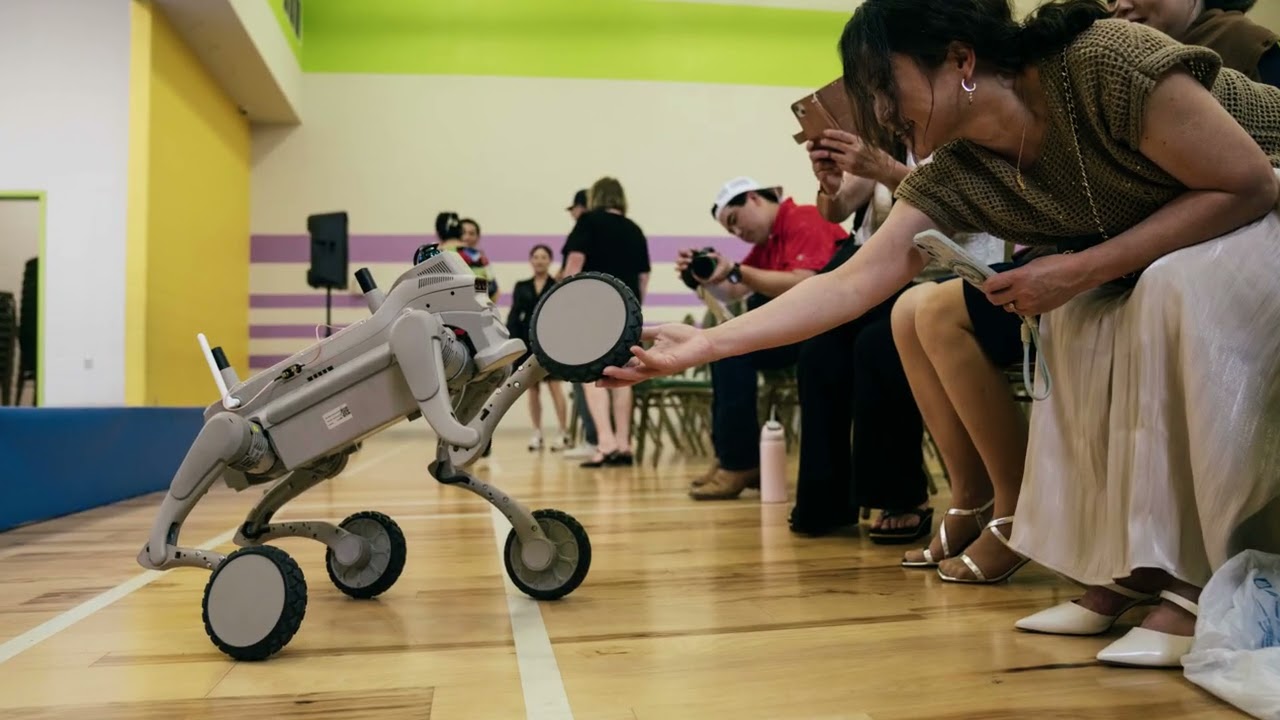
What is the Master Robot?
The Faraday Future Master is a compact bipedal humanoid robot developed by Faraday Future, a US-based electric vehicle company headquartered in Los Angeles, California. Standing just 131 cm tall and weighing 39 kg, it is designed as a personal assistant and home automation companion, integrating with the company's EV ecosystem. Unlike larger industrialized humanoids, the Master focuses on safe human interaction, entertainment, and education. It is powered by an Nvidia Jetson Orin NX compute module, features stereo RGB cameras and 3D LiDAR, and offers 30 degrees of freedom with 7‑DOF arms. The robot was first shown in 2024 and remains in the concept stage, with no confirmed production date.
Specifications
Here are the full technical specifications.
| Spec | Value |
|---|---|
| Height | 1310 mm |
| Weight | 39 kg |
| Degrees of freedom | 30 |
| Battery life | 2 hours |
| Max speed | 7.2 km/h |
| Payload | 5 kg |
| Price (new) | Undisclosed |
| Price (used range) | N/A |
Price & Value
New MSRP: Undisclosed (contact manufacturer)
Used range: N/A
As of 2026, the Faraday Future Master remains a concept without a publicly disclosed price. Faraday Future has not announced a price, and its focus on electric vehicles suggests the robot may not be a near‑term commercial product. If it ever reaches market, its compact size and home‑assist focus could allow an aggressive price, possibly below $20,000, to compete in the consumer humanoid space. However, buyers should expect higher costs for custom integration, software, and ongoing support. The lack of a clear production timeline means potential adopters must verify availability and total cost of ownership directly with Faraday Future.
Who Is It For?
Best for: - Early‑adopter households seeking a compact, interactive humanoid assistant
Not for: - Industrial material handling (only 5 kg payload, 131 cm tall, not suited for heavy loads)
Alternatives & Comparison
While humanoid robots like Tesla Optimus and Figure 01 target general labor, the FF Master is designed as a personal companion with a focus on home integration.
| Model | Price | Available | Key Difference |
|---|---|---|---|
| Tesla Optimus | ~$20,000 (est.) | preorder | Larger, general‑purpose humanoid for factories |
| Figure 01 | Undisclosed | no | Full‑size bipedal for logistics and general tasks |
| Boston Dynamics Atlas | Research‑only (no price) | no | Advanced research platform; not available commercially |
Verdict: If you need a home companion robot with vehicle integration, the FF Master’s small form factor and lightweight design are clear benefits. For anyone needing robust payloads or industrial tasks, the Tesla Optimus or Figure 01 are far more capable choices. The Atlas is not a real alternative for any commercial buyer.
Use Cases & Capabilities
Home Assistant & Entertainment
The Master is envisioned as a friendly, interactive companion that can manage smart home devices, provide reminders, and entertain family members with games, storytelling, and music. Its compact 131 cm height and lightweight design make it safe around children and pets. It uses an adaptive AI dialogue stack to maintain natural conversations and can navigate rooms using its 3D LiDAR and RGB cameras. However, its 2‑hour battery life will require frequent recharging during extended use.
Education & STEM
Schools and universities could use the Master for teaching robotics, programming, and human‑robot interaction. Its Nvidia Jetson Orin NX compute and 30‑DOF body provide a real‑world platform for experimenting with motion planning, computer vision, and AI. Its smaller size makes it easier to store and operate in a classroom compared to full‑sized humanoids. On‑board cameras and sensors allow students to work with live sensor data. The lack of a commercial price, though, means institutions must contact Faraday Future directly for any demo unit.
Vehicle Integration
Faraday Future promotes the Master as an extension of its electric vehicle ecosystem. The robot could serve as an in‑car companion, pre‑conditioning the vehicle, managing infotainment, or acting as a co‑pilot assistant. It could also bridge the smart home and the car, checking door locks or climate settings while you are away. Its 4G/5G connectivity and mobile app integration would allow remote operation. This use case remains theoretical until a Faraday Future EV with such support is available.
History & Background
Faraday Future was founded in 2014 in Los Angeles, California, primarily to develop electric vehicles. The company gained attention with the FF 91 luxury sedan but faced repeated production delays and financial struggles. In 2024, it unexpectedly revealed the Master humanoid robot as a concept, signaling an expansion into consumer robotics. The first prototype, built that year, demonstrated 30 degrees of freedom, lightweight construction, and integration with Faraday’s vehicle platform. Since then, the company has released only limited specifications and no production timeline. As of 2026, the Master remains a pre‑commercial concept, and Faraday Future has not announced any plans for mass production or sales.
Buying Used — What to Check
Verify payload and battery health Payload (5 kg) is modest and battery life (2 h) is critical; both degrade over time.
Inspect structural integrity Lightweight construction may be less durable; look for cracks or loose joints.
Obtain software updates AI dialogue stack and integration features may require manufacturer‑specific updates that are not publicly available.