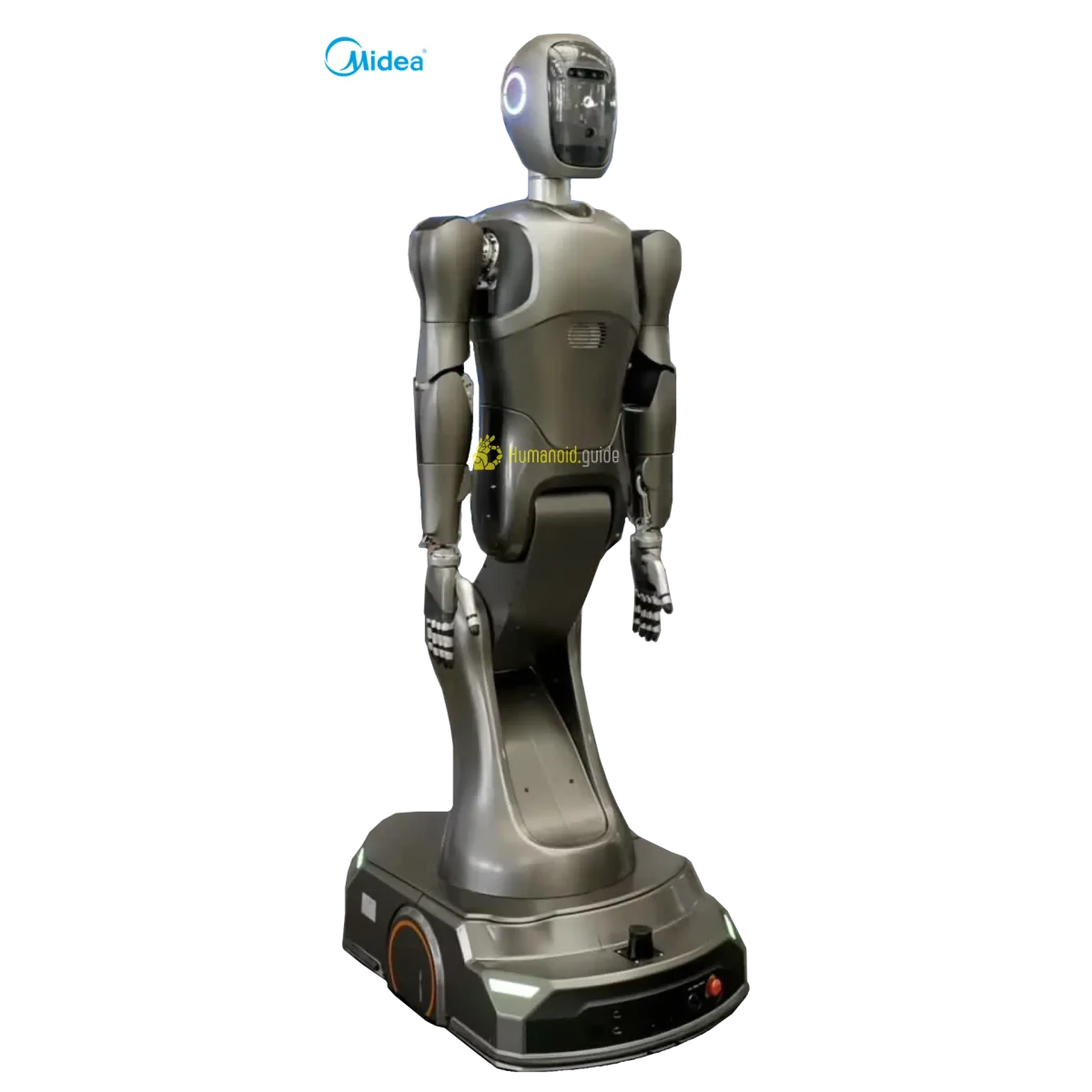
What is the Miro Midea?
The Midea MIRO is an industrial humanoid robot developed by the Chinese home appliance and robotics giant Midea Group. Conceived as an 'execution agent' within Midea's AI-driven smart manufacturing system, the MIRO is designed to perform assembly, material transport, and quality-inspection tasks on the factory floor. Unlike commercial humanoid robots intended for external sale, the MIRO is an internal proprietary platform that Midea deploys within its own factories to improve automation efficiency. The robot prototype, first shown in 2025, reportedly features a proprietary 3D camera, 48-volt DC geared motors with encoders, and a payload capacity of 8 kilograms. It moves at up to 4 km/h. While a wheeled, six-armed variant called MIRO U began pilot testing at Midea’s Wuxi factory in late 2025, the standard bipedal MIRO remains an internal research and deployment asset with no public pricing or commercial release.
Specifications
Here are the full technical specifications.
| Spec | Value |
|---|---|
| Height | Not specified |
| Weight | Not specified |
| Degrees of freedom | Not specified |
| Battery life | Not specified |
| Max speed | 4 km/h |
| Payload | 8 kg |
| Price (new) | Undisclosed |
| Price (used range) | N/A |
Price & Value
New MSRP: Undisclosed
Used range: N/A
As an internal factory automation tool, the Midea MIRO has no public price tag because it is not offered for sale to outside companies. The robot’s development and deployment costs are absorbed within Midea’s manufacturing operations, which makes estimating its unit production cost difficult. If the technology were ever commercialized, it would likely compete with other industrial humanoids such as the Tesla Optimus (targeting ~$20,000) or the quadruped-like wheeled platforms. However, Midea has given no indication of a commercial launch, and the MIRO’s reliance on proprietary AI and factory integration software would make it challenging for third-party buyers to use. For now, there is no primary or secondary market; Midea has not published any rental, lease, or purchase options. Prospective buyers looking for a similar capability should consider commercial alternatives that are closer to productization, as the MIRO’s value proposition is exclusively internal to Midea.
Who Is It For?
Best for: - Midea’s internal factory automation teams (assembly, kitting, and material handling) - Midea R&D groups exploring AI-driven manufacturing execution agents
Not for: - Any external manufacturer or logistics provider (the robot is not sold) - Research labs or universities seeking a humanoid platform for study (unavailable for purchase or collaboration)
Alternatives & Comparison
The MIRO is not a commercial product, so a direct buyer’s comparison is moot. However, if Midea were to eventually sell its humanoid, the following commercially oriented industrial humanoids are the most relevant reference points.
| Model | Price | Available | Key Difference |
|---|---|---|---|
| Tesla Optimus | Undisclosed (target ~$20,000) | preorder | Mass-production design, full external sales planned |
| Figure 02 | Undisclosed | preorder | General-purpose humanoid with advanced AI, externally available |
| UBTECH Walker S | Undisclosed (est. $150,000) | enterprise-only | Commercially shipping for factory tasks, but high cost |
Verdict: For a factory looking to buy a humanoid today, the UBTECH Walker S is the only one actually available for enterprise purchase, albeit at an estimated six-figure price. Tesla Optimus and Figure 02, while not yet shipping, are the highest-profile platforms and will likely define the market. The Midea MIRO remains an internal secret weapon — if you’re not Midea, your only option is to monitor these external alternatives.
Use Cases & Capabilities
Factory Assembly & Kitting
MIRO’s 8 kg payload and dexterous arms allow it to pick components from bins, align parts on fixtures, and drive screws or snap connectors in an assembly line setting. Midea’s AI manufacturing system coordinates multiple MIRO units to handle complex multi-step assembly workflows that traditionally required human workers. The robot’s 4 km/h top speed lets it move between workstations without a conveyor belt, adding flexibility to line layouts. Its 3D camera enables precise object localization even in dimly lit factory environments. The robot's manipulation performance rating of 2 out of 3 suggests medium-complexity tasks are feasible, though very fine precision may still require human oversight. Currently, these assembly tasks are demonstrated in Midea’s own home appliance factories, not available to external production lines.
Material Transport & Logistics
Equipped with a sturdy upper body and the ability to walk at 4 km/h, the MIRO can carry parts, tools, and sub-assemblies from storage areas to production cells. Its 8 kg strength is sufficient for many small to medium components used in electronics and appliance manufacturing. The robot’s navigation performance, rated 2 out of 3 by early spec sheets, suggests adequate autonomy to avoid obstacles and follow predetermined routes on the factory floor. Compared to fixed conveyor systems, the MIRO can be repurposed for different transport tasks simply by reprogramming its routes, offering a flexible alternative to dedicated automated guided vehicles. Although the robot can step over small obstacles, its battery endurance remains undisclosed, which may limit continuous operation without recharging infrastructure.
Quality Inspection & Monitoring
The MIRO’s proprietary 3D camera can be used for in-line quality checks, scanning assembled products for defects such as missing screws or surface damage. Its ability to manipulate parts means it can hold an item under a camera or rotate it for multi-angle inspection, and even apply test forces where needed. Because the robot is integrated into Midea’s AI-driven factory execution system, inspection data is fed back in real time to adjust upstream processes and prevent defects from recurring. By performing in-process inspections rather than end-of-line checks, the MIRO helps reduce scrap and rework, a key advantage for high-volume appliance manufacturing. The lack of published camera resolution limits external evaluation, but within Midea’s controlled environment the setup is tuned for specific part geometries and quality standards.
History & Background
Midea Group was founded in 1968 in Foshan, Guangdong, as a maker of household appliances and has since grown into a Fortune 500 company with a significant robotics division. In 2016, Midea acquired German industrial robot maker KUKA for $5 billion, gaining deep expertise in automation and robot manufacturing. Using this knowledge, Midea began developing its own humanoid robot, leveraging its manufacturing data and AI capabilities. The MIRO project reportedly emerged around 2023-2024 and culminated in a prototype reveal in 2025. Early documentation described it as an execution agent within Midea’s AI-driven factory automation platform. A more advanced version, the MIRO U, featuring six arms and a wheeled base, entered pilot testing at Midea’s Wuxi smart factory in December 2025. As of 2026, the original bipedal MIRO continues to be used internally; no plans for external sale have been announced, and most technical specifications remain confidential. The project reflects Midea’s strategy to become a leader in smart manufacturing, following the vision of fully automated lights-out factories.
Buying Used — What to Check
Motor and gearbox wear 48V DC geared motors with encoders are critical for locomotion; used units may have worn brushes or gears that affect movement accuracy.
3D camera calibration The proprietary camera is essential for task execution; verify it provides reliable depth data without drift.
Control system access Because MIRO relies on Midea’s AI factory system, a used unit may be locked to proprietary software and useless without integration support.