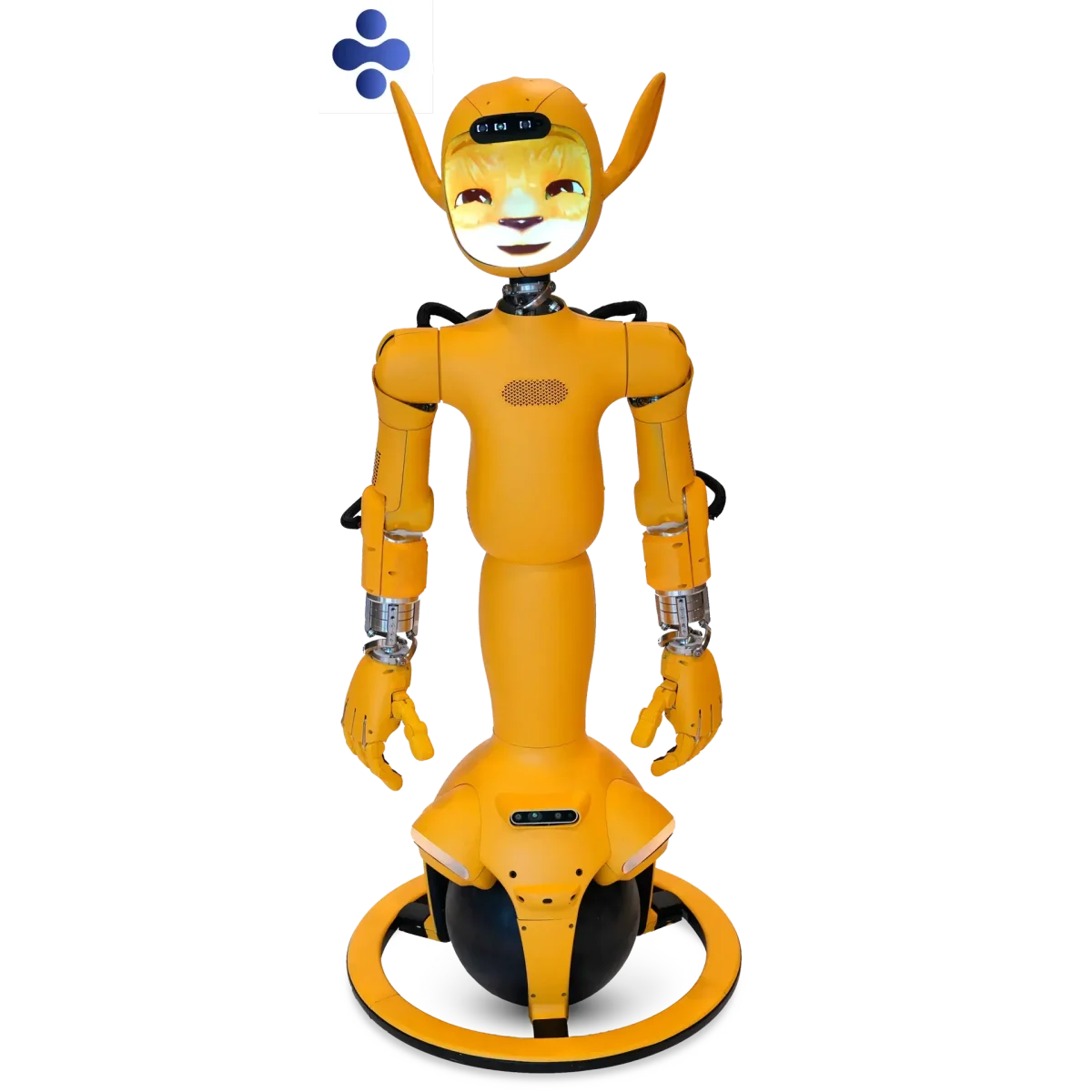
What is the Mirokai?
The Enchanted Tools Mirokai is a social humanoid robot designed for hospitality, retail, and healthcare environments. Built in France by Enchanted Tools, it stands 130 cm tall and weighs 30 kg, using an omnidirectional ball-bot base for fluid, space-efficient movement. Unlike tablet-centric service robots, Mirokai engages through an animated face, expressive gestures, and two dexterous hands capable of light manipulation (1.5 kg per hand, towing up to 15 kg). Its 28 degrees of freedom enable lifelike postures and interactions, while a suite of RGBD, infrared, ToF cameras and microphones provide situational awareness. First revealed as a prototype in 2023, Mirokai entered commercial production in 2025 and is now available for enterprise deployment, targeting roles like reception, wayfinding, and assisted customer service.
Specifications
Here are the full technical specifications.
| Spec | Value |
|---|---|
| Height | 130 cm |
| Weight | 30 kg |
| Degrees of freedom | 28 |
| Battery life | 4 hours |
| Max speed | 3.2 km/h |
| Payload | 1.5 kg per hand |
| Price (new) | ~$30,000 (enterprise quote) |
| Price (used range) | N/A (no secondary market yet) |
Price & Value
New MSRP: ~$30,000
Used range: N/A
At approximately $30,000 per unit, Mirokai is positioned as a mid-range social humanoid with light manipulation – significantly more capable than pure display or tablet-based robots, yet far cheaper than industrial humanoids like UBTECH Walker S ($100k+). Its value lies in being a characterful, mobile assistant that can guide, carry small items, and interact without a touchscreen. Total cost of ownership will include training, maintenance, and possible spare parts from Enchanted Tools; early adopters should budget for integration and software updates. Because the robot is only recently commercial, there is no used market to establish depreciation, but its modular design and French manufacturing may support a longer service life. Compared to SoftBank's Pepper (€20k–€30k, no arms), Mirokai provides additional utility for settings that need hands-on assistance, though buyers should verify reliability in high-traffic environments.
Who Is It For?
Best for: - Hotels and resorts wanting a moving, talking greeter that can carry small items like welcome drinks - Healthcare facilities for non-critical patient companionship and item delivery (1.5 kg payload per hand) - Retail stores seeking an attention-grabbing guide that can answer questions and hold products
Not for: - Heavy industrial tasks or warehouse logistics (payload limited to 1.5 kg, not intended for lifting) - Unsupervised security patrols (no IP rating, intended for indoor social spaces) - Precision manipulation research (DOF and hand dexterity not comparable to specialist research arms)
Alternatives & Comparison
For social interaction with light manipulation, Mirokai competes against more established platform robots and simpler kiosk-style companions. Below we compare with the most relevant alternatives a buyer would evaluate.
| Model | Price | Available | Key Difference |
|---|---|---|---|
| SoftBank Pepper | ~$20,000 | yes | Tablet-based, no arms; proven in thousands of deployments but lacks Mirokai's manipulation and character animation |
| SoftBank NAO | ~$8,000 | yes | Small humanoid (58 cm), educational focus – not suited for public hospitality environments |
| Invento Mitra | ~$15,000 | yes | Cute desktop companion with touchscreen, little mobility, no physical manipulation |
Verdict: For buyers needing a full-body, expressive robot that can both talk and physically assist guests, Mirokai is the clear winner among currently available options. Pepper remains the safe, well-established choice if interaction can be entirely screen-based and arms are unnecessary. NAO and Mitra are not realistic alternatives for public-facing service roles. However, Mirokai's commercial track record is short; risk-averse operators may wait for larger-scale deployment data before replacing proven solutions.
Use Cases & Capabilities
Hospitality Front Desk & Concierge
Mirokai can welcome guests, check them in via voice interaction, and provide information about hotel amenities. Its ball-bot locomotion allows silent, omnidirectional movement through lobbies and corridors. The robot can carry small items such as key cards, welcome drinks, or brochures with its hands, making it more useful than a static kiosk. Animated facial expressions and gestures create a memorable, personable experience that boosts brand differentiation. However, continuous operation may require charging stations and staff oversight for unexpected situations like dropped objects.
Retail Greeter & Shopping Assistant
In a retail setting, Mirokai serves as an engaging greeter that draws customer attention while providing product information and directions. Thanks to its payload of 1.5 kg per hand, it can hold and present small merchandise, letting shoppers physically inspect items. The robot’s omnidirectional mobility allows it to move around displays without taking up much space, and its array of cameras helps it avoid collisions. Staff can pre‑load sales scripts or interactive demos, freeing human employees for complex tasks. One limitation is that it cannot handle heavy or bulky goods, so it complements rather than replaces human sales associates.
Healthcare Companion & Light Logistics
In hospitals or elder‑care facilities, Mirokai can act as a comforting companion, guiding patients to appointments, engaging in basic conversation, and reducing feelings of isolation. It can carry personal items, mail, or light medical supplies between rooms, supporting nurses with non‑critical courier tasks. The robot’s friendly appearance and expressiveness aim to create a calming presence, although it is not a medical device and should not replace trained caregivers. Early commercial deployments in UK healthcare facilities in 2025 show promise for patient engagement and wayfinding. As with all social robots in clinical settings, hygiene and cleaning protocols must be established.
Event & Trade Show Attraction
At trade shows, conferences, or promotional events, Mirokai serves as an eye‑catching host that can greet visitors, hand out materials, and answer frequently asked questions. Its ball‑bot agility allows it to move through crowds and stop precisely, while expressive animations draw attendees to the booth. With a 4‑hour battery life, it can operate for a full session without recharging when on a rotating schedule. The robot’s compact 130 cm height makes it approachable without being imposing, and its French‑designed aesthetics give it a premium feel. Event organizers must consider the need for a quiet, smooth floor surface and may want backup units for long‑duration shows.
History & Background
Enchanted Tools was founded in 2021 in France with the mission of creating character‑rich social robots. Its first product, Mirokai, was unveiled as a prototype at CES 2023, where the ball‑balancing humanoid generated significant media attention for its animated face and omnidirectional movement. In 2024, the company produced a pilot batch of approximately 50 units, which were used for internal testing and early partner trials. Commercial deployment officially began in 2025 with the first units placed in select UK healthcare facilities, marking the robot’s transition from concept to product. By mid‑2026, Enchanted Tools’ website allowed customers to order Mirokai directly, targeting hospitality, retail, and healthcare operators. No ownership changes or acquisition have been reported; the company remains privately held and continues to iterate on the platform based on early field data.
Buying Used — What to Check
Verify payload rating Payload and runtime are critical for practical use; ensure the 1.5 kg hand payload and 4‑hour battery meet your workload before purchasing a used unit.
Inspect battery health A nearly four‑year‑old battery may have degraded; test actual runtime and request charging‑cycle history to avoid hidden replacement costs.
Confirm software & training availability Enchanted Tools may require ongoing subscriptions or limited support for older hardware; verify that the robot’s software can be updated and that staff training is still offered.