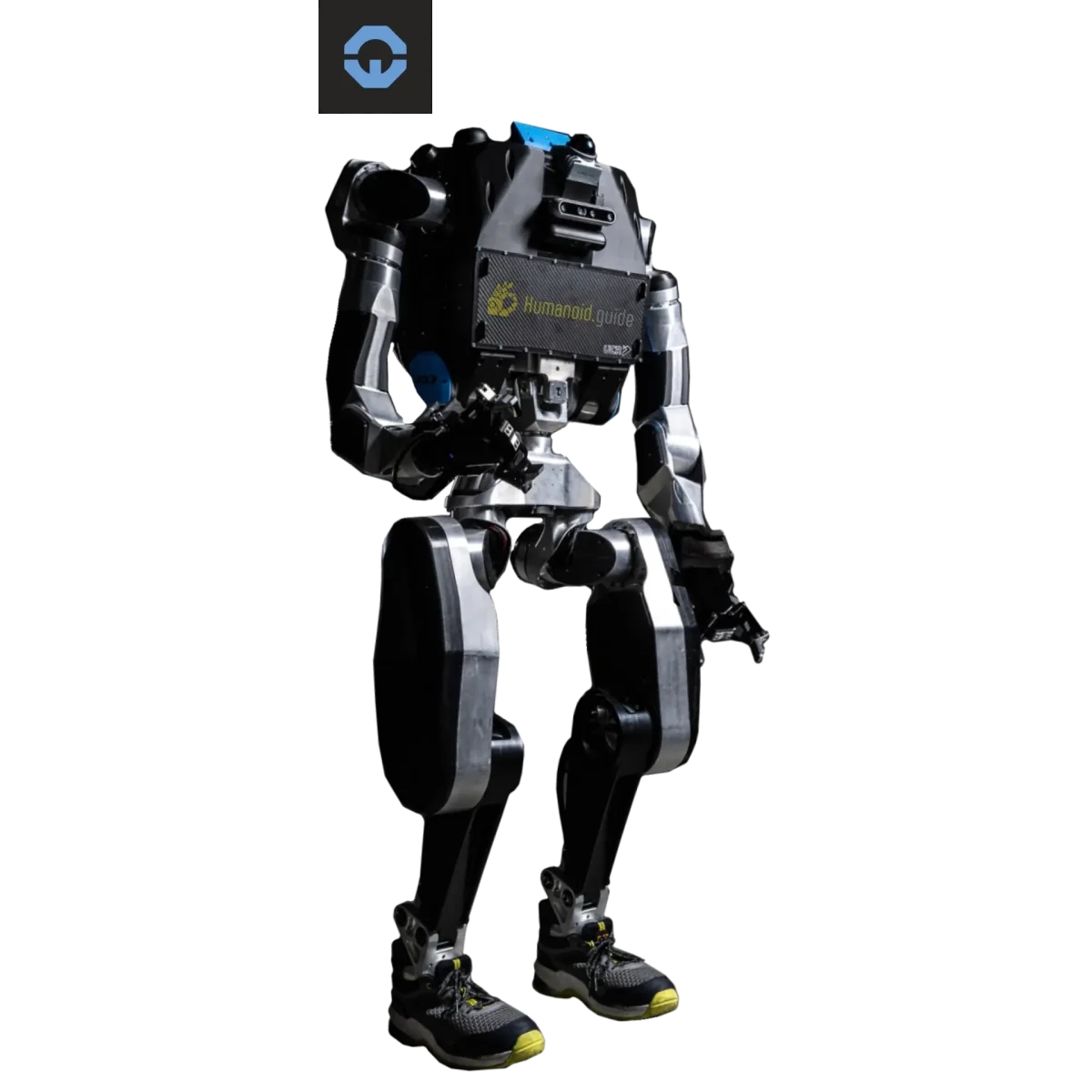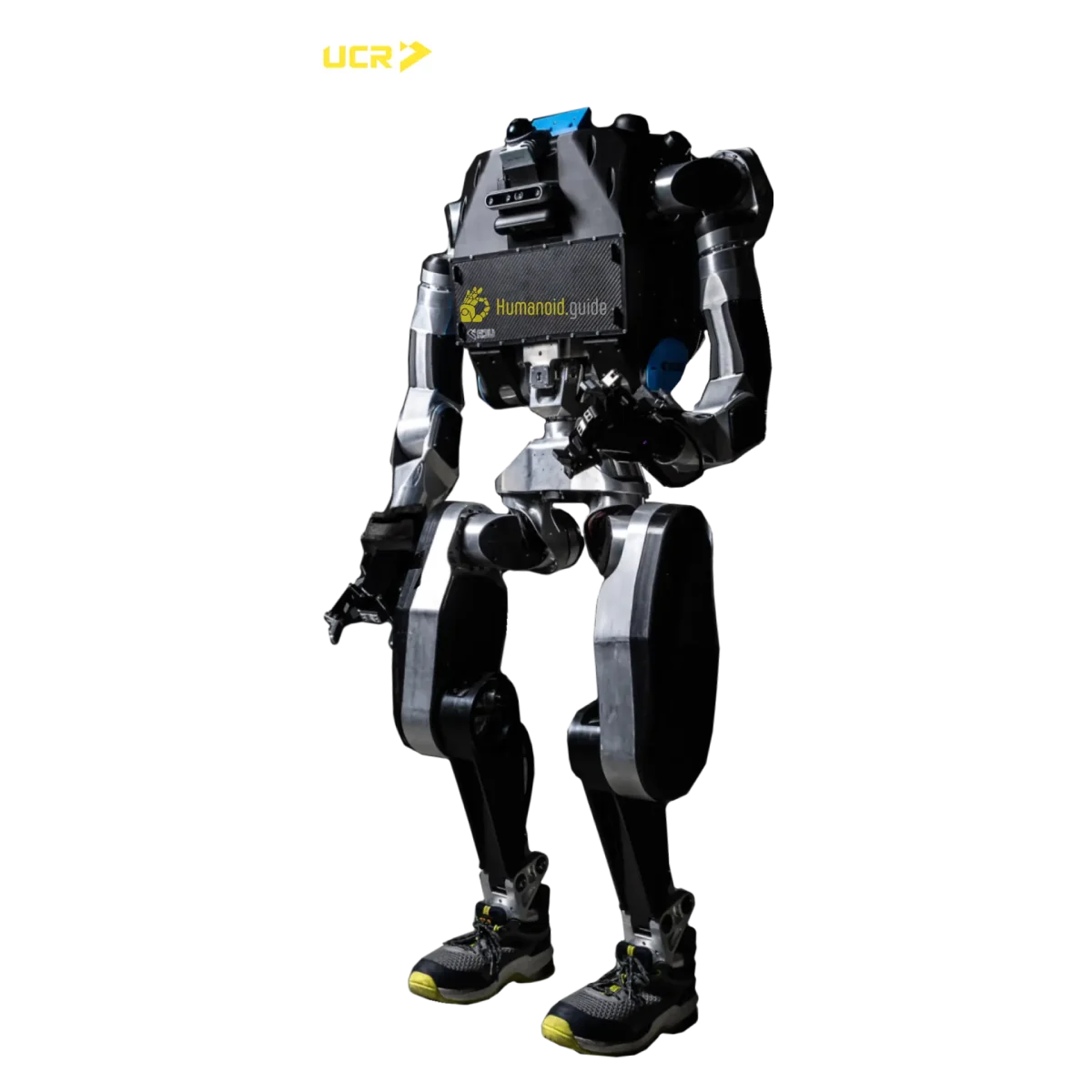
What is the Moby Noble?
Moby is a wheeled humanoid robot by Noble Machines (Sunnyvale, CA), formerly Under Control Robotics. Unveiled in 2024, it targets hospitality, research, and education with a differential-drive base for indoor stability and 3 km/h navigation. It has 34 degrees of freedom (including 10 per hand) enabling dexterous manipulation of up to 9 kg. Standing 170 cm tall and weighing 45 kg, the robot features a composite polymer and aluminum frame, runs ROS on Ubuntu Linux, and integrates large language models for natural interactions. Partners Schaeffler, ADLINK, and Solomon support the project. Moby is currently available for pre-order; initial units have been deployed at a Fortune Global 500 customer.
Specifications
Here are the full technical specifications.
| Spec | Value |
|---|---|
| Height | 170 cm |
| Weight | 45 kg |
| Degrees of freedom | 34 |
| Battery life | 5 hours |
| Max speed | 3 km/h |
| Payload | 9 kg |
| Price (new) | Undisclosed (contact manufacturer) |
| Price (used range) | N/A – no secondary market yet |
Price & Value
New MSRP: Undisclosed (contact manufacturer)
Used range: N/A – pre-commercial, expect future listings when available
Noble Machines has not published a list price for Moby; interested parties must contact the manufacturer directly. As a pre-order humanoid platform, pricing is likely negotiated per deployment scale, similar to enterprise-focused service robots. No secondary market exists yet, but early adopters may eventually resell units, potentially in the $X,000 range (speculative). Compared to other wheeled humanoids like Engineered Arts Ameca (quoted ~$150k+), Moby's price-to-capability ratio may be competitive if priced below six figures. The total cost of ownership will depend on software licensing, maintenance contracts, and integration support, which Noble Machines has not disclosed. Buyers should budget for a full-stack solution rather than a standalone hardware purchase.
Who Is It For?
Best for: - University robotics labs (34 DOF and open ROS/Linux for manipulation research) - Hospitality and service environments (wheeled stability, LLM interaction, 3 km/h indoor mobility)
Not for: - Heavy industrial lifting (9 kg arm payload limits) - Outdoor operation (IP20 ingress protection, wheeled base)
Alternatives & Comparison
The Moby competes in the emerging wheeled humanoid segment alongside platforms from Engineered Arts, PAL Robotics, and UBTECH, delivering a practical balance of manipulation and mobility at an undisclosed but likely competitive price.
| Model | Price | Available | Key Difference |
|---|---|---|---|
| Engineered Arts Ameca | ~$150,000 (est.) | yes | Mature platform with expressive face and 50+ DOF; wheeled base, but higher cost and no dedicated payload arm. |
| PAL Robotics TIAGo | ~€80,000 (est.) | yes | Mobile manipulator with ROS; not humanoid but highly customizable for research, offering 7-DOF arm. |
| UBTECH Cruzr | ~$20,000 (est.) | yes | Wheeled service robot for hospitality; limited manipulation (6-DOF arm), no advanced dexterity, lower price. |
Verdict: For research labs needing a full-body humanoid with open Linux/ROS and dual 10-DOF hands, Moby offers a compelling price-to-DOF ratio if priced aggressively. However, buyers requiring facial expressiveness should look to Ameca, while those on tight budgets with simpler interaction needs might find UBTECH Cruzr sufficient. Moby's niche is in material transport and human-robot interaction studies where its payload and LLM integration excel.
Use Cases & Capabilities
Hospitality and Service
Moby’s wheeled base provides smooth indoor navigation in hotels, hospitals, and retail spaces, moving at 3 km/h to deliver supplies or guide guests. Its 10-DOF hands can carry up to 9 kg, enabling tasks like delivering room service items or moving lightweight medical supplies. LLM integration allows natural spoken interactions for customer inquiries, wayfinding, and basic concierge duties. IP20 ingress protection limits use to clean, dry environments, but its stable base avoids the fall risks of bipedal robots.
Research and Education
With 34 degrees of freedom and native ROS support on Linux, Moby is a capable platform for manipulation research. Labs can program complex dual-arm coordination, integrate additional sensors via standard interfaces, and develop AI behaviors powered by the embedded large language model. Educators can use Moby to teach ROS-based robotics courses, teleoperation, and human-robot interaction without the distraction of bipedal balancing. The open software stack and partner ecosystem lower the barrier for academic institutions to modify and extend the robot.
Service and Research Labs (Enterprise Pilots)
Moby’s initial deployment at a Fortune Global 500 customer underscores its suitability for enterprise pilot programs in logistics and internal material transport. The robot’s differential-drive base ensures reliable operation in controlled environments, moving small payloads between stations or assisting with inventory checks. Its humanoid form factor and LLM integration make it approachable for co-worker interactions in collaborative settings. Enterprises can use Moby to study human-robot workflow without the complexity of bipedal locomotion, gathering data to inform future automation strategies.
History & Background
Noble Machines, originally named Under Control Robotics, was founded in 2024 in Sunnyvale, California, to develop practical humanoid robots for service industries. The company emerged from stealth in late 2024 with the Moby, a wheeled humanoid targeting hospitality, research, and education. Unlike many bipedal humanoid startups, Noble Machines opted for a differential-drive base to ensure reliability and rapid deployment. Initial prototypes were built and tested, and by early 2025, Moby units were placed at a Fortune Global 500 customer for pilot programs. The company has announced strategic partnerships with Schaeffler for precision components, ADLINK for edge computing, and Solomon for AI integration. As of 2026, Moby remains in pre-order with a focus on scaling production and expanding its partner ecosystem.
Buying Used — What to Check
Verify payload rating Payload specification is critical for your application; confirm it's 9 kg arm payload, not stand-only.
Inspect battery health Battery packs degrade; ensure runtime meets 5 hours on a full charge.
Confirm software stack version ROS/Linux integration and LLM capabilities may require specific versions; verify compatibility with your development tools.