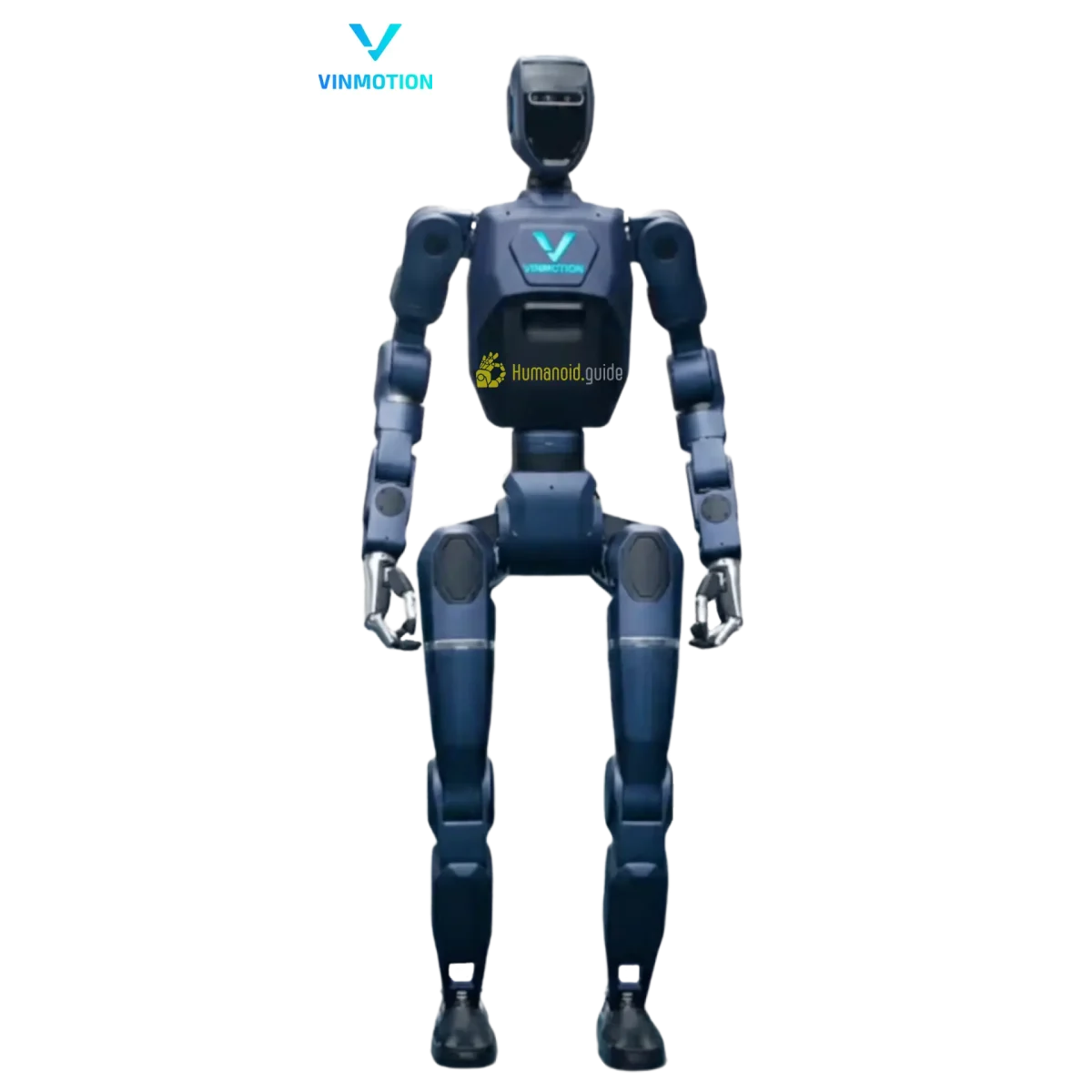
What is the Motion 2 Vinmotion?
The VinMotion Motion 2 is a bipedal humanoid robot developed by VinMotion, a Vietnamese startup founded with $39 million in backing from Vingroup, Vietnam’s largest conglomerate. Unveiled in 2024 and demonstrated at CES 2026, it targets factory automation, logistics, and research & education. The robot offers 32 degrees of freedom, a top speed of 4 km/h (walking 3.2 km/h), and a 4-hour battery. It can lift 10 kg with its arms and demonstrates a 40 kg back-lifting capacity. Standing 160 cm and weighing 60 kg, the Motion 2 is built for indoor industrial settings (IP20). As of 2026, it remains a prototype with no commercial sales, but pilot deployments inside Vingroup’s manufacturing ecosystem are planned for H1 2026.
Specifications
Here are the full technical specifications.
| Spec | Value |
|---|---|
| Height | 160 cm |
| Weight | 60 kg |
| Degrees of freedom | 32 |
| Battery life | 4 hours |
| Max speed | 4 km/h |
| Payload | 10 kg |
| Price (new) | Undisclosed |
| Price (used range) | N/A |
Price & Value
New MSRP: Undisclosed
Used range: N/A
As a pre-commercial prototype, the VinMotion Motion 2 has no official list price; costs are undisclosed. Given the $39M initial funding and integration within Vingroup’s ecosystem, initial deployments are likely subsidized as industrial pilots rather than commercial sales. Compared to established humanoid platforms like UBTECH Walker S (estimated ~$150,000) or Fourier GR-2 (~$80,000 est.), the Motion 2 may aim for a lower price point if produced at scale, but no public pricing suggests early units will be lease-only or offered through pilot programs. Depreciation and used market are irrelevant today, but once commercially available, buyer interest will depend on reliability and ecosystem support.
Who Is It For?
Best for: - Factory automation pilot programs within Vingroup’s ecosystem (e.g., automotive or electronics assembly lines) - University robotics research labs studying bipedal locomotion and human-robot interaction - R&D teams exploring Vietnamese-made humanoid platforms for cost-sensitive industrial applications
Not for: - Organizations seeking a commercially available robot immediately (still prototype, no delivery timelines) - Outdoor unstructured environments (no IP rating above IP20 confirmed) - Heavy payload logistics requiring more than 10 kg arm payload (back-lifting 40 kg may not suit precise manipulation)
Alternatives & Comparison
In the emerging market for affordable humanoid robots for industrial and research use, the Motion 2 competes with other pre-commercial Asian platforms and established Western research humanoids.
| Model | Price | Available | Key Difference |
|---|---|---|---|
| UBTECH Walker S | ~$150,000 (est.) | yes | Mature platform with proven enterprise deployments and 36 DOF |
| Fourier GR-2 | ~$80,000 (est.) | preorder | Cost-effective Chinese humanoid with 40+ DOF and strong developer community |
Verdict: For organizations needing a proven, deployable humanoid today, UBTECH Walker S is the safer bet with established support and enterprise track record. If cost is the primary driver and you can wait, Fourier GR-2 may offer more value. The VinMotion Motion 2 remains a high-potential but untested option, suitable only for research partners within Vingroup’s supply chain or those betting on Vietnam’s growing robotics sector.
Use Cases & Capabilities
Factory Automation
The Motion 2 is designed to operate on production lines, performing tasks such as assembly, inspection, and component handling. With 32 degrees of freedom and a 10 kg arm payload, it can manipulate parts and tools in structured indoor environments. Its 4-hour battery allows for multiple shifts with battery swaps, and integration within Vingroup’s automotive plants (VinFast) is expected in pilot phases. Limitations include IP20 rating, restricting it to clean factory floors, and the lack of published reliability data from sustained field operation.
Research & Education
University labs can leverage the Motion 2 for bipedal locomotion research, human-robot interaction studies, and AI development. The robot’s open Linux-based OS and potential LLM integration offer flexibility for custom algorithms. At a projected cost potentially lower than Western research humanoids, it could democratize humanoid research in emerging economies. However, as a prototype with no public SDK, immediate teachability is limited, and support channels are unproven.
Logistics & Warehousing
With a maximum walking speed of 4 km/h and a back-lifting capacity of 40 kg, the Motion 2 could perform goods transport, shelf restocking, and package handling in warehouses. Its bipedal form allows it to navigate human-centric spaces, but battery life of 4 hours may limit continuous operation without frequent swaps. Current prototype stage and lack of commercial availability means no logistics deployments are confirmed, and safety certifications for mixed human-robot environments are still pending.
History & Background
VinMotion was founded in Vietnam with a vision to develop indigenous humanoid robotics, backed by a $39M investment from Vingroup. The company unveiled the Motion 2 humanoid in 2024, showcasing it at CES 2026 with demonstrations of bipedal walking, back-lifting of 40 kg, and potential industrial applications. The robot is part of Vingroup’s broader push into AI and automation, with plans to deploy pilot units in VinFast automotive plants and other Vingroup facilities by H1 2026. As of 2026, the Motion 2 remains a prototype, with no commercial sales announced. VinMotion is one of the first Vietnamese companies to enter the global humanoid race.
Buying Used — What to Check
Verify payload and speed claims Manufacturer specs are unverified; independent tests of actual arm payload (claimed 10 kg) and back-lifting (40 kg) are crucial.
Check battery condition and runtime With only a 4-hour rated battery and prototype status, real-world endurance may differ, and battery degradation on used units could shorten usable shifts.
Confirm software stack availability As a prototype, SDKs and API access may be limited; ensure the robot can be programmed with intended workflows before purchase.