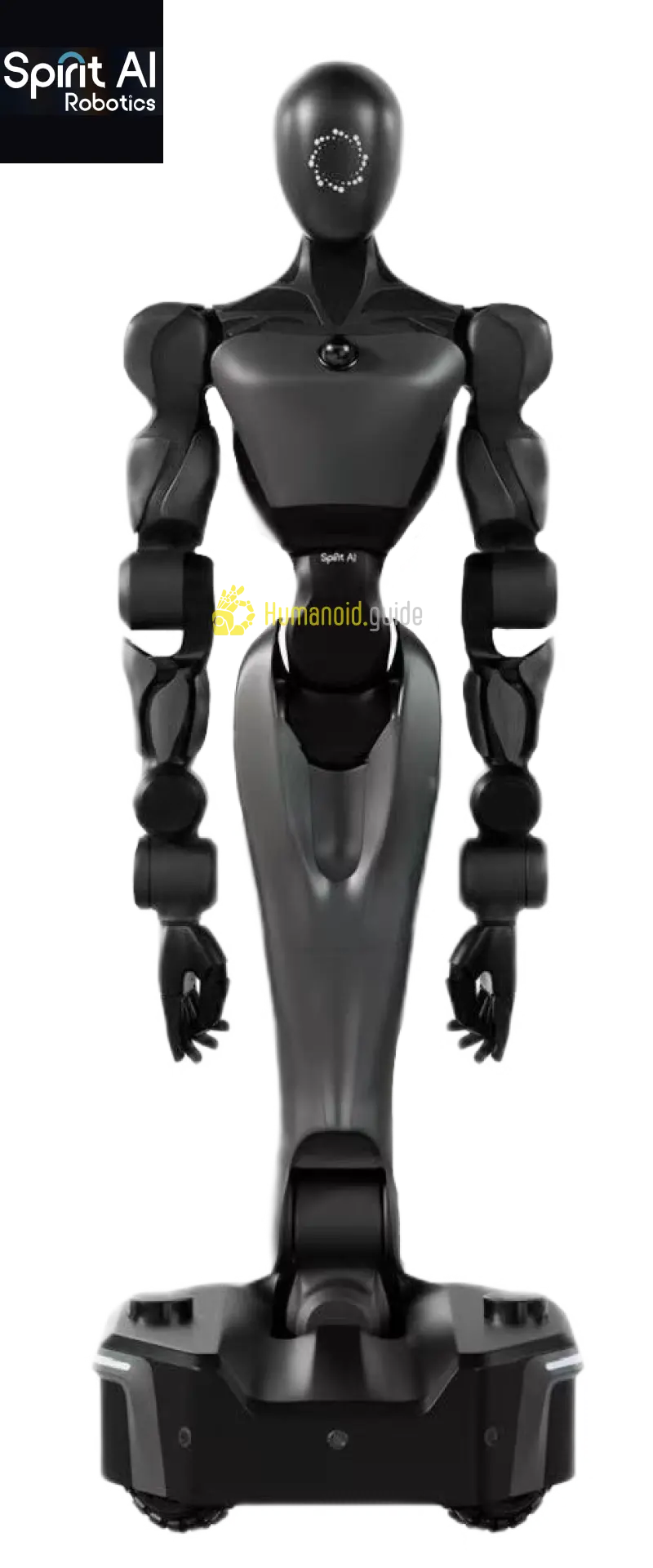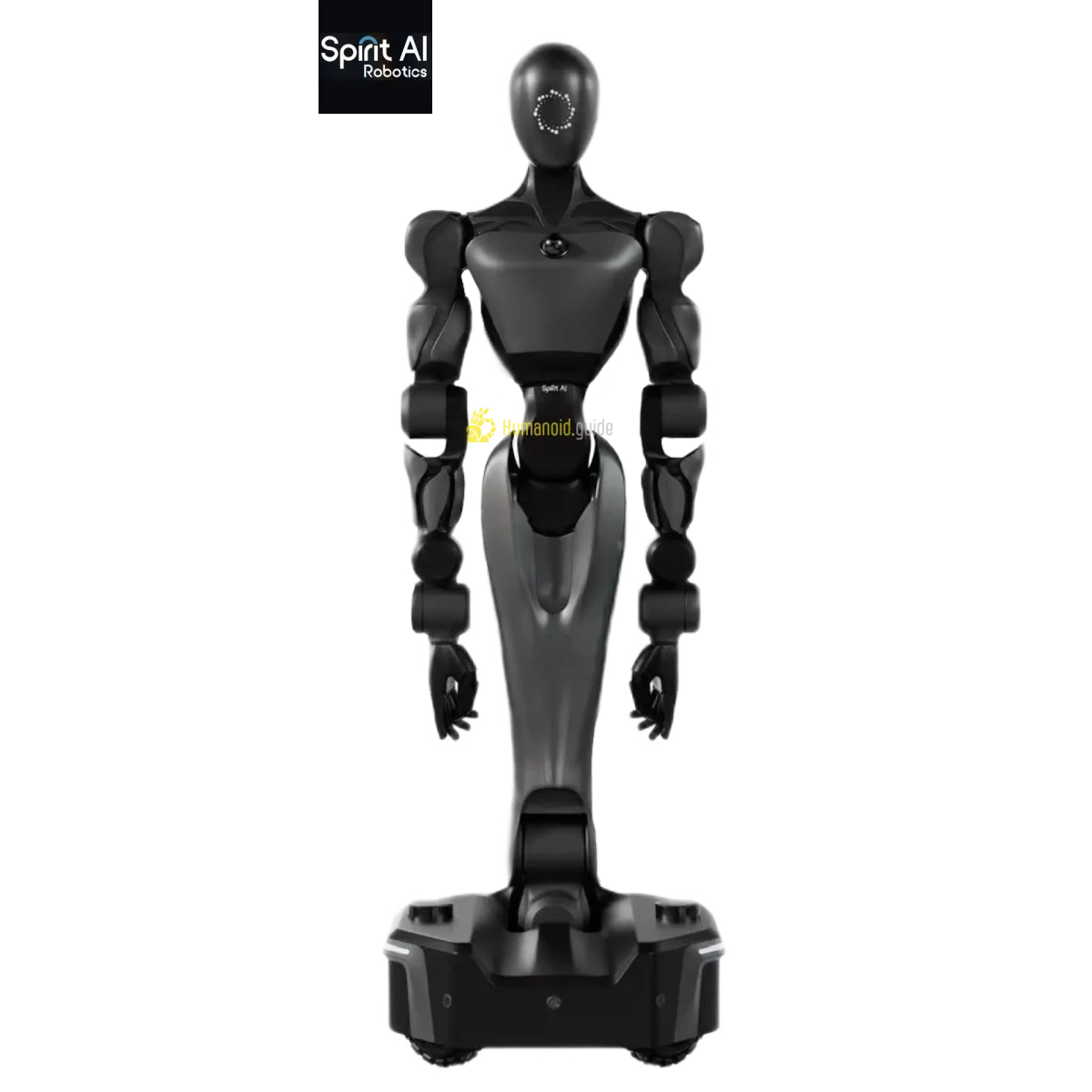
What is the Moz1 Spirit?
The Spirit AI Moz1 is a full-size humanoid robot built by Spirit AI, a Chinese robotics company. Standing 160 cm tall and weighing 70 kg, the Moz1 features 26 degrees of freedom, including over 10 in each five-fingered hand, enabling fine manipulation tasks. It is powered by an industrial CPU with AI accelerator and runs a Linux-based ROS stack. The robot uses electric servo motors with harmonic drives and an aluminum-alloy/composite frame. Designed for dexterous indoor work—such as clothes folding and office tidying—the Moz1 serves as a testbed for vision-language-action (VLA) models and whole-body force control. It is currently a prototype, not available for general sale.
Specifications
Here are the full technical specifications.
| Spec | Value |
|---|---|
| Height | 160 cm |
| Weight | 70 kg |
| Degrees of freedom | 26 |
| Battery life | 3 hours |
| Max speed | 3.6 km/h |
| Payload | Not specified |
| Price (new) | Undisclosed (contact manufacturer) |
| Price (used range) | N/A (pre-commercial) |
Price & Value
New MSRP: Undisclosed
Used range: N/A
The Moz1 is not offered for direct purchase; Spirit AI positions it as a research platform. Without a public MSRP, budget expectations must be set by direct inquiry. As a prototype, depreciation is not applicable. For labs evaluating cost, comparable humanoids range from $50,000 to $150,000, but the Moz1's unique VLA focus may justify a premium that can only be determined through negotiation. Total cost of ownership—including sensor upgrades, maintenance, and integration—will be higher than for simpler educational robots, and ongoing support is uncertain until Spirit AI clarifies its commercial roadmap. Universities and labs should budget for a full engineering team to exploit the platform's capabilities.
Who Is It For?
Best for: - AI research labs developing embodied VLA models: the 26 DOF and full-body force control enable complex manipulation experiments that locomotion-focused humanoids cannot match. - University robotics programs needing a humanoid platform for dexterity and vision research: the Moz1 offers a rare combination of finger dexterity and a full-body platform, making it ideal for projects on human-robot interaction. - Service robotics developers testing fine-motor tasks like laundry folding or light assembly: the robot's VLA integration promises autonomous skill learning, reducing the need for explicit programming.
Not for: - Heavy industrial lifting: no published payload rating, and the design prioritizes careful manipulation over load carrying; suitable payload likely under 10 kg. - Commercial deployment requiring certified safety: prototype-only, lacks IP rating, and has not undergone industrial safety validation; not ready for unsupervised environments.
Alternatives & Comparison
Though pre-commercial, the Moz1 competes conceptually with other research humanoids in the sub-$200k range, such as the UBTECH Walker S, Fourier GR-1, and Unitree H1. These robots offer different trade-offs in dexterity, mobility, and software openness.
| Model | Price | Available | Key Difference |
|---|---|---|---|
| UBTECH Walker S | ~$150,000 (est.) | preorder | More advanced full-body mobility; larger payload and faster walking (5 km/h). |
| Fourier GR-1 | Undisclosed | preorder | Focused on torque-controlled locomotion; lacks the 10+ finger DOF for fine manipulation. |
| Unitree H1 | ~$90,000 (est.) | yes | More affordable, but dexterity limited and primarily designed for locomotion research. |
Verdict: For labs that need VLA-driven fine manipulation, the Moz1's 26 DOF and dedicated hand dexterity make it the most suitable prototype—if you can obtain one. For general-purpose locomotion and pick-and-place, the Unitree H1 offers better value and immediate availability.
Use Cases & Capabilities
AI Research
The Moz1 is purpose-built for embodied AI research, integrating vision-language-action (VLA) models with whole-body force control. Researchers can explore complex tasks like clothes folding, office tidying, and tool use that require both fine perception and dexterity. Its 10+ finger DOFs and RGB+D cameras enable high-precision manipulation experiments impossible on simpler platforms. The Linux/ROS stack and possible LLM integration allow rapid prototyping of interactive behaviors, making it a natural testbed for next-generation AI agents. However, the lack of commercial availability means access is restricted to labs with direct manufacturer relationships.
Education
Universities can use the Moz1 as a platform for advanced robotics courses, teaching topics such as kinematic control, computer vision, and human-robot interaction. Its full-size humanoid form factor provides a realistic physical substrate for project-based learning, bridging the gap between simulation and real-world deployment. The robot's dexterous hands and force control allow students to experiment with fine manipulation—a rare capability in educational humanoids. Yet, the prototype status and likely high cost (or partnership requirement) limit accessibility to well-funded institutions. Once commercialized, it could become a staple in graduate robotics labs.
Service Robotics
Spirit AI targets light manufacturing and service environments where the Moz1's dexterity can handle delicate components or household tasks. Its estimated 26 kg strength (unconfirmed) is sufficient for moving small objects like laundry or tools. The VLA-driven control means it could potentially adapt to new tasks by watching demonstrations, reducing programming overhead. However, the absence of safety certifications and IP rating makes unsupervised public deployment unviable. Controlled pilots in research settings could validate its utility for tasks like bedside assistance or retail stocking.
History & Background
Spirit AI, a Chinese robotics firm, first revealed the Moz1 humanoid in 2024 as a showcase for embodied AI. The robot was designed to demonstrate vision-language-action (VLA) model integration with whole-body force control—an approach that sets it apart from traditional locomotion-focused humanoids. While little is known about Spirit AI's founding date or headquarters, the company positions itself as an AI-first hardware developer. The Moz1 is a first-generation prototype, with no previous versions publicly known. It has been presented at industry events and highlighted for its fine-motor capabilities like clothes folding. As of 2026, the Moz1 remains in development, with no announced commercial release date.
Buying Used — What to Check
Confirm DOF count Early prototypes may have different configurations; verify hands truly have >10 DOF if dexterity is crucial.
Inspect force control calibration Whole-body force control is a major selling point; ensure it hasn't degraded on a used unit.
Test VLA integration If the previous owner customized the AI stack, compatibility with your models may need verification.