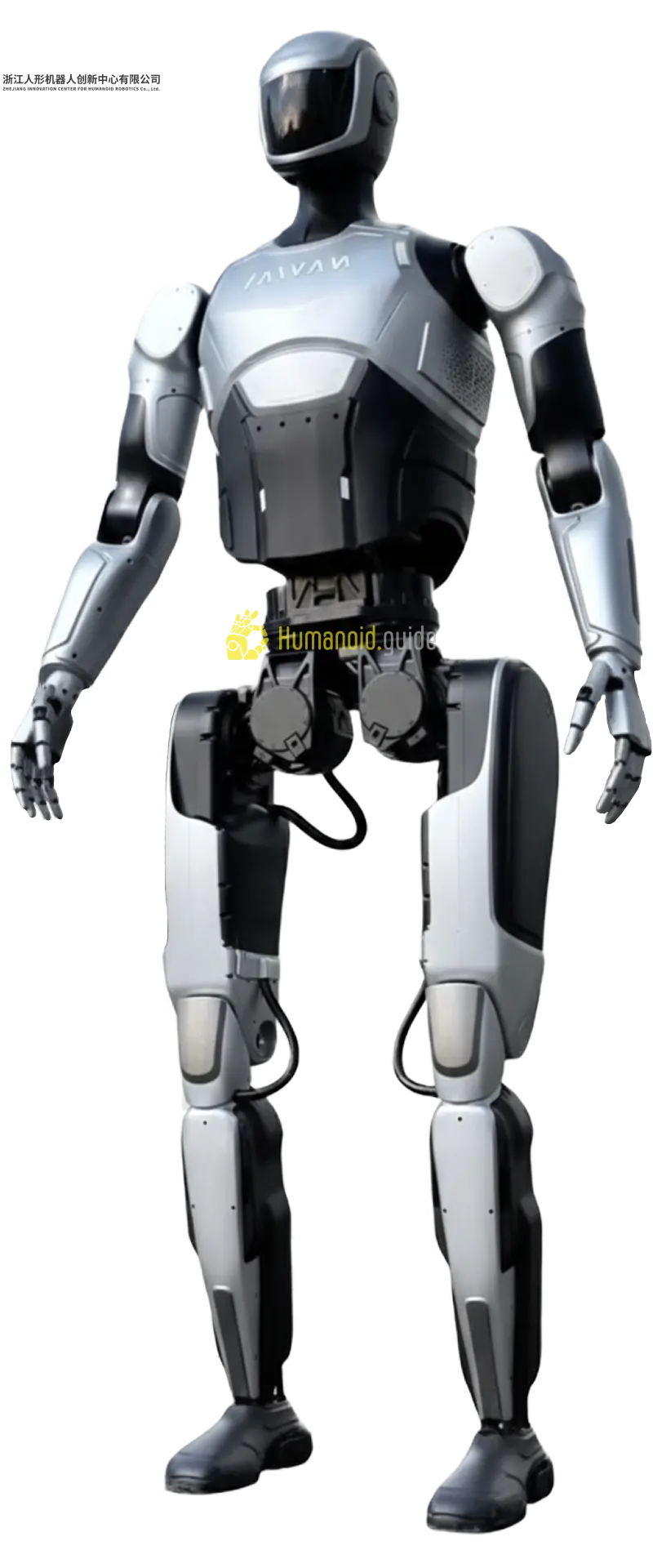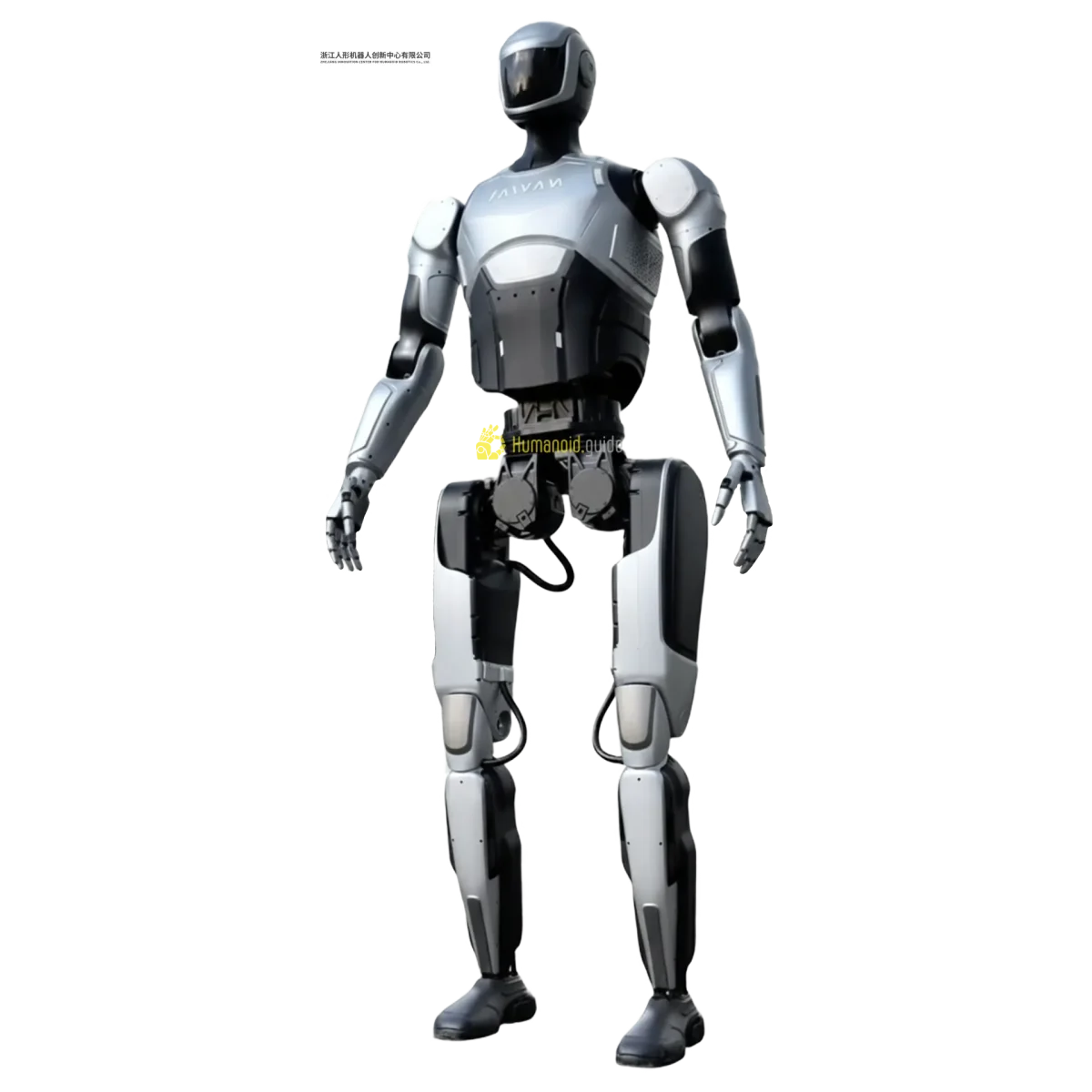
What is the Navai I3?
The NAVAI I3 is a full-size bipedal humanoid robot developed by the Zhejiang Humanoid Robot Innovation Center, a state-backed lab in China. Unveiled in 2024, it targets research and development use cases with a robust hardware platform. Standing 180 cm tall and weighing 70 kg, the I3 integrates 44 degrees of freedom, including 14 in its dexterous hands, enabling dual-arm manipulation and bipedal locomotion. Equipped with electric servo motors and harmonic drives, it achieves a walking speed of 4 km/h and a maximum speed of 9 km/h. Onboard sensing includes 1080p RGB and depth cameras, and it supports Ethernet, Wi-Fi, Bluetooth, and 5G connectivity. The robot runs a likely Linux-based control stack with ARM+embedded GPU compute and achieves glass-to-action latency of 150–250 ms. As of 2026, it is available for pre-order at a reported price of $120,000.
Specifications
Here are the full technical specifications.
| Spec | Value |
|---|---|
| Height | 180 cm |
| Weight | 70 kg |
| Degrees of freedom | 44 |
| Battery life | 2 hours |
| Max speed | 9 km/h |
| Payload | 10 kg (arm) |
| Price (new) | $120,000 (pre-order) |
| Price (used range) | N/A (pre-commercial) |
Price & Value
New MSRP: $120,000 (pre-order)
Used range: N/A (no secondary market yet)
The NAVAI I3 is priced at $120,000, positioning it in the mid‑tier of research humanoid robots. Compared to the Fourier GR‑2 (~$150,000) or Unitree H1 (~$90,000), the I3 offers 44 DOF with 14‑DOF hands and integrated depth sensing, a strong value for dexterous manipulation research. The pre‑order status suggests early‑stage production, so buyers should anticipate lead times of several months and likely minimal after‑sales support beyond initial warranty. Without a commercial track record, depreciation on the used market is uncertain, but well‑maintained units could retain 60–70% of their value within the first two years if demand materializes. Total cost of ownership must account for spare parts, maintenance contracts (if available), and potential software licensing fees that are not yet disclosed. As a pre‑commercial platform, it suits labs with strong in‑house integration capabilities rather than turn‑key deployments.
Who Is It For?
Best for: - University robotics labs (44 DOF with 14 in hands enables advanced grasping and manipulation research) - AI developers needing a bipedal platform with 5G connectivity for edge‑computing experiments - Exhibition and demonstration projects where a full‑size humanoid form factor draws attention
Not for: - Industrial manufacturing lines (no heavy‑payload or IP rating beyond IP20) - Outdoor all‑terrain deployment (walking speed limited to 4 km/h, no ruggedization) - Buyers seeking a turn‑key service robot (requires significant programming and systems integration)
Alternatives & Comparison
The NAVAI I3 competes with other research-grade humanoid robots in the $90k–$200k range. Buyers seeking dexterous hands and a China‑based support ecosystem may prefer the I3, while those requiring higher payload or domestic support might choose alternatives.
| Model | Price | Available | Key Difference |
|---|---|---|---|
| Fourier GR-2 | ~$150,000 | preorder | Higher torque and industrial orientation, but hands have fewer DOF (est. 12). |
| Unitree H1 | $90,000 | yes | Faster walking (5 km/h) and dynamic locomotion, but limited manipulation (no hands by default). |
| UBTECH Walker S | Undisclosed (enterprise only) | preorder | Designed for industrial inspection with rugged build, but less dexterous hands and higher price uncertainty. |
Verdict: The NAVAI I3 wins for research labs focused on dual-arm dexterous manipulation at a known price. The Unitree H1 is the better value for dynamic locomotion studies, while the Fourier GR‑2 appeals to labs needing higher payload. For turn‑key industrial deployment, the Walker S’s enterprise‑specific support may be necessary despite its undisclosed cost.
Use Cases & Capabilities
Humanoid Robotics Research
The NAVAI I3 serves as a full-scale platform for studying bipedal locomotion, whole-body control, and dexterous manipulation. Its 44 degrees of freedom, including 14 in each hand, allow researchers to implement advanced grasping algorithms and dual-arm coordination. The embedded depth camera and low latency (150–250 ms) support real-time visual feedback for closed-loop control experiments. While the walking speed is modest at 4 km/h, the platform’s open architecture (Ethernet, Wi‑Fi, 5G) facilitates integration with external motion capture systems and custom controllers. Labs can also use the robot to benchmark humanoid stability and energy efficiency thanks to its 2‑hour battery life.
AI and Embodied Intelligence Development
With its ARM+embedded GPU compute stack and comprehensive connectivity, the I3 is well‑suited for prototyping embodied AI agents. Developers can deploy neural network models directly on the robot or stream sensor data to cloud servers using 5G, enabling vision-language-action pipelines. The dexterous hands permit fine-grained manipulation tasks such as pick‑and‑place of delicate objects, making it a testbed for reinforcement learning of contact-rich behaviors. While the platform lacks built‑in LLM integration, its Linux‑based OS allows seamless interfacing with popular AI frameworks (ROS, PyTorch, TensorFlow). The IP20 rating means experiments should be conducted in controlled indoor environments.
Demonstrations and Exhibitions
The NAVAI I3’s life‑size stature, white/grey appearance, and smooth motion make it an eye‑catching attraction at tech exhibitions, robotics summits, and corporate showcases. It can perform pre‑programmed routines such as walking, waving, and object handovers, engaging audiences with a future‑of‑robotics narrative. The 5‑fingered hands and full upper‑body mobility allow it to gesture expressively or interact with props, enhancing demonstration impact. Operators can choreograph sequences using the robot’s real‑time control interface, though significant programming skill is required. For multi‑day events, the 2‑hour runtime necessitates careful scheduling and quick‑charging infrastructure.
History & Background
The Zhejiang Humanoid Robot Innovation Center, a Chinese research institution, first demonstrated the NAVAI I3 in 2024 as a prototype for advancing bipedal robotics. The robot emerged from China’s state-supported push into humanoid technologies, with a focus on providing an open hardware platform for academic and industrial R&D. Early publicity highlighted its 44-DOF structure and integration of dexterous hands. By early 2026, the I3 entered a pre‑order phase at $120,000, signaling a move toward limited commercial production. There are no known earlier generations of the NAVAI line; the I3 appears to be the center’s first humanoid product. No ownership changes or corporate restructuring have been reported. The robot remains a pre‑commercial offering, with ongoing software and hardware refinements expected based on feedback from initial research partners.
Buying Used — What to Check
Verify payload rating Payload and runtime are critical for manipulation research and may degrade with wear.
Check battery health Battery capacity declines over cycles; confirm runtime meets your experiment needs.
Inspect joint actuators Harmonic drive wear can introduce backlash; request service history if available.