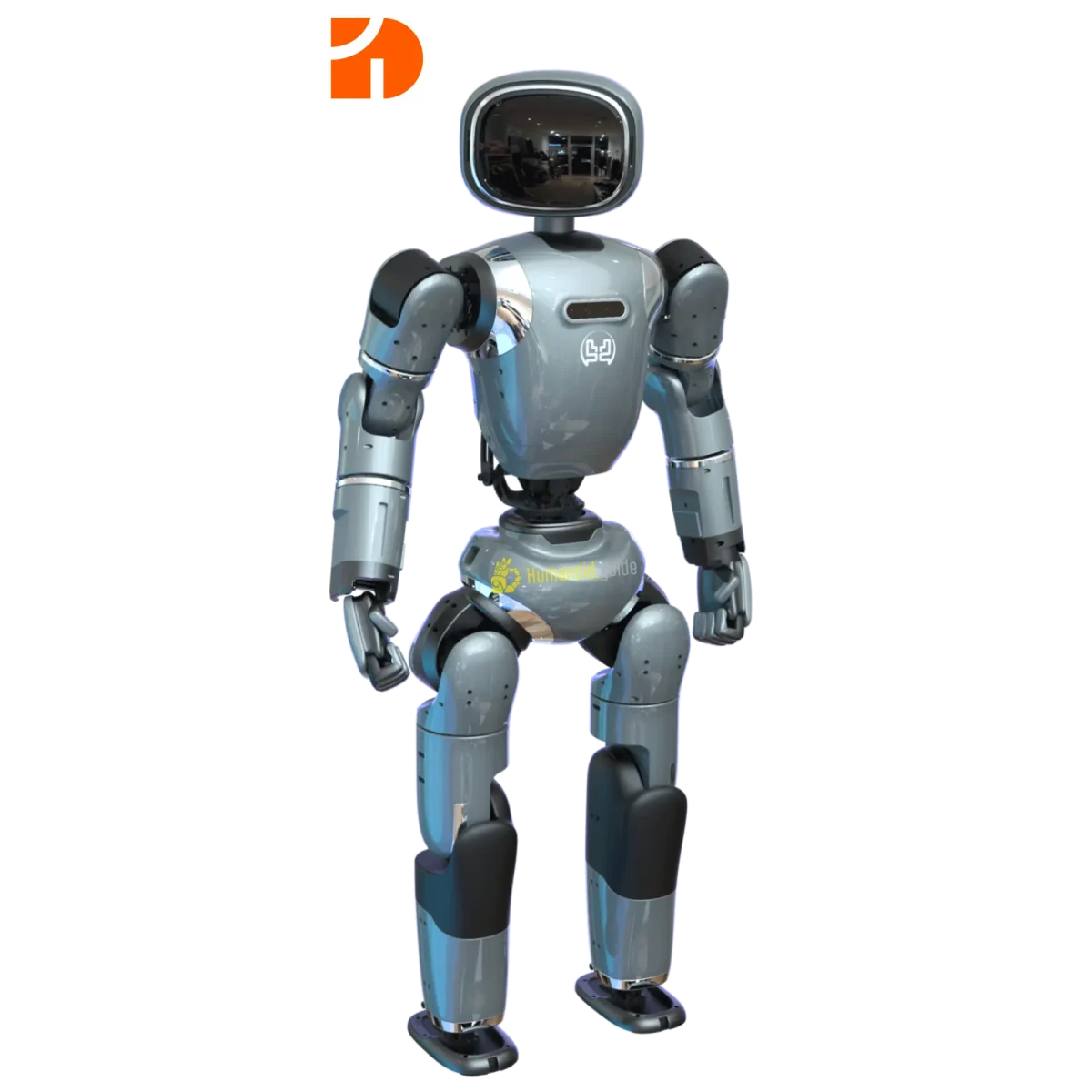
What is the Nezha P01?
The Digit Robotics Nezha P01 is a full-size humanoid robot developed in China as a platform for embodied AI research. Standing 145 cm tall and weighing 65 kg, it features 54 degrees of freedom (11 per hand) and is constructed from an aluminum alloy frame with lightweight composite panels. High-torque electric servo actuators and precision gear drives provide smooth motion, while a Linux-based robotics framework (likely ROS/ROS2) enables integration with external AI models. Designed for university labs and corporate research, it offers 10 hours of runtime, Ethernet/Wi-Fi connectivity, and a 1 kg manipulation payload. It was first shown in 2025 and remains in prototype development.
Specifications
Here are the full technical specifications.
| Spec | Value |
|---|---|
| Height | 145 cm |
| Weight | 65 kg |
| Degrees of freedom | 54 |
| Battery life | 10 hours |
| Max speed | 2 km/h |
| Payload | 1 kg |
| Price (new) | Undisclosed |
| Price (used range) | N/A |
Price & Value
New MSRP: Undisclosed
Used range: N/A
As a research prototype, the Nezha P01 does not yet have a public price. Digit Robotics appears to be positioning it for academic and industrial AI labs, competing with platforms like the UBTECH Walker S (~$100,000) and Fourier GR-2 (~$150,000). Its limited 1 kg payload suggests it is not intended for heavy industrial tasks, keeping costs lower than logistics-oriented humanoids. Without pricing, assessing value is difficult, but if priced in the mid five-figure range it could be a compelling option for dexterity research given its 11-DOF hands. Depreciation is speculative until commercial release. Researchers should contact Digit Robotics directly for quotes and partnership opportunities. Total cost of ownership will include Linux-based software maintenance and likely modular end-effectors for different experiments.
Who Is It For?
Best for: - University robotics labs needing a full-size humanoid for whole-body control and motion planning research - AI labs testing embodied cognition and LLM integration with a dexterous hardware platform (11-DOF hands)
Not for: - Industrial manufacturing or warehouse tasks (1 kg payload is insufficient for heavy lifting) - Consumer or public-facing service deployment (still in prototype phase, no safety certifications)
Alternatives & Comparison
In the emerging landscape of full-size research humanoids, the Nezha P01 competes with other pre-commercial and early-stage platforms aimed at labs and universities.
| Model | Price | Available | Key Difference |
|---|---|---|---|
| UBTECH Walker S | ~$100,000 (est.) | enterprise-only | 25 kg payload outperforms Nezha’s 1 kg for industrial tasks |
| Fourier GR-2 | ~$150,000 (est.) | no | 76 kg weight, 15 kg payload — suited for heavier lab work |
| Unitree H1 | ~$90,000 (preorder) | preorder | 3.3 m/s speed and 30 kg payload make it more dynamic |
Verdict: For dexterity research and AI integration, the Nezha P01 stands out with its 11-DOF hands and open Linux framework. Labs prioritizing manipulation over strength should consider it. Those requiring industrial payloads or faster locomotion would be better served by the Unitree H1 or UBTECH Walker S.
Use Cases & Capabilities
Embodied AI Research
The Nezha P01 provides a physical platform for training reinforcement learning models that combine locomotion and manipulation. Its 54 degrees of freedom allow realistic whole-body motion, and ROS/ROS2 integration streamlines algorithm deployment. Researchers can use the 11-DOF hands for dual-arm coordination experiments. A 10-hour battery life supports long autonomous sessions without interruption, making it suitable for iterative learning cycles.
Dexterous Manipulation Studies
With 11 degrees of freedom per hand, the robot excels in fine motor tasks like grasping, tool use, and in-hand object manipulation. High-torque servos and harmonic gear drives provide precise force control, enabling delicate interaction with objects. Students can program grasping strategies for varied shapes and weights, while AI integration permits vision-guided manipulation. The 1 kg payload limits graspable weight but suits small-object handling experiments.
Human-Robot Interaction (HRI) Labs
The Nezha P01’s humanoid form factor and safe operation design make it appropriate for HRI studies. Its expressive 5-finger hands and full-body mobility enhance social cue generation. Researchers can integrate external LLMs via Ethernet or Wi-Fi to test natural language command and response. The robot’s 145 cm height and 65 kg weight approximate a small adult, making it relatable in person-following or collaborative task scenarios.
University Teaching Platform
As a Linux-based humanoid, the Nezha P01 serves as an advanced teaching tool for robotics and AI curricula. Students learn motion planning, inverse kinematics, and ROS programming on a real hardware platform. The aluminum frame withstands repeated use in lab exercises, and the variety of available colors (red, silver, blue, etc.) could help differentiate multiple units. Though pre-commercial, it can be used by research partner institutions under evaluation agreements.
History & Background
Digit Robotics, a Chinese startup known for desktop companion robots XiaQi and Xialan, unveiled the Nezha P01 in 2025. Designed as a full-size research humanoid, it marked the company’s entry into the competitive academic humanoid market. The robot features 54 degrees of freedom and a lightweight aluminum body, reflecting an emphasis on dexterity over payload. Company founding details and exact headquarters remain undisclosed. No production timeline or commercial sales have been announced, and the Nezha P01 is considered a functional prototype. Digit Robotics continues to showcase the robot at industry events and through partner labs, positioning it for embodied AI research collaborations.
Buying Used — What to Check
Verify battery health Prototype units may have degraded cells after extensive lab use.
Confirm software updates Early units might require proprietary firmware not publicly available.
Inspect actuator wear 54 servo-driven joints accumulate mechanical wear; request maintenance logs.