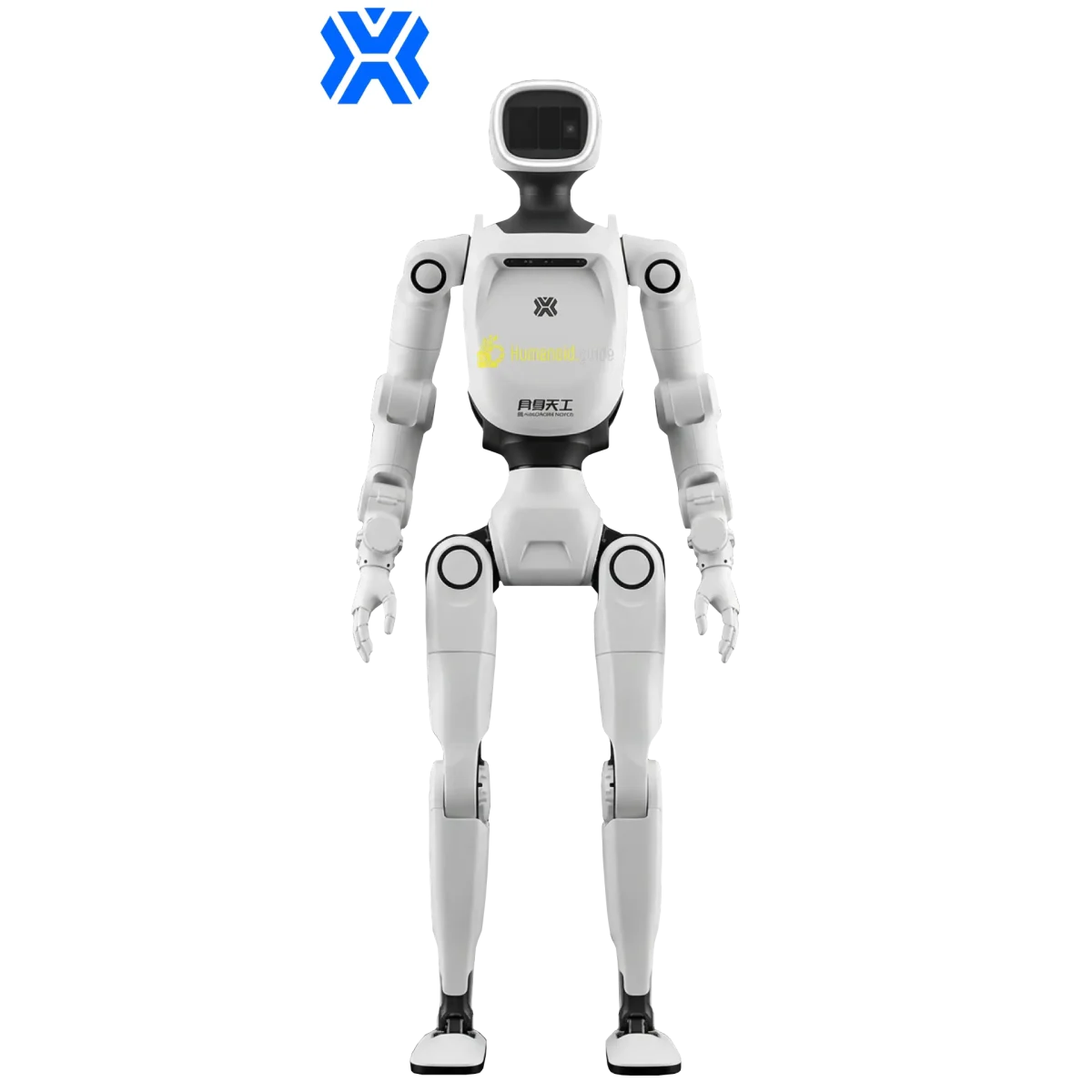
What is the Omni X Humanoid?
The X-Humanoid Omni is a full-scale humanoid robot developed by X-Humanoid, the Beijing Humanoid Robot Innovation Center. It stands 165 cm tall and weighs 55 kg, with 32 total degrees of freedom, including 12 in its two five-finger hands. Designed for interactive service, logistics, and research, the Omni features electric servo actuation and a ROS-based system running on high-performance NVIDIA-like compute. It balances a 10 kg arm payload and walks at up to 5 km/h, with a 2-hour battery runtime. It is powered by electric servo actuators with harmonic drive gearing, and its control stack runs on Linux with ROS compatibility, enabling developers to implement custom behaviors using standard robotics frameworks. As a pre-commercial prototype, the Omni frequently appears at Chinese tech demonstrations, showcasing advanced bipedal locomotion and manipulation capabilities, though no pricing or release date has been announced.
Specifications
Here are the full technical specifications.
| Spec | Value |
|---|---|
| Height | 165 cm |
| Weight | 55 kg |
| Degrees of freedom | 32 |
| Degrees of freedom (hands) | 12 |
| Battery life | 2 hours |
| Max speed | 5 km/h |
| Payload | 10 kg |
| Price (new) | Undisclosed (contact manufacturer) |
| Price (used range) | N/A |
Price & Value
New MSRP: Undisclosed (contact manufacturer)
Used range: N/A
The Omni’s pricing remains unpublished, with X-Humanoid only offering the robot through enterprise channels within its larger Tian Yi product family. Without a defined price, buyers cannot assess value against competitors like the Unitree H1 (~$90,000) or Fourier GR-2 (~$150,000). As a prototype, depreciation and total cost of ownership are unknown; any acquisition would likely involve custom engineering services and ongoing support costs. For organizations willing to collaborate directly with the developer, an undisclosed but likely significant investment should be anticipated. Enterprise partnerships likely involve NRE (non-recurring engineering) fees, driving total cost well above any component-level estimate. Until the Omni moves to production, it remains a speculative investment for research labs with direct government backing. No leasing or rental options are known; all access is via bilateral research agreements.
Who Is It For?
Best for: - Robotics research labs exploring humanoid locomotion and manipulation (32 DOF, ROS-based system) - Chinese universities and government robotics programs (prototype access, close ties to the Beijing Innovation Center) - Interactive service pilot projects in controlled environments (safe human interaction, 2-hour runtime for demonstrations)
Not for: - Industrial material handling (10 kg arm payload too low for heavy logistics) - Routine commercial deployment (pre-commercial prototype with no reliability data or support infrastructure) - Budget-constrained organizations (undisclosed enterprise pricing suggests a high investment)
Alternatives & Comparison
For Chinese bipedal humanoids, the Omni competes with more mature platforms from Unitree, Fourier, and UBTECH, which offer published pricing and availability. The Omni enters a crowded field of Chinese humanoids, with several competitors offering published prices and real-world usage data.
| Model | Price | Available | Key Difference |
|---|---|---|---|
| Unitree H1 | ~$90,000 (est.) | preorder | Fastest in class (4.3 m/s) and lowest cost with integrated force-control |
| Fourier GR-2 | ~$150,000 (est.) | preorder | Higher dexterity (54 DOF) and payload (30 kg), with a track record in research |
| UBTECH Walker S | ~$100,000 (est.) | enterprise | Proven durability in industrial inspections and enterprise services |
Verdict: For buyers who need a commercially viable humanoid today, the Unitree H1 offers the best balance of performance and price, with genuine pre-order availability. The Omni is a compelling research platform but remains locked behind enterprise partnerships and lacks a defined delivery timeline; it is not a practical purchasing option for most organizations.
Use Cases & Capabilities
Interactive Service
The Omni's humanoid form factor makes it a candidate for customer-facing roles in retail, hospitality, and education. Standing 165 cm tall with a human-like silhouette and five-fingered hands, it can gesture naturally and engage visitors with expressive body language. Its 5 km/h walking speed lets it navigate indoor spaces, while the onboard depth cameras and microphones enable voice and gesture recognition. A 10 kg payload allows it to distribute small items, such as brochures or souvenirs, and the 2-hour battery supports short duty cycles between charges. The ROS-based system can be integrated with LLMs via cloud for natural language interaction, though real-world deployment would require robust Wi-Fi connectivity and fallback behaviors. As a prototype, reliability for continuous public use is unproven, but demonstration events have shown smooth interaction with minimal latency.
Logistics Support
In research-driven logistics pilots, the Omni can perform light pick-and-place tasks and item transport up to 10 kg. Its bipedal locomotion, though slower than wheeled AGVs, could handle stairs and cluttered floors in human-shared environments. The 2-hour battery life, however, limits shift duration, and the lack of hot-swappable packs means downtime for recharging. The aluminum and composite body is durable for prototypes, but industrial certification is absent. Integration with warehouse management systems would require custom software, and the Omni’s velocity and payload cannot yet match dedicated logistic robots like the Unitree H1 or mobile manipulators. Nevertheless, it offers a testbed for developing whole-body coordination algorithms for material handling research. Current demonstrations focus on controlled environments with minimal variability, and the robot is not yet validated for real-world logistics operations.
Research Platform
The Omni is purpose-built for academic and corporate R&D into bipedal locomotion, dexterous manipulation, and human-robot interaction. With 32 total DOF—including 12 in the hands—researchers can explore contact-rich manipulation, walking stability, and whole-body planning. The onboard NVIDIA-class compute enables real-time sensor fusion from RGB-D cameras and IMUs, while the ROS-based open architecture simplifies algorithm prototyping and controller design. X-Humanoid provides simulation models and low-level API access, facilitating sim-to-real transfer studies. Access to the robot, however, is restricted to partner institutions, which limits wider adoption compared to commercially available research platforms like the Unitree H1 or Fourier GR-2. Nonetheless, the Omni’s design reflects the cutting edge of Chinese humanoid research and serves as a benchmark for future generations.
History & Background
X-Humanoid, the Beijing Humanoid Robot Innovation Center, was established as part of China’s strategic initiative to advance humanoid robotics. In 2024, the center unveiled the Omni, a full-scale bipedal robot designed for service and research, joining the broader Tian Yi (or Tien Kung) product family. The Omni quickly gained attention at domestic tech expos for its fluid locomotion and expressive hand gestures, showcasing rapid progress in Chinese humanoid development. It has since been demonstrated in scenarios like object manipulation and visitor guidance. By 2026, the Omni remains a pre-commercial prototype, with no official sales, pricing, or mass production timeline, and is only available to select research partners through direct collaboration with the center. Its early appearances at the World Robot Conference in Beijing drew comparisons to established humanoids, cementing its role as a showcase of China’s robotics ambitions.
Buying Used — What to Check
Verify payload rating Arm payload capability is critical for logistics or service tasks; confirm actual tested strength, not just published spec.
Confirm battery condition Prototype units may have degraded or experimental battery packs; runtime could drop below 2 hours.
Inspect actuator wear Heavily used demo units may have worn harmonic drives, affecting precision and safety.