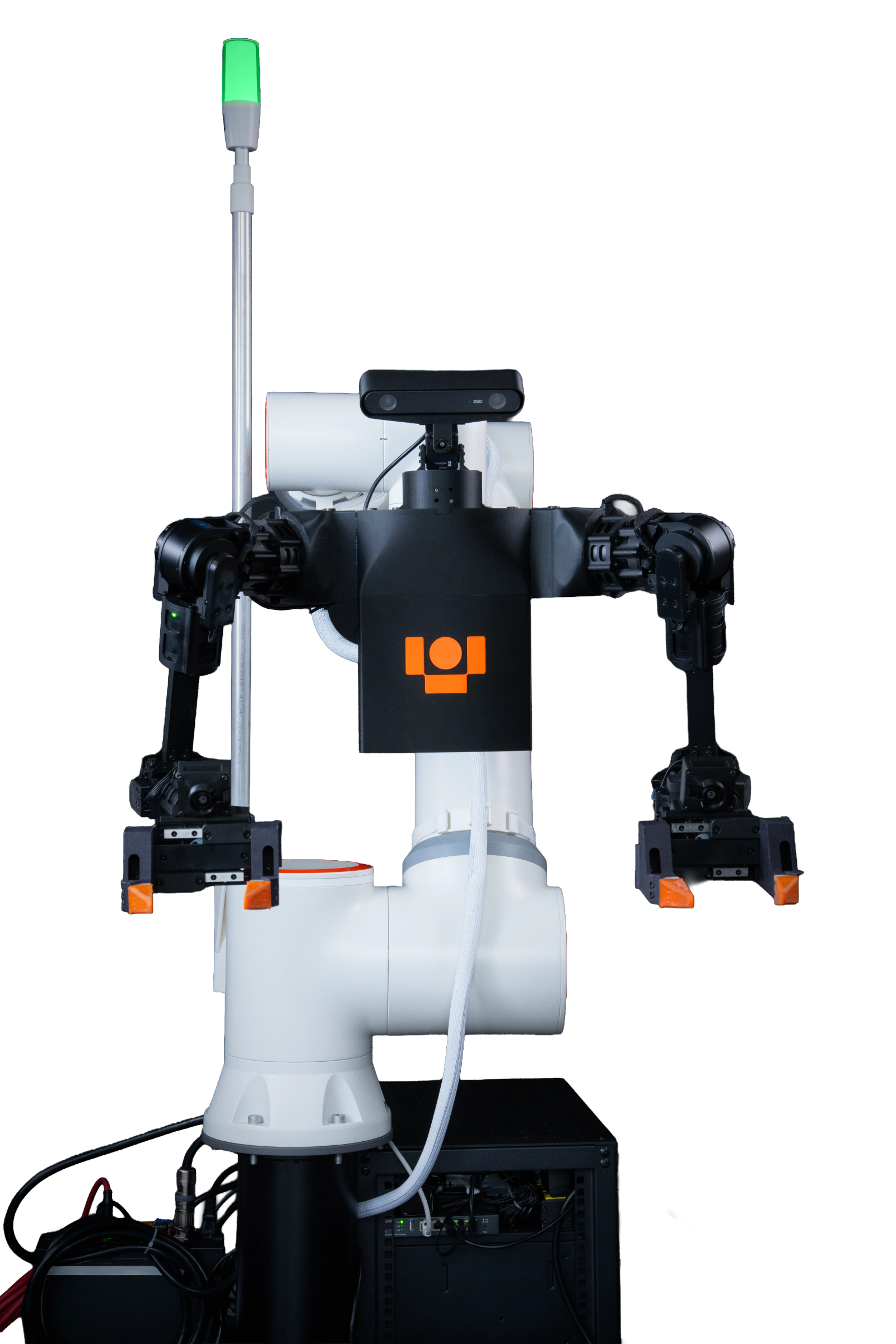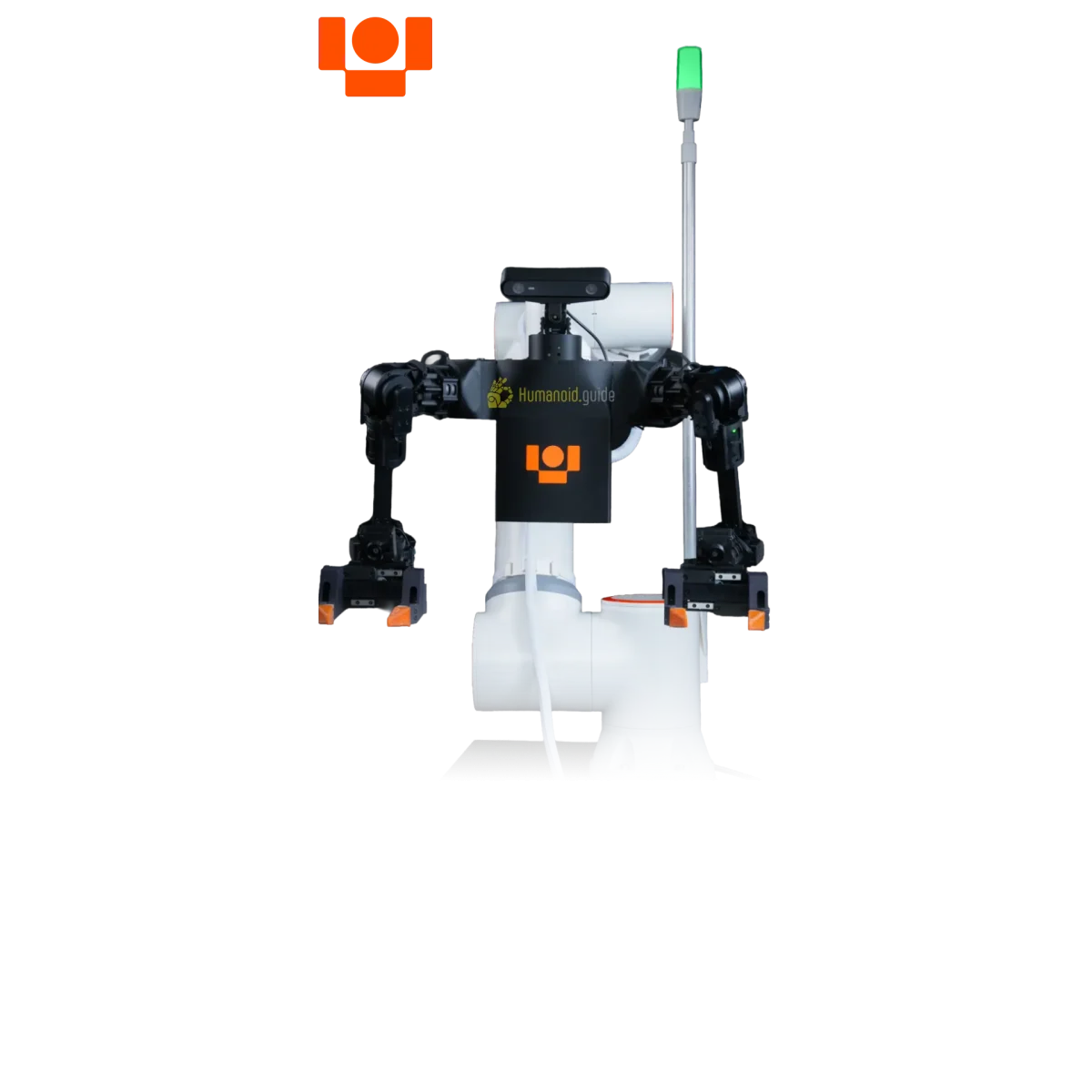
What is the Operator Op1?
The Operator OP1 is a stationary dual-arm AI robot from Ultra Robotics Corp, USA. It rolls to a workstation, plugs into 120 V, and installs in hours—no complex integration. Designed for US e-commerce fulfillment and warehouse operations, it automates order packaging, sorting, kitting, and returns processing. With 14 degrees of freedom, two 2-fingered claws, and 5 kg payload per arm, it stands 180 cm tall and weighs 140 kg. An NVIDIA Jetson-class computer runs Fleet AI, a perception-to-action policy trained on teleoperation data at 10 Hz. Battery life is 2 hours, top speed 3 km/h. It connects via dedicated Ethernet and is built on an aluminum frame with composite covers.
Specifications
Here are the full technical specifications.
| Spec | Value |
|---|---|
| Height | 180 cm |
| Weight | 140 kg |
| Degrees of freedom | 14 |
| Battery life | 2 hours |
| Max speed | 3 km/h |
| Payload | 5 kg |
| Price (new) | Undisclosed (contact manufacturer) |
| Price (used range) | N/A (too new for secondary market) |
Price & Value
New MSRP: Undisclosed (contact manufacturer)
Used range: N/A
Ultra Robotics has not publicly confirmed pricing for the Operator OP1; early reports suggest a $80,000 list price, but this remains unverified. For warehouse operators, the value proposition hinges on rapid deployment — no infrastructure changes, standard outlet power, and same-day installation — reducing integration costs versus traditional industrial robots. Without official pricing, it is difficult to benchmark against alternatives like the Fetch Robotics freight robots or Rethink Robotics Sawyer (discontinued). If priced near $80k, the OP1 competes on flexibility, offering dual-arm manipulation for a variety of tasks without requiring conveyors or custom end-effectors. Depreciation should be slower than mobile manipulators given its stationary, maintenance-friendly design, but the lack of a used market makes ROI projections speculative. Prospective buyers should request a quote that includes total cost of ownership, factoring in spare parts, fleet software licensing, and support.
Who Is It For?
Best for: - US e-commerce fulfillment centers needing rapid automation of kitting, sorting, and returns without infrastructure changes - Third-party logistics (3PL) providers with variable workflows where easy redeployment matters - Warehouses upgrading from manual stations to AI-assisted picking where dual-arm capability adds flexibility
Not for: - Heavy payload tasks (5 kg arm limit insufficient for palletizing heavy items) - Continuous operation without battery hot-swapping (2-hour runtime demands frequent charging or swapping) - Outdoor or dusty environments (no IP rating, not sealed)
Alternatives & Comparison
The Operator OP1 targets stationary dual-arm tasks in warehouse settings, competing with mobile manipulators and fixed automation that offer single-arm or conveyor-based solutions.
| Model | Price | Available | Key Difference |
|---|---|---|---|
| ABB YuMi IRB 14000 | $50,000–$100,000 | yes | Precision dual-arm for small parts assembly (0.5 kg payload), not heavy warehouse packing. |
| Zebra Fetch Freight + Arm | ~$120,000 (est.) | yes | Mobile single-arm platform with autonomous navigation for item transport and picking. |
Verdict: For pure stationary workstation automation with minimal integration, Operator OP1 is a purpose-built choice. If mobility is required across the warehouse floor, Zebra Fetch’s mobile platform adds transport capability, though at a higher price. The ABB YuMi is far more precise but cannot handle the packaging variety and heavier payloads that OP1 can. Choose OP1 for plug-and-play US warehouse tasks; consider Fetch if you need item transport and a single arm suffices.
Use Cases & Capabilities
Order Packaging
The OP1 picks items from incoming totes, arranges them into shipping boxes, and can apply tape or labels using its two arms. Dual-arm coordination allows one arm to hold the box while the other places items, increasing packing speed over single-arm systems. Its 5 kg payload per arm handles typical e-commerce products, from apparel to small electronics. The robot learns optimal packing sequences through Fleet AI, improving over time. It integrates directly into existing pack-out stations without conveyor modifications.
Sorting
At induction or sortation points, the OP1 identifies items via visual recognition and places them into appropriate outbound totes or chutes. Two arms work in parallel, one picking from the source while the other deposits, effectively doubling throughput compared to single-arm sorters. The 3 km/h travel speed and 2-hour battery suit shift-based sorting operations with swapable batteries or charging breaks. It can handle a wide variety of SKUs thanks to its learning-based grasping policy, reducing the need for pre-programmed grasp points.
Kitting
For assembling multi-SKU kits (e.g., subscription boxes, medical device kits), the OP1 collects components from separate bins and combines them into a single package. Its dual arms ensure that fragile items can be delicately handled with one gripper while the other stabilizes the kit container. The robot’s Fleet AI learns from teleoperation demonstrations to handle unconventional combinations, minimizing manual programming. With no need for safety cages, it can sit alongside human workers for hybrid kitting lines.
Returns Processing
Reverse logistics centers benefit from the OP1’s ability to open returned packages, assess item condition, sort into restock, refurbish, or disposal streams, and repackage sellable units. Dual-arm manipulation allows it to peel tape, remove packing material, and handle different box sizes, tasks difficult for single-arm grippers. Its vision system flags damaged goods and routes accordingly. The robot can be quickly repositioned to handle seasonal return surges, plugging in at any available workstation.
Brownfield Warehouse Integration
The OP1 is specifically designed for existing warehouses: it rolls up to a standard workbench, plugs into a 120 V outlet, and is ready in hours. No floor anchors, pneumatic lines, or safety fencing are required, making it ideal for facilities that cannot afford downtime for major retrofits. Its Ethernet-based connectivity ties into existing WMS with minimal IT overhead. This plug-and-play nature means warehouses can pilot automation on a single station and scale gradually, reducing upfront risk.
History & Background
Ultra Robotics Corp, a US-based startup, launched the Operator OP1 in 2025 as a dual-arm stationary robot for e-commerce fulfillment. The company designed the OP1 to be infrastructure-light, allowing deployment in hours at existing workstations. First units were deployed in US warehouses in 2025 for pilot programs, with full production ramping up by early 2026. The robot features Fleet AI, a continuous learning system that aggregates teleoperation data across the entire fleet to improve all units simultaneously. No major hardware variants have been announced, though software updates expand capabilities via the Fleet AI platform. As of 2026, the OP1 is actively shipping to US fulfillment centers, positioning Ultra Robotics as an emerging player in accessible warehouse automation.
Buying Used — What to Check
Verify warranty transfer Since the OP1 is a recent product, any used unit may lack manufacturer warranty and ongoing support—critical for a robot that relies on Fleet AI updates.
Check battery health The 2-hour runtime degrades with cycle count; a worn battery could reduce operational uptime significantly, and replacement cost is unknown.
Confirm software licensing Fleet AI continuous learning likely requires an active software license tied to the robot; ensure it is transferable and what updates are included.