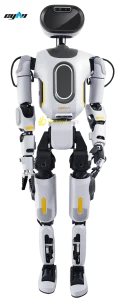
What is the Orca Cyan?
The Cyan Robotics Orca is a bipedal humanoid research platform announced in 2024 by Chinese manufacturer Cyan Robotics. Designed as an open-source, low-cost alternative for academia and industrial R&D, it stands 1.6 meters tall and weighs 50 kg. The robot packs 40 total degrees of freedom, including 10-DoF dexterous hands, and runs on an ARM CPU with an onboard GPU module. Its ROS2-based operating system, open SDK, and support for external cloud-based LLM integration make it attractive for universities, corporate labs, and exhibitions. The Orca balances navigation and manipulation capabilities, reporting a 3 km/h top speed and a 9 kg strength rating from unverified sources, all at an as-yet unrevealed budget price point.
Specifications
Here are the full technical specifications.
| Spec | Value |
|---|---|
| Height | 160 cm |
| Weight | 50 kg |
| Degrees of freedom | 40 |
| Battery life | 2 hours |
| Max speed | 3 km/h |
| Payload | Not specified |
| Price (new) | Undisclosed |
| Price (used range) | N/A |
Price & Value
New MSRP: Undisclosed (contact manufacturer)
Used range: N/A
Cyan Robotics has not publicly listed a price for the Orca, describing it only as a low-budget research humanoid available via direct inquiry. Industry observers speculate a target well below the $16,000 Unitree G1, given Orca’s academic focus and open-source hardware approach. However, no confirmed figures exist, and total cost of ownership remains unknown until the company reveals service contracts, spare parts, and software support. Should Orca eventually retail in the $10,000–$15,000 range, it would be one of the most affordable full-scale humanoid platforms, though buyers must weigh prototype risk against proven alternatives. Until commercial details emerge, its value proposition is purely speculative.
Who Is It For?
Best for: - University robotics labs: the open SDK and ROS2-native architecture enable custom manipulation and locomotion research on a full-size bipedal platform. - R&D startups: an affordable testbed for humanoid service robot concepts before committing to high-cost commercial units. - Exhibition and educational centers: a safe, anthropomorphic robot with 2-hour runtime can engage audiences at trade shows or museum displays.
Not for: - Industrial deployment: IP20 rating, low payload strength, and prototype reliability make it unsuitable for factory floors or heavy tasks. - Buyers needing immediate purchase: as of 2026, Orca remains in development with no retail channels—expect a multi-year wait. - Outdoor or rough-terrain applications: the robot’s navigation performance of 3 and 2.5 km/h walking speed indicates indoor-only capabilities.
Alternatives & Comparison
The Orca competes in the emerging space of open, low-cost humanoid research platforms. Its closest comparables today are the Unitree G1 and the Fourier GR-2, though both are at very different price points.
| Model | Price | Available | Key Difference |
|---|---|---|---|
| Unitree G1 | ~$16,000 | yes | 20–27 DOF, proven supply chain, fully open-source hardware and software, shipping now. |
| Fourier GR-2 | ~$150,000 (est.) | preorder | Advanced force-control actuators and 3D vision, 10 kg arm payload, but far more expensive. |
Verdict: If you need a humanoid today, the Unitree G1 is the clear winner with shipping units and a known price. For labs willing to wait and prioritize maximum DOF on a strict budget, the Orca might become a compelling alternative once released, but its prototype status means it cannot compete on reliability or availability. The Fourier GR-2 is overkill for academic budgets and only makes sense for well-funded industrial research groups needing heavy manipulation.
Use Cases & Capabilities
Bipedal Locomotion Research
At 160 cm and 50 kg, the Orca’s anthropomorphic proportions make it a realistic testbed for bipedal gait optimization, balance control, and whole-body motion planning. Researchers can leverage the open ROS2 environment to implement custom control algorithms, test zero-moment-point strategies, or integrate reinforcement learning on the onboard GPU. The robot’s 3 km/h top speed and reported 2.5 km/h walking speed provide a reasonable baseline for indoor laboratory experiments. However, its unverified prototype mechanics mean extreme dynamic maneuvers or uneven terrain remain untested, and sensor degradation may affect odometry. Still, as an open platform, it offers a valuable stepping stone before moving to more expensive commercial humanoids.
Dexterous Manipulation Experiments
With 40 total DOF—including 10-DoF hands featuring five fingers each—the Orca enables advanced manipulation research such as grasp planning, in-hand object repositioning, and dual-arm coordination. Tactile or force sensors (inferred from related hand designs) could support contact-rich tasks, and the open SDK allows custom low-level motor control. Users can integrate external AI models via cloud connectivity for semantic grasping or task planning. The reported 9 kg strength rating, though unverified by the manufacturer, suggests the ability to handle common lab objects and lightweight tools. Researchers must validate payload and joint torque limits before designing heavy-duty experiments, but the platform’s potential for exploring dexterous manipulation is significant.
Open-Source Education Platform
Designed from the ground up for academia, the Orca’s open hardware and software philosophy lowers barriers for teaching humanoid robotics. Students can modify 3D-printed structural elements, rewrite control loops in ROS2, and experiment with camera-based SLAM using the onboard 1080p binocular depth sensors. The robot’s IP20 rating and declared human-safe operation permit hands-on teaching without expensive safety cages. Its expected low cost makes it feasible for university budgets that cannot afford systems like TALOS or Atlas, potentially allowing entire lab classes to work with multiple units. The 2-hour battery life is sufficient for supervised lab sessions, though charging logistics and battery swap capabilities are unknown.
AI & Embodied Intelligence Integration
Orca’s built-in support for external cloud-based LLM services turns it into a physical embodiment for conversational agents and autonomous task execution. Researchers can pair the robot’s navigation and manipulation capabilities with natural language commands, enabling demos like “pick the blue cube from the table.” The <200ms end-to-end latency and industrial ARM CPU ensure responsive real-time performance, though heavy inference workloads will likely offload to the cloud. As an open system, it can also serve as a platform for exploring vision-language-action models. The lack of a native LLM and requirement for external connectivity may limit fully offline scenarios, but for research it’s a fertile testing ground.
Public Engagement & Exhibition Displays
The Orca’s sleek white shell and human-like gestures make it an eye-catching exhibit for museums, trade shows, and corporate lobbies. Its 2-hour runtime allows extended interactive sessions, while ROS2 programmability enables custom choreography, speech output, and simple Q&A interactions. The robot’s safe interaction design and IP20 enclosure suit indoor, supervised environments, and its relatively low weight (50 kg) eases transportation and setup compared to heavier industrial humanoids. As a prototype, occasional glitches are likely—event organizers should plan for spare units or simplified demos—but the visual impact of a full-size humanoid at a fraction of the cost of established commercial alternatives is a compelling draw.
History & Background
Cyan Robotics, a Chinese startup sometimes listed as Cyanborg Robotics Co., Ltd., first unveiled the Orca humanoid in 2024. Part of a new wave of open, low-cost bipedal robots, the Orca was explicitly pitched to universities, labs, and early-stage industrial researchers. The company highlighted its open SDK and ROS2 foundation as key differentiators, aiming to democratize humanoid research in a market dominated by expensive, closed platforms. Little public information exists about Cyan Robotics’ founding date, funding, or team, though the Orca has appeared on distributor sites like MERA Robotics and in hobbyist guides, listed as “in development.” As of 2026, the robot remains a prototype with availability strictly through direct inquiry for research partnerships; no mass production schedule has been announced.
Buying Used — What to Check
Verify payload rating No official payload figure exists; any claimed strength should be confirmed with the manufacturer before purchase.
Inspect gearbox and joint wear Prototype mechanics may have limited lifespan with unknown service history.
Confirm battery health and charging method With only a 2-hour runtime and no information on battery swappability, degraded cells could severely restrict operation.