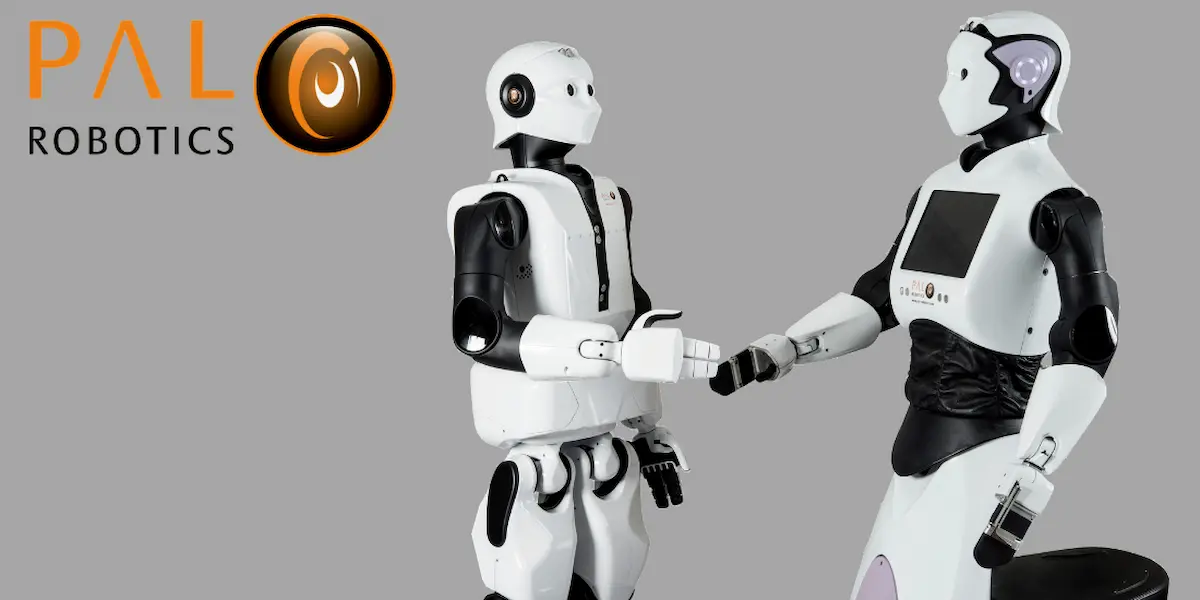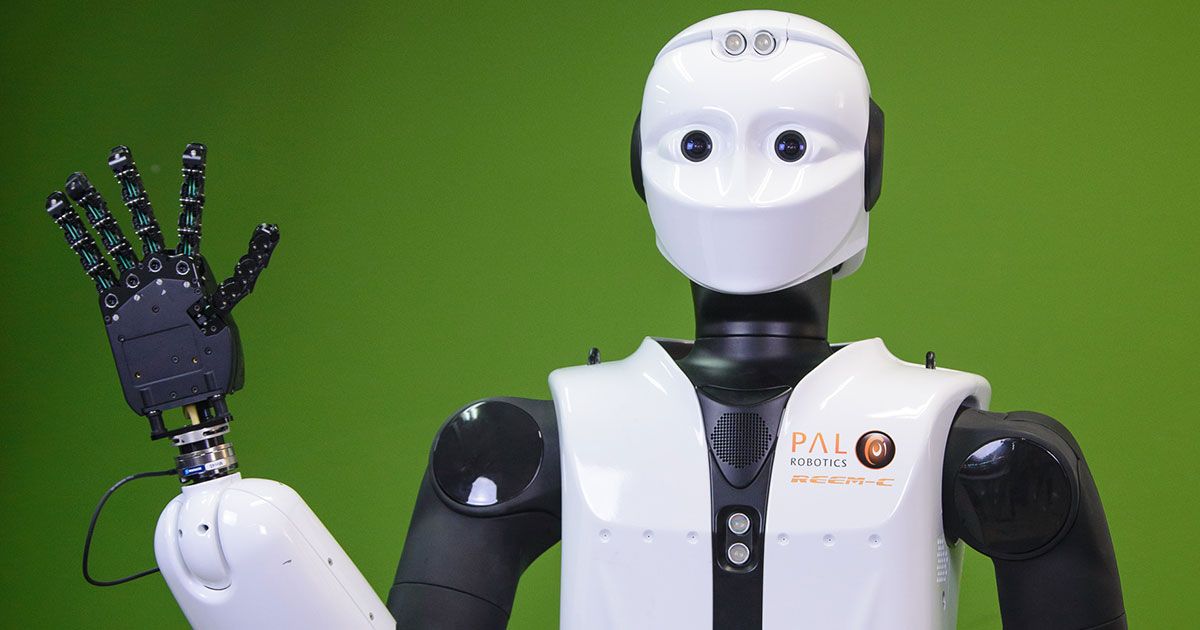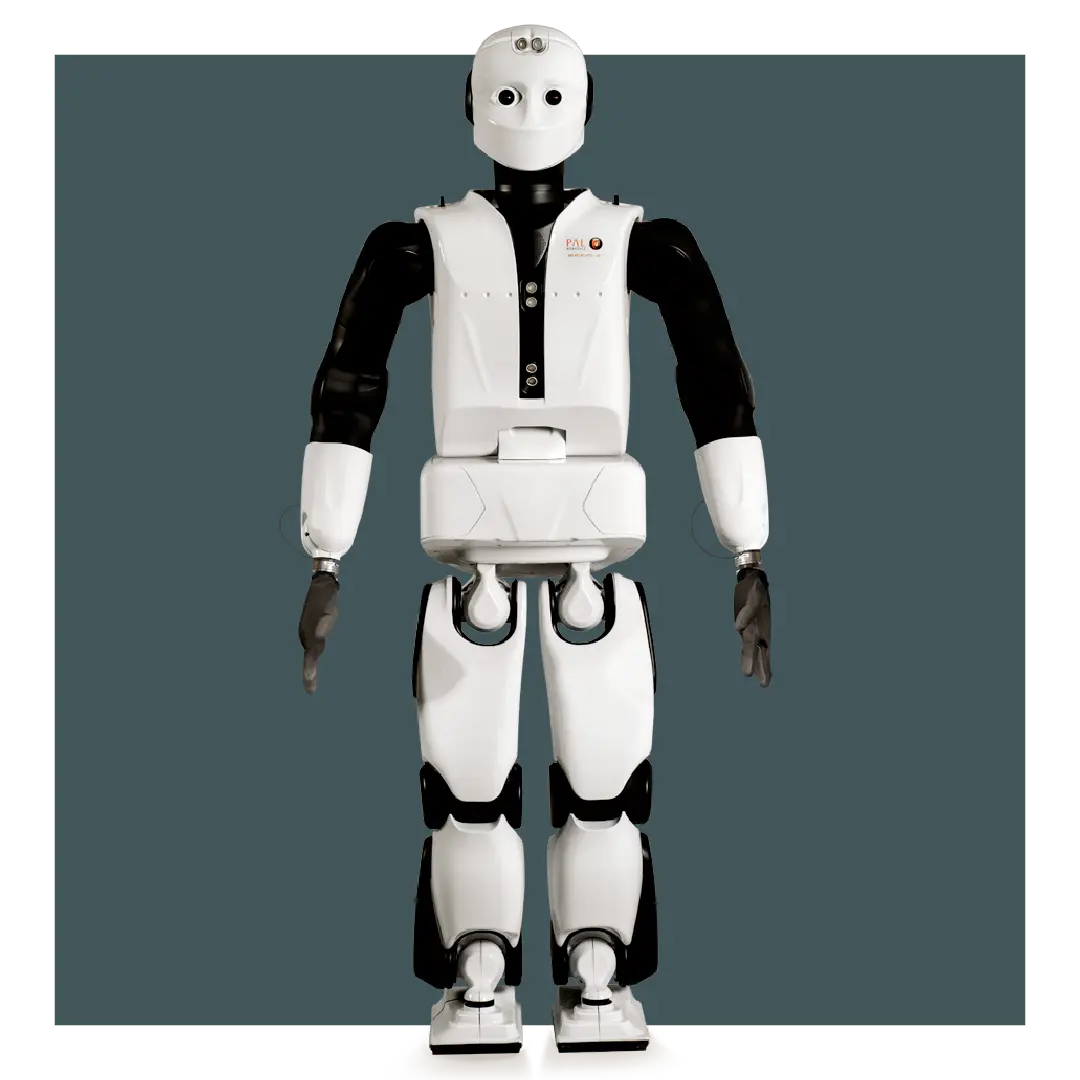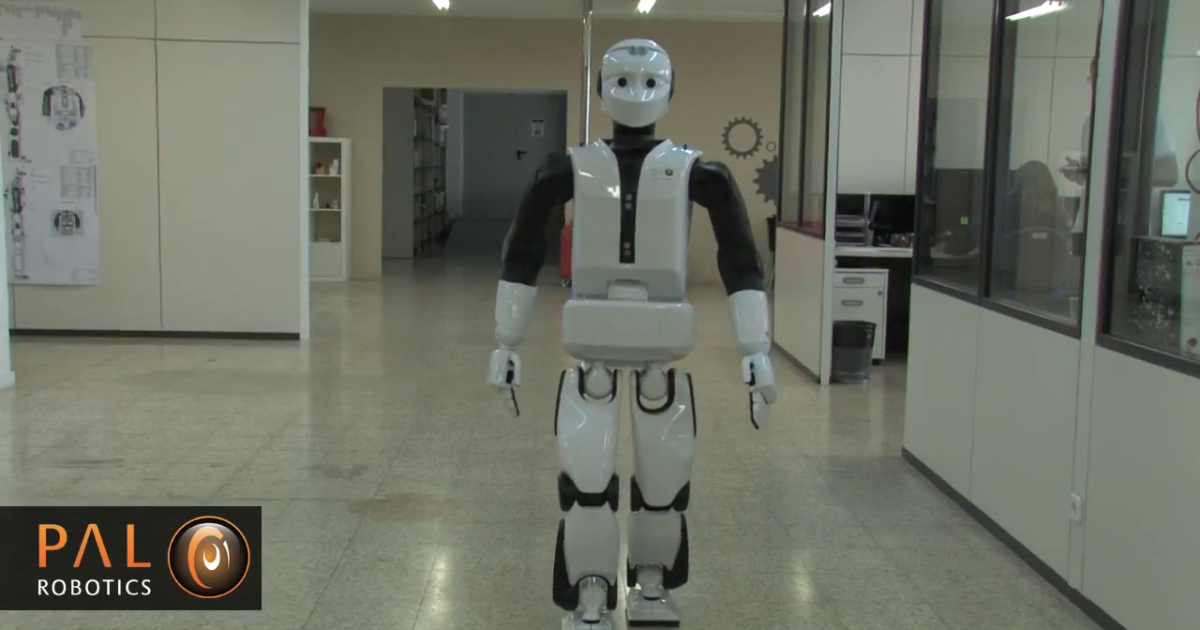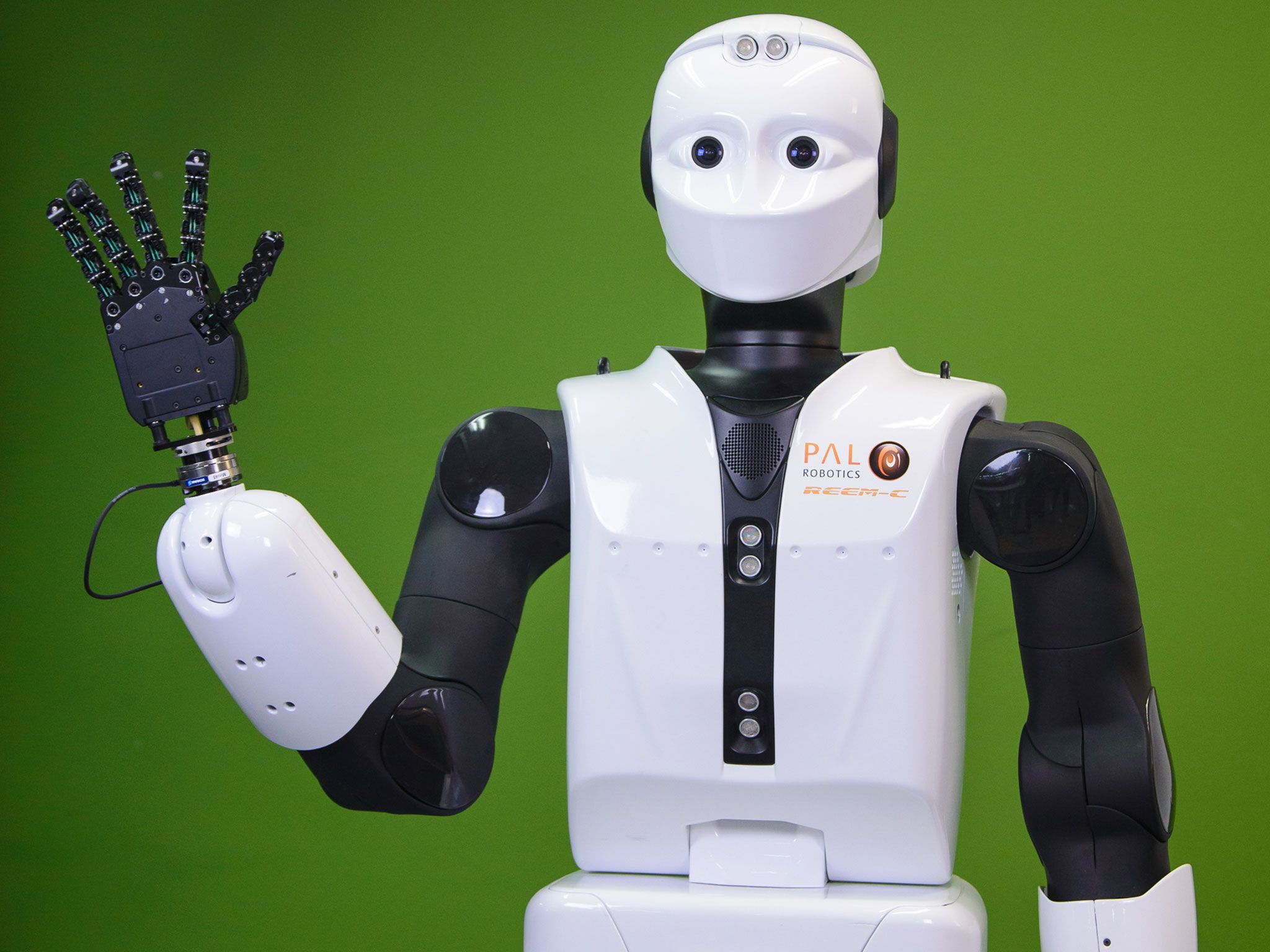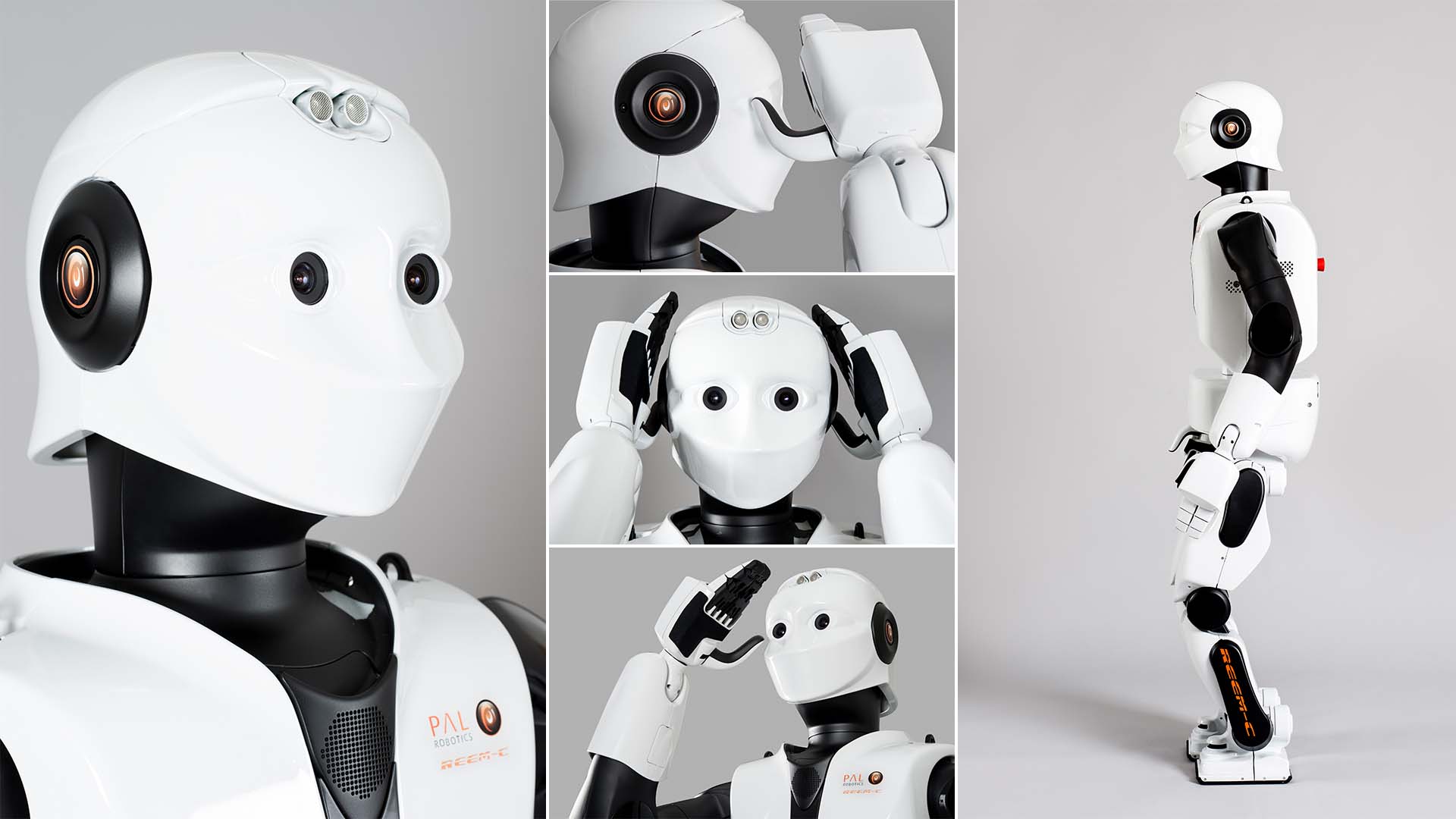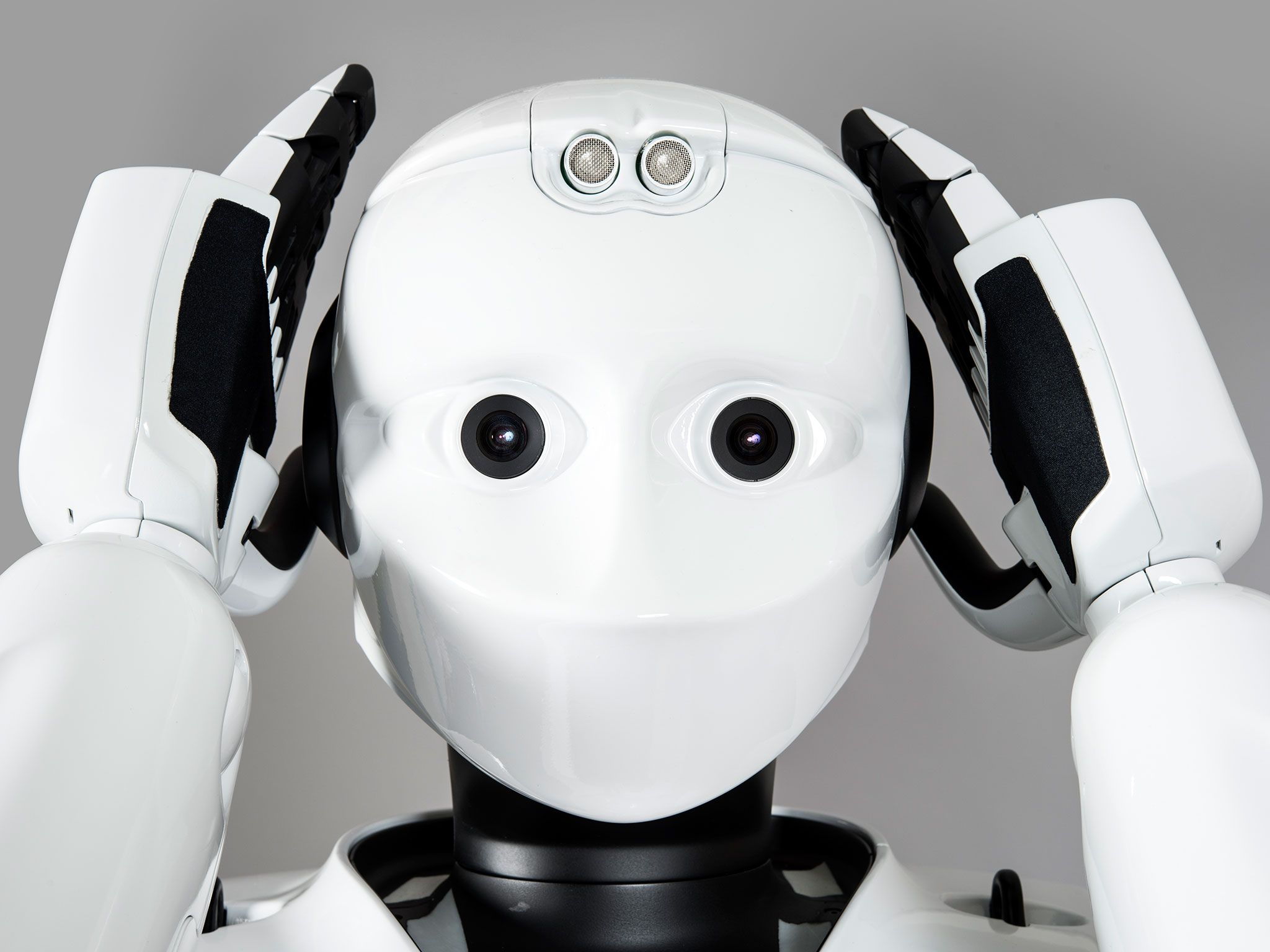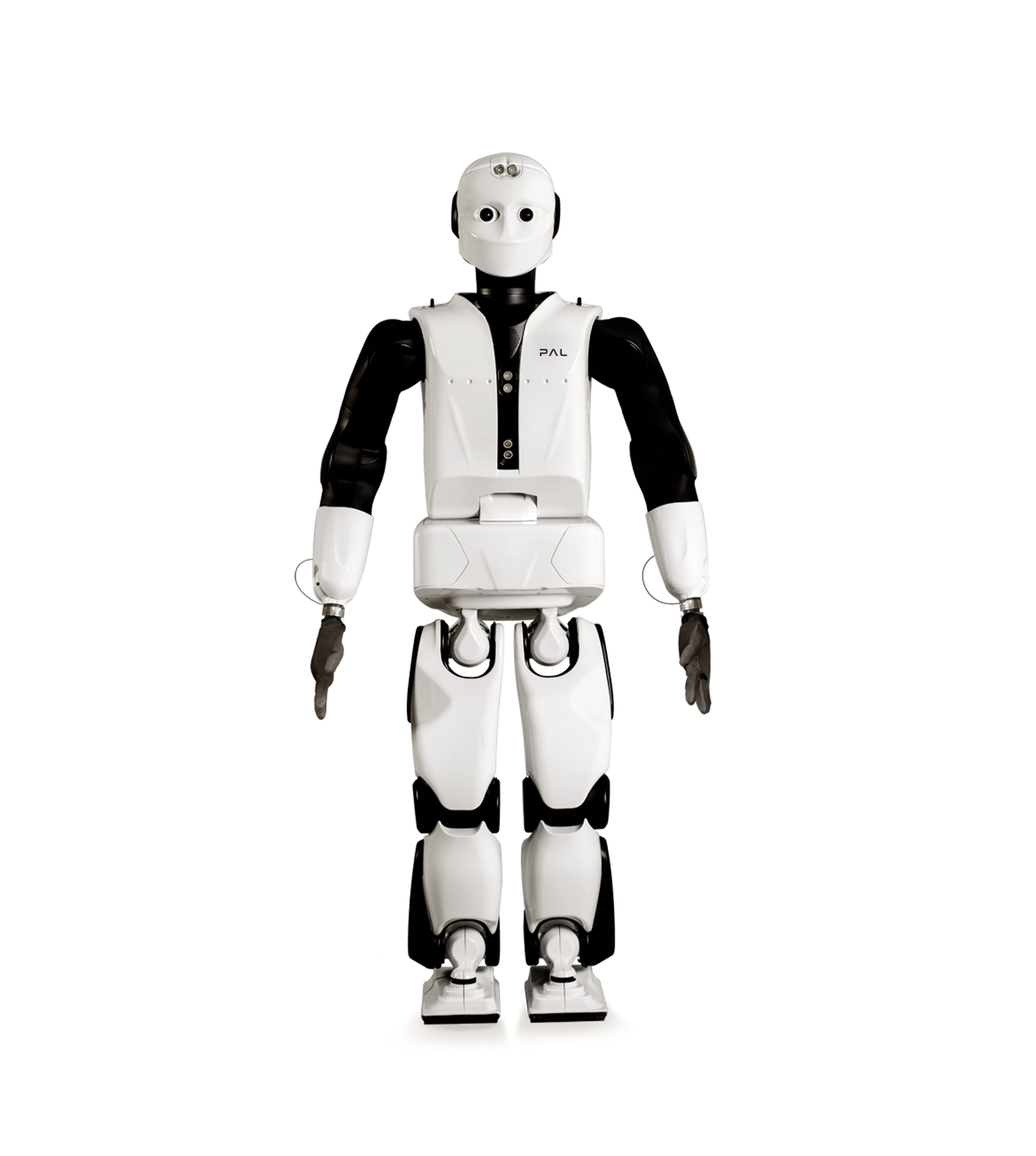
What is the Pal Reem C?
The PAL Robotics REEM-C is a full-size bipedal humanoid research platform developed in Barcelona, Spain, first released in 2013. It stands 165 cm tall, weighs 80 kg, and has 44 degrees of freedom driven by brushless DC motors with harmonic drives. Designed for whole-body control, locomotion, and HRI research, REEM-C runs Ubuntu Linux with ROS and is equipped with stereo cameras, an IMU, and force/torque sensors in the ankles and wrists. Its 6‑hour lithium‑ion battery supports indoor operation, and each arm can handle a 10 kg payload. The robot is sold directly to universities and research labs on a custom‑quote basis, often with a support contract.
Specifications
Here are the full technical specifications.
| Spec | Value |
|---|---|
| Height | 1650 mm |
| Weight | 80 kg |
| Degrees of freedom | 44 |
| Battery life | 6 hours |
| Max speed | 2.88 km/h |
| Payload | 10 kg |
| Price (new) | Quote-based (est. €300k–€400k) |
| Price (used range) | N/A (no active used market) |
Price & Value
New MSRP: Undisclosed (contact manufacturer)
Used range: N/A (no active used market)
REEM-C has no public retail price; it is sold exclusively to research institutions on a custom-quote basis. Based on disclosed contracts and industry reports, the typical cost falls between €300,000 and €400,000, varying with hardware options, software licenses, and multi‑year support agreements. This places it in the same bracket as comparable full‑size research humanoids like the Kawada HRP‑4, which lists around $400,000. Total cost of ownership includes annual support (often 15–20% of hardware), spare parts, and dedicated lab infrastructure. Depreciation is modest because of the platform’s longevity and shared software with TALOS; well‑maintained units can retain 50–60% of their original cost after five years. For labs with tighter budgets, PAL Robotics offers a rental program that reduces upfront expense and includes maintenance. The high entry cost is offset by extensive ROS documentation and a large active research community, ensuring a faster start‑up and lower integration risks compared to newer, less‑tested platforms.
Who Is It For?
Best for: - University robotics labs (44 DOF enables dexterous manipulation and walking research)
Not for: - Industrial deployment (payload limited to 10 kg, indoor only) - Budget‑constrained academic programs (<€300,000 purchase) - Outdoor field research (battery and thermal limits)
Alternatives & Comparison
For laboratories seeking a full‑size bipedal research humanoid, REEM‑C competes primarily with the Kawada HRP‑4 and its own successor, the PAL Robotics TALOS. Other smaller humanoids like NAO or Pepper serve different educational or HRI niches and are not substitutes.
| Model | Price | Available | Key Difference |
|---|---|---|---|
| Kawada HRP‑4 | ~$400,000 (est.) | yes | Similar full‑size research humanoid; HRP‑4 has a slightly different actuator layout and is primarily used in Japan’s HRP project. |
| PAL Robotics TALOS | Undisclosed | enterprise-only | Successor with higher torque actuators, faster walking speed, and more robust outdoor capability, at a higher price. |
Verdict: REEM-C remains the best value for established research groups already invested in the ROS ecosystem that need a reliable, indoor bipedal platform with strong community support. Labs prioritizing outdoor mobility, faster walking, or higher payload should seriously consider the TALOS despite its higher cost. For those unable to secure the €300k+ budget, acquiring a used HRP‑4 or a smaller humanoid may be more realistic.
Use Cases & Capabilities
Bipedal Locomotion Research
REEM‑C’s 44 degrees of freedom, including 6‑DOF legs, make it an ideal testbed for dynamic walking, push recovery, and terrain adaptation algorithms. Its force/torque sensors in the ankles and wrists provide high‑fidelity feedback for gait optimization. The onboard IMU and optional LIDAR support SLAM‑based navigation, while the ROS ecosystem allows rapid prototyping of control strategies. Researchers have used REEM‑C to demonstrate whole‑body step planning and compliant locomotion, and the robot has participated in EU‑funded projects like RoboHow, where it navigated office corridors autonomously. Its walking speed of 2.88 km/h is typical for a full‑size biped, though outdoor performance is limited by battery life and joint thermal constraints. Labs have published results on real‑time footstep replanning and balance recovery using this platform.
Whole-Body Control & Manipulation
With 7‑DOF arms and 6‑DOF legs, REEM‑C enables coordinated arm‑leg tasks such as opening doors, carrying objects, or bimanual manipulation. Each arm has a 10 kg payload capacity, sufficient for light tools and research payloads. The ROS‑based software stack includes libraries for inverse kinematics and dynamic balancing, allowing users to integrate custom planners. Force/torque sensing in wrists supports compliance control for safe interaction with humans or objects. However, the absence of dexterous hands (only 2‑DOF per hand gripper) limits fine manipulation, so many labs add custom end‑effectors. Multiple research groups have successfully demonstrated door‑opening using whole‑body impedance control on REEM‑C.
Human-Robot Interaction (HRI) Research
REEM‑C’s humanoid form factor and expressive head (2 DOF) make it suitable for social robotics studies. Its stereo cameras and optional GPU enable real‑time person tracking, gesture recognition, and facial analysis. Researchers have deployed REEM‑C as a receptionist or guide in controlled settings, leveraging its speech and vision capabilities via ROS packages. The robot’s size (165 cm) and weight (80 kg) provide a more realistic presence than smaller platforms, important for studying proxemics and trust. Despite its research focus, the lack of a built‑in facial expression screen limits emotive communication unless retrofitted. Projects like the ROCKIN@Home challenge used REEM‑C to evaluate HRI in assistance tasks.
Autonomous Navigation and Mapping
Equipped with stereo cameras and an optional LIDAR, REEM‑C supports SLAM (Simultaneous Localization and Mapping) and path planning in dynamic indoor environments. Its Ubuntu‑based ROS framework provides packages such as gmapping and move_base, enabling researchers to develop and test navigation stacks. The bipedal platform introduces unique challenges like footstep planning and obstacle avoidance while maintaining balance, making it an excellent testbed for locomotion‑aware navigation. Labs have integrated external depth cameras to improve mapping fidelity, and the onboard IMU aids odometry. While outdoor SLAM with GPS is possible, the robot’s battery life limits extended outdoor surveys.
Computer Vision Research
REEM‑C’s stereo camera pair, combined with optional Nvidia GPU, allows real‑time object detection, scene segmentation, and 3D reconstruction. Researchers have used the platform to train deep learning models for person tracking and gesture recognition, taking advantage of the humanoid’s eye‑level perspective. The ROS vision pipeline integrates easily with OpenCV and TensorFlow, enabling custom computer vision applications. Force‑sensitive wrists enable safe human‑robot hand‑over tasks, bridging perception and physical interaction. However, the fixed camera position limits adjustability, and some labs augment with pan‑tilt cameras for wider coverage.
Education & Training Platform
REEM‑C serves as a hands‑on teaching tool in graduate‑level robotics courses, exposing students to bipedal walking controllers, inverse kinematics, and ROS. Its open architecture allows students to implement custom algorithms and test them on a physical system. Universities often incorporate the robot into multi‑semester projects, building from basic walking to complex manipulation tasks. The availability of detailed documentation and a supportive community makes it accessible for instructors, though the high cost typically limits deployment to well‑funded programs. Several European universities have integrated REEM‑C into their Mechatronics and AI curricula.
History & Background
PAL Robotics was established in Barcelona in 2004, initially developing mobile manipulators and service robots. Its first humanoid, REEM‑A (2006), was a wheeled platform with an upper body, designed for object manipulation. REEM‑B (2009) added bipedal legs but with limited walking stability. In 2013, the company launched REEM‑C, its first full‑size bipedal research humanoid integrating 44 DOF, ROS, and robust sensor suite. Over the years, REEM‑C received hardware revisions improving joint reliability, adding optional LiDAR, and updating compute modules (Intel Core i7, optional Nvidia GPU). More than 50 units have been shipped to labs in Europe, Asia, and North America, participating in EU projects such as RoboHow and RockEU2. The robot’s success paved the way for TALOS (2017), a more powerful successor, but REEM‑C remains in production and support due to legacy compatibility and lower cost. PAL Robotics continues to enhance the platform through software updates and community collaboration.
Buying Used — What to Check
Inspect joints for backlash Harmonic drives can develop play after heavy use, degrading gait performance.
Verify sensor calibration IMU and force/torque sensors require periodic recalibration; factory reset may be needed.
Confirm software license transfer PAL Robotics may require a new support agreement to transfer ROS packages and updates.