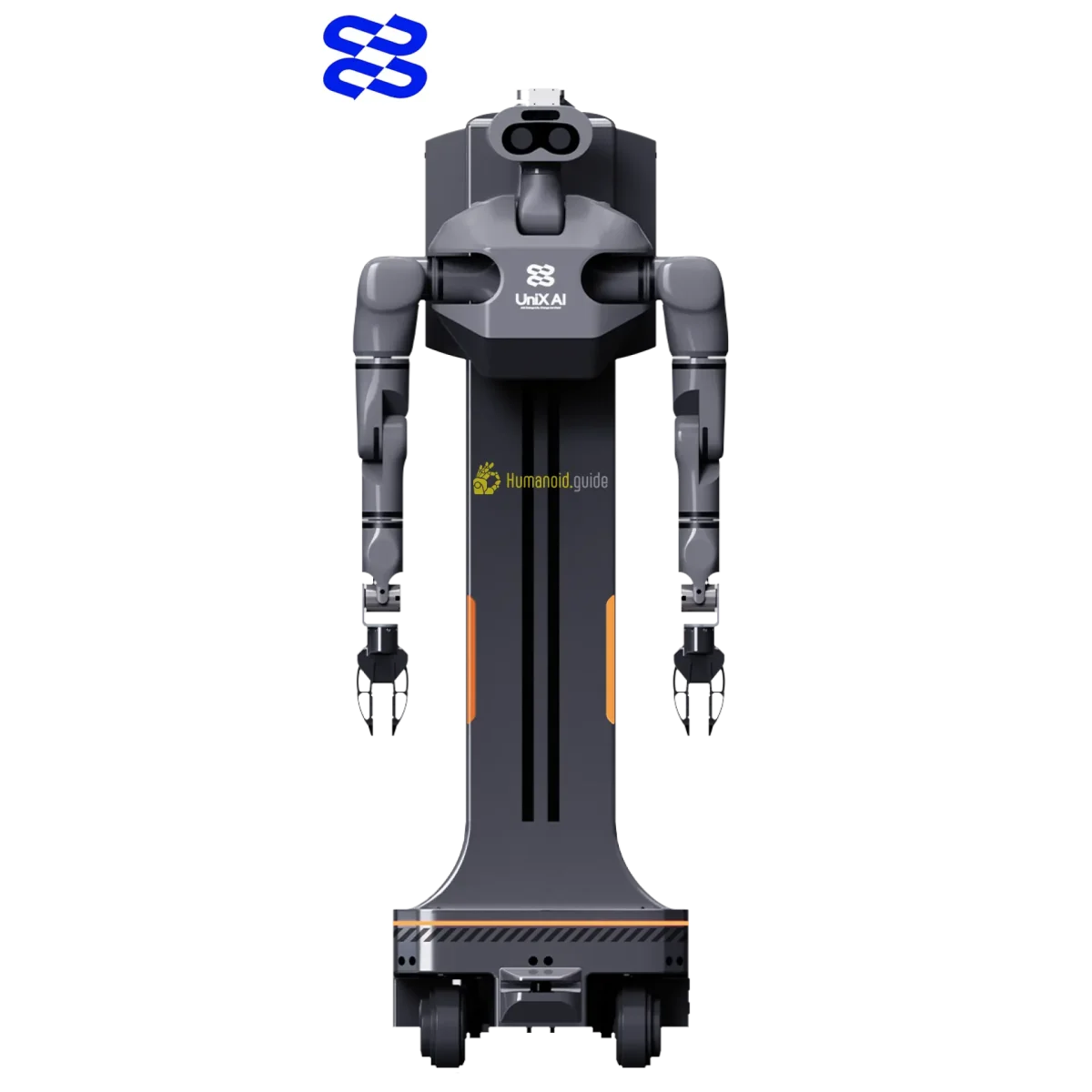
What is the Panther Unix?
The Unix AI Panther is a full-size industrial humanoid robot designed by Unix Group, a Chinese robotics company. Standing 160 cm tall, the bipedal platform combines an aluminum alloy frame with a composite outer shell, a biomimetic two-finger gripper, and integrated AI capabilities including large language model (LLM) integration and powerful edge computing up to 2070 TOPS. Its head-mounted dual RGB and RGBD cameras, along with a 6-microphone circular array, enable visual and audio perception for tasks in structured industrial environments such as warehouses and production lines. The robot is part of Unix Group’s expanding humanoid family alongside the service-oriented Wanda 2.0 and all-terrain Martian.
Specifications
Here are the full technical specifications.
| Spec | Value |
|---|---|
| Height | 160 cm |
| Weight | Not specified |
| Degrees of freedom | 34 |
| Battery life | 16 h (max) |
| Max speed | 5.4 km/h |
| Payload | 12 kg |
| Price (new) | Undisclosed (contact manufacturer) |
| Price (used range) | N/A (pre-order only) |
Price & Value
New MSRP: Undisclosed (contact manufacturer)
Used range: N/A
As of 2026, Unix Group has not publicly disclosed pricing for the Panther humanoid, which remains in pre-order and pilot deployment status. Interested buyers must contact the manufacturer directly for commercial terms. While comparable industrial humanoids from Chinese competitors like Fourier’s GR-2 or UBTECH’s Walker S typically range between $150,000 and $250,000 when offered to enterprises, the Panther’s price could be positioned competitively to gain early market share. Without a confirmed MSRP, it is difficult to assess value, but the Panther’s claimed specs — 34 DOF, 12 kg payload, and up to 16 hours runtime — match or exceed many rivals, suggesting a strong price-to-performance ratio if offered at a mid-range price point. Early adopters may face depreciation risks typical of first-generation robotics platforms, and total cost of ownership will depend on maintenance, software licensing, and integration expenses. Organizations considering the Panther should request a formal quote and evaluate long-term support commitments before purchasing.
Who Is It For?
Best for: - Manufacturers exploring AI-powered humanoid automation for logistics with a 12 kg payload capacity. - Warehouse operators needing a bipedal robot that can work full shifts (up to 16 hours) and navigate narrow aisles.
Not for: - Outdoor or dusty/wet environments (no IP rating confirmed; likely not weather-sealed). - High-payload manipulation tasks beyond 12 kg, such as palletizing heavy boxes or handling irregular loads.
Alternatives & Comparison
The Panther competes in the emerging market of full-size industrial humanoids designed for logistics and manufacturing. Here’s how it stacks up against three notable alternatives.
| Model | Price | Available | Key Difference |
|---|---|---|---|
| Unitree G1 | $16,000 | yes | Cost leader with 43 DOF but only 2 kg payload, limiting industrial use. |
| UBTECH Walker S | Undisclosed | enterprise-only | Proven enterprise biped with 36 DOF and NVIDIA Orin onboard. |
| Fourier GR-2 | ~$150,000 (est.) | preorder | Dexterous 5-finger hands and large training ecosystem for complex tasks. |
Verdict: For budget-conscious pilots, the Unitree G1 delivers impressive walking and light manipulation at a fraction of the price, but its 45-kg frame and 2-kg payload limit industrial use. The Panther, with its 12 kg payload and up to 16 hours runtime, is better suited for material handling and shift operations in warehouses. If dexterity and manipulation are paramount, the Fourier GR-2’s five-finger hands and dedicated training platform may justify a higher investment. Without confirmed pricing, the Panther’s value proposition remains theoretical, but its specs suggest it could be a strong mid-range contender for companies seeking an AI-native logistics humanoid.
Use Cases & Capabilities
Warehouse Material Transport
The Panther can autonomously navigate warehouse floors, using its dual cameras and AI to recognize inventory, pick totes or boxes weighing up to 12 kg, and transport them to designated drop zones. Its bipedal design allows it to traverse narrow aisles and step over obstacles that wheeled robots cannot, though its maximum speed of 5.4 km/h keeps it in a collaborative pace with human workers. The 8–16 hour battery runtime ensures it can work across a full shift, and its LLM integration enables natural language task instructions, making it easily re-deployable without reprogramming. Initial pilots will likely focus on repetitive logistics tasks in structured environments with clear visual markers.
Manufacturing Line Supply
On assembly lines, the Panther can fetch components from kitting stations and deliver them to human workers at the exact moment needed, reducing walking time and non-value-added motion. Its two-finger gripper is suited for handling structured, uniform parts like boxes, spacers, or pre-assembled modules. The onboard edge computing (up to 2070 TOPS) processes sensor data locally, enabling real-time path planning and obstacle avoidance without cloud dependency. Manufacturers looking to complement existing robotic arms and AGVs can deploy the Panther to bridge gaps between stationary automation and mobile tasks. Safety features such as speed limitation and human detection are expected, though formal certifications remain unconfirmed.
Autonomous Facility Patrol
Equipped with an RGBD camera and 6-mic array, the Panther can perform security and inspection rounds in warehouses or factories after hours. It can detect anomalies like open doors, fluid leaks, or temperature variations if integrated with additional sensors, and its 5G/Wi‑Fi connectivity allows immediate reporting to security systems. The ability to integrate LLM-driven decision-making means it can interpret unusual sounds or notify personnel with contextual alerts. This use case leverages the Panther’s humanoid form factor for mobile surveillance in spaces originally designed for humans, though its unrated IP protection limits operation in dusty or wet environments.
History & Background
Unix Group, a China-based robotics firm, introduced the Panther humanoid in 2024 as part of its strategy to develop a family of full-sized bipedal robots for industrial and service tasks. The Panther, along with the service-focused Wanda 2.0 (released in 2025) and the all-terrain exploration humanoid Martian (2024), showcases the company’s ambition to compete in the global humanoid market. The Panther is described as an ‘advanced prototype / pilot industrial deployment,’ indicating it is undergoing field trials in logistics and manufacturing environments. The robot appears alongside other Unix models on distributor sites like MERA Robotics, with pre-order interest forms available. As of 2026, detailed public documentation is limited, and no formal press release or technical paper has been widely circulated, but the Panther’s edge AI compute (up to 2070 TOPS) and LLM integration point to a design optimized for autonomous decision-making on the factory floor.
Buying Used — What to Check
Verify payload rating Payload and runtime are critical for industrial tasks; request manufacturer datasheet with load curves.
Confirm actual availability Pre-order may have long lead times; ask for pilot program terms and estimated delivery windows.
Check IP certification If deployed in semi-outdoor or wash-down areas, confirm dust/water resistance beyond the unknown rating.