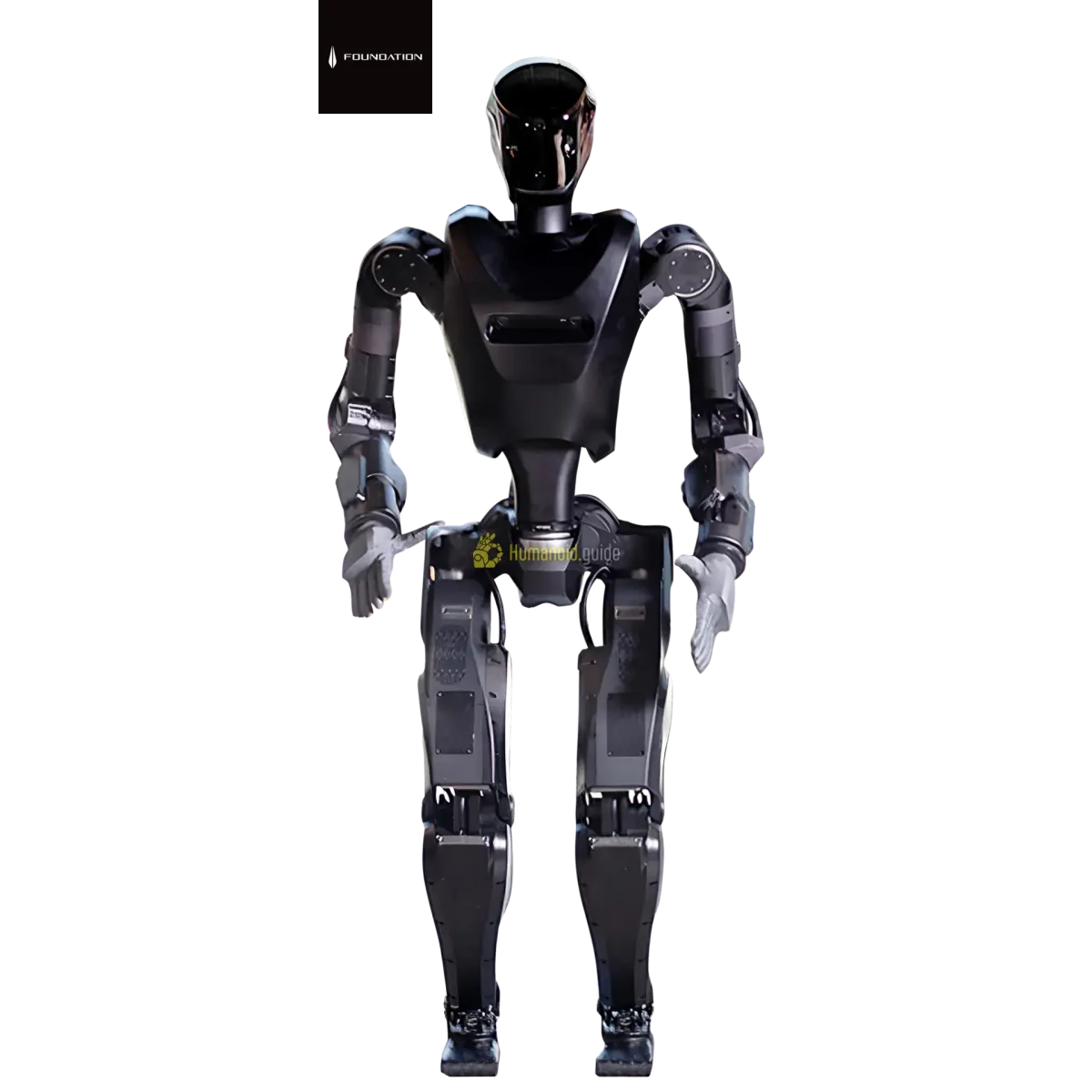
What is the Phantom Mk1?
The Foundation Phantom MK1 is a full-size heavy-duty humanoid robot developed by Foundation Robotics, a startup based in the USA. Standing 175 cm tall and weighing 80 kg, it is built with a carbon fiber frame and powered by proprietary backdrivable cycloidal actuators. It has 19 degrees of freedom (upper body focus), 10 fingers, and a payload capacity of 20 kg. The robot integrates LLM for natural language interaction and is designed for defense and industrial research. Currently a pre-commercial prototype, it is not available for public purchase.
Specifications
Here are the full technical specifications.
| Spec | Value |
|---|---|
| Height | 175 cm |
| Weight | 80 kg |
| Degrees of freedom | 19 |
| Battery life | Not specified |
| Max speed | 6.1 km/h |
| Payload | 20 kg |
| Price (new) | Undisclosed |
| Price (used range) | N/A (prototype) |
Price & Value
New MSRP: Undisclosed
Used range: N/A
The Phantom MK1 is currently a research prototype with no public pricing. As a heavy-duty humanoid with advanced cycloidal actuators and defense focus, its future price is expected to be in the high six-figure range, comparable to other industrial humanoids like Tesla Optimus (estimated $20-30k aspirational) or Figure 02 (undisclosed but likely >$100k). Given its payload and rugged design, it may justify a premium for military contracts. However, no used market exists until commercial production begins, and total cost of ownership remains unknown due to unspecified battery and software licensing.
Who Is It For?
Best for: - Defense research labs exploring legged mobility and heavy manipulation in unstructured outdoor environments (20 kg payload, cycloidal actuators, backdrivable joints) - Industrial R&D teams validating humanoid integration for assembly, machine tending, and material handling where high torque and 20 kg payload are essential
Not for: - Immediate factory deployment (no runtime specification, no obstacle avoidance, no confirmed safety certifications) - Consumer or educational applications (high expected cost, prototype status, no autonomous navigation capability)
Alternatives & Comparison
The Foundation Phantom MK1 competes in the emerging heavy-duty humanoid segment against well-funded projects from Tesla, Figure, and Fourier. All are pre-commercial or early-production, with varying mechanical approaches.
| Model | Price | Available | Key Difference |
|---|---|---|---|
| Tesla Optimus Gen 2 | ~$20,000 (aspirational) | preorder | Lighter (68 kg), Tesla's AI stack, lower cost goal |
| Figure 02 | Undisclosed | preorder | Slimmer (60 kg), general-purpose warehouse focused, 20 kg payload |
| Fourier GR-1 | ~$150,000 | yes | Commercially available with 32 DOF, ROS integration, lighter (68 kg) |
Verdict: If defense-grade ruggedness and backdrivability are paramount, the Phantom MK1 is the only option with cycloidal joints, but its pre-commercial status makes it a gamble. For immediate integration into warehouse and research workflows, the Fourier GR-1 offers proven availability and higher dexterity, while Tesla Optimus promises a low-cost future platform with Tesla's AI ecosystem, though neither matches the Phantom's 80 kg brute build.
Use Cases & Capabilities
Defense Field Operations
The Phantom MK1's rugged build, backdrivable cycloidal joints, and 20 kg payload make it a candidate for military applications like improvised explosive device (IED) disposal, reconnaissance in hazardous environments, and logistics resupply. Its 6.1 km/h walking speed enables mobility on uneven terrain, while LLM integration could allow voice-commanded task execution. However, the lack of stated ingress protection, runtime, and onboard autonomous navigation limits immediate field readiness. The design prioritizes strength and mechanical transparency over speed and battery life, suggesting it is better suited for stationary or short-range outdoor duties rather than long-duration patrols.
Heavy Industrial Manipulation
With 20 kg of payload and cycloidal actuators offering high torque density, the Phantom MK1 is well-suited for assembly line material handling, machine tending, and heavy tool operation in factories. Its backdrivability provides inherent safety for human-robot collaboration, and the carbon fiber frame reduces weight without sacrificing stiffness. The upper-body-focused 19 DOF may limit full-body tasks that require leg dexterity, but for stationary workcells it is adequate. The robot's LLM integration could also streamline reprogramming by operators. Unfortunately, the lack of disclosed battery runtime and computing hardware means facilities would need to budget for external power and possibly a tethered setup.
Research Platform
As a pre-commercial prototype, the Phantom MK1 serves as a development toolkit for university labs and corporate R&D centers testing whole-body control algorithms, human-robot interaction, and LLM-driven autonomy. Its open integration with language models and standard ROS-compatible control architecture makes it attractive for AI research, while the backdrivable joints allow safe physical experimentation. The absence of a published datasheet for battery life and onboard compute means researchers may need to run computationally heavy tasks offboard or use an external battery pack. Nevertheless, the platform offers a rare combination of industrial payload and compliant actuator technology for advancing legged manipulation science.
History & Background
Foundation Robotics, a U.S.-based startup founded in the early 2020s (exact year undisclosed), unveiled the Phantom MK1 humanoid in 2025 as a pre-commercial prototype. The robot’s development appears focused on rugged defense and industrial applications, leveraging proprietary cycloidal actuator technology. No prior generations have been announced, and the company has not disclosed a production timeline or pricing. As of 2026, the Phantom MK1 remains in development with limited public demonstrations at trade shows and via dedicated reseller listings.
Buying Used — What to Check
Confirm battery specs Runtime is not specified; once commercialized, verify actual endurance meets your task needs.
Inspect actuator condition Cycloidal backdrivable joints could suffer wear under heavy loads; test smoothness and tension before purchase.
Validate software stack LLM integration and ROS compatibility may evolve; ensure future upgrades and support from manufacturer.