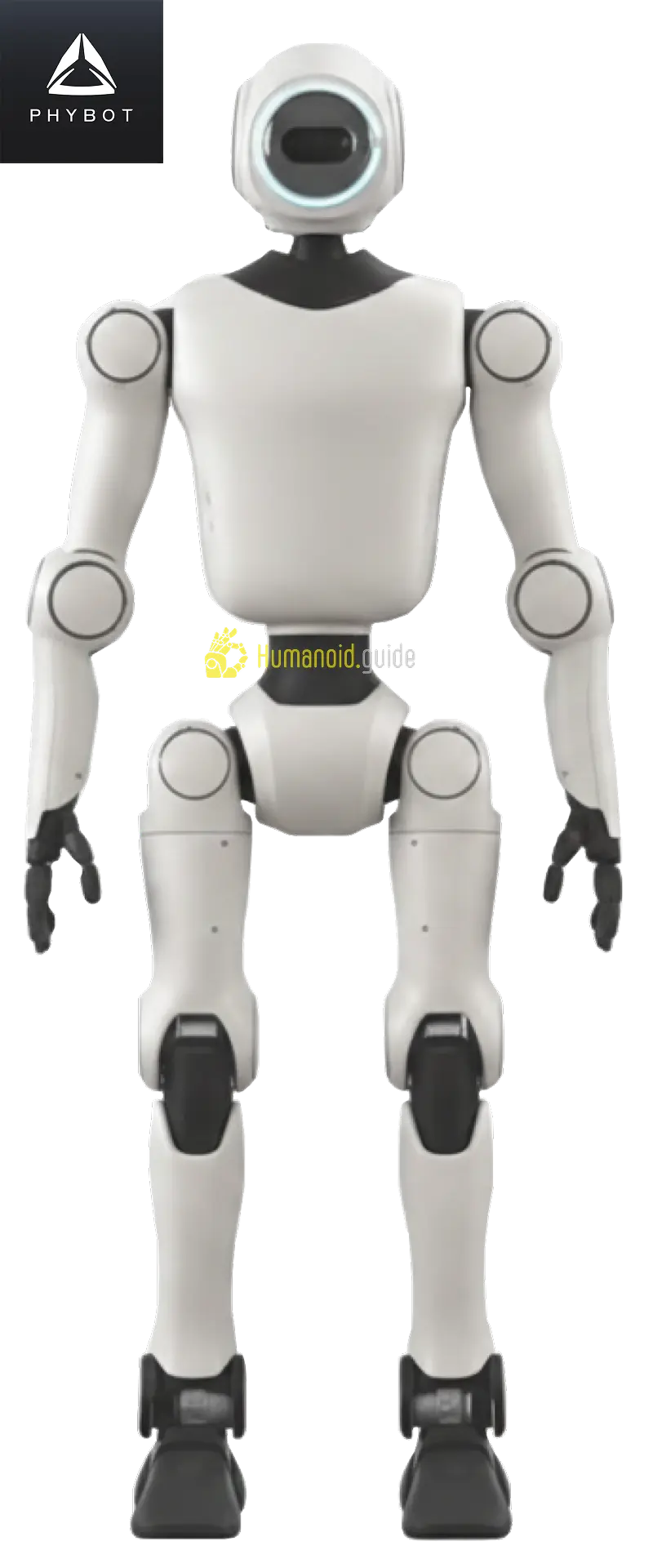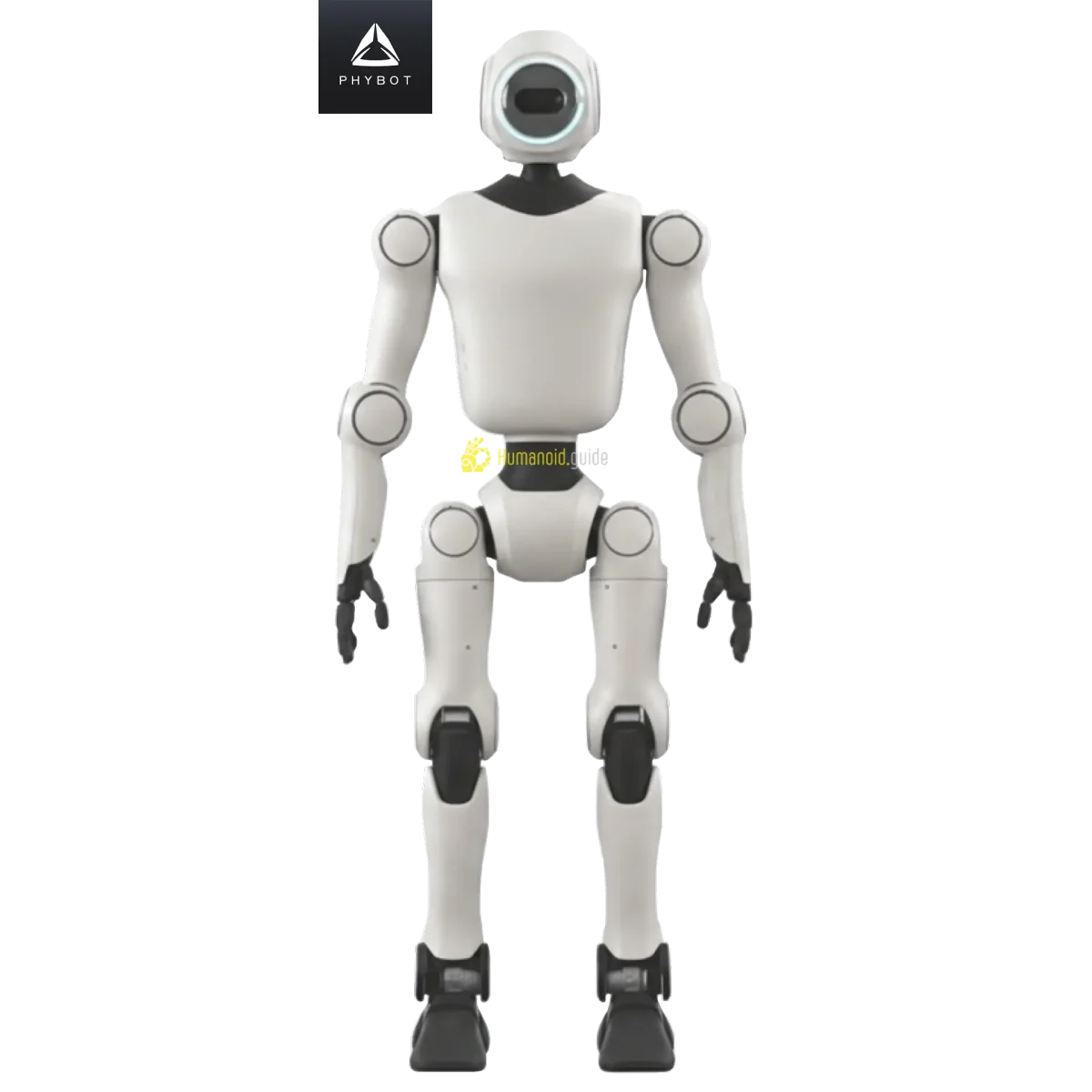
What is the Phybot C1?
The PHYBOT C1 is a compact humanoid collaborative robot developed by Taiwanese robotics firm Phybot. With 28 degrees of freedom — including 12 dexterous hand DOFs — it is tuned for logistics pick-and-place tasks in research and educational settings. A binocular vision system (1080p RGB + depth) enables object recognition and manipulation. Standing 125 cm tall and weighing 25 kg, the C1 can handle payloads up to 5 kg and moves at a top speed of 3 km/h. It runs on a Linux‑based ROS environment and supports external LLM API integration for AI research. The robot’s frame combines composite polymer and aluminum, with an IP20 rating. First introduced in 2024, the C1 remains a prototype, with pre‑order pricing listed at $22,000.
Specifications
Here are the full technical specifications.
| Spec | Value |
|---|---|
| Height | 125 cm |
| Weight | 25 kg |
| Degrees of freedom | 28 |
| Battery life | 3 hours |
| Max speed | 3 km/h |
| Payload | 5 kg |
| Price (new) | $22,000 |
| Price (used range) | N/A |
Price & Value
New MSRP: $22,000
Used range: N/A
At $22,000, the PHYBOT C1 sits at the affordable end of humanoid research platforms — about 30% below the price of similar 28‑DOF humanoids like the Fourier GR‑1 ($30,000). For an in‑development prototype, this pricing signals Phybot’s intention to compete on value. However, the C1 is not yet commercially available, so buyers are effectively placing a pre‑order with no guaranteed delivery timeline. Given its niche as a research‑focused manipulator, resale value is nonexistent today, and long‑term depreciation will depend on eventual production volume and software ecosystem maturity. Total cost of ownership is likely to include only the hardware, since most software is open‑source ROS. Budget‑conscious labs should consider the C1 a promising option pending final production and support commitments.
Who Is It For?
Best for: - University robotics labs and AI research groups needing a compact, low‑cost humanoid platform for dexterous manipulation and vision experiments - Educational institutions teaching humanoid robotics and ROS programming - Startups prototyping AI‑driven pick‑and‑place logistics applications
Not for: - Industrial assembly lines requiring high‑speed, heavy‑payload automation (max 5 kg payload and 3 km/h speed) - Outdoor operations or harsh environments (IP20 rating, no weatherproofing) - Military or hazardous material handling (not rated for such use)
Alternatives & Comparison
The Phybot C1 competes in the emerging sub‑$25,000 humanoid research robot market alongside the Unitree G1, Fourier GR‑1, and the LOLA‑2 research platform. Each offers distinct strengths in dexterity, speed, and software maturity.
| Model | Price | Available | Key Difference |
|---|---|---|---|
| Unitree G1 | $16,000 | preorder | 23 DOF overall, faster 5 km/h walking, but no dedicated dexterous hands (3‑fingered gripper) |
| Fourier GR‑1 | ~$30,000 (est.) | preorder | 40 DOF and higher payload (10 kg) but heavier (55 kg) and no confirmed object vision system |
| LOLA‑2 | Undisclosed | no | Research‑only bipedal locomotion platform, lacking upper‑body manipulation; not buyable |
Verdict: For labs that need a lightweight, dexterous humanoid for vision‑guided pick‑and‑place research, the Phybot C1 offers a strong value with its 28 DOF (12‑DOF hands) and sub‑$25k price. The Unitree G1 is a better choice if faster bipedal mobility and a lower budget are priorities, while the Fourier GR‑1 suits projects requiring higher payloads and full‑body compliance. As of 2026, however, the C1’s development status means it is a speculation — buyers should await production delivery before committing.
Use Cases & Capabilities
Research & Education
The C1’s 28‑DOF body includes fully articulated hands (12 DOF combined), making it ideal for dexterous manipulation research in university labs. Its compact size (125 cm, 25 kg) allows safe experimentation in shared spaces, while the ROS‑based Linux environment simplifies algorithm development. Students can study kinematic controls, grasping strategies, and sensor fusion using the integrated 1080p RGB‑D camera. The 3‑hour battery is sufficient for multiple lab sessions before recharging. At $22,000, the C1 is one of the most affordable dexterous humanoid platforms for academic budgets.
Logistics Pick‑and‑Place Prototyping
Phybot designed the C1’s binocular vision system specifically for logistics pick‑and‑place applications in warehouse and fulfillment environments. Its 5 kg payload and 3 km/h movement speed allow it to simulate bin picking, item sorting, and packaging tasks on a benchtop scale. The robot’s low weight and durable composite‑aluminum frame make it suitable for repeated demos in R&D labs. However, its IP20 rating limits deployment to clean indoor settings, and its top speed is insufficient for production‑rate operations. For early‑stage logistics automation prototyping, the C1 provides a cost‑effective testbed.
AI Vision & LLM Integration
With a native ROS environment and external LLM API integration capabilities, the C1 is built for AI‑driven research. Its 1080p RGB‑D camera and 150‑250 ms glass‑to‑action latency enable real‑time object detection and command execution from natural language prompts. Developers can connect the robot to cloud‑based LLMs to create embodied AI experiments, such as autonomous tabletop manipulation triggered by spoken instructions. The combination of hands capable of precision grips and a software stack that supports high‑level AI planning makes the C1 an appealing platform for robotic foundation‑model research. The pre‑integration of these tools reduces setup time compared to scratch‑built research platforms.
History & Background
Phybot, a robotics company based in Taiwan (with potential design and manufacturing ties to mainland China), appears to have been founded in the early 2020s, though official incorporation details remain scarce. The company introduced the C1 humanoid in 2024, positioning it as a collaborative robot for research, education, and AI labs. The C1’s design emphasizes dexterity, featuring 28 degrees of freedom overall — among the highest in its price class — with 12 DOF in the pair of five‑fingered hands. Early listings appeared on distributor sites like MERA Robotics and humanoid catalogues, indicating international interest. As of 2026, no production units have shipped; the robot remains a prototype. Phybot has not disclosed any venture capital or large‑scale manufacturing plans. The C1 stands as a promising but unproven entry in the low‑cost humanoid market, competing against more established players like Unitree.
Buying Used — What to Check
Verify payload and DOF specs Early specs may differ from final production; confirm 5 kg payload and 28 DOF before purchase.
Inspect battery health Prototype batteries may have degraded; ensure runtime meets 3-hour spec.
Assess software stack maturity ROS‑based, but custom drivers may need updates — confirm API documentation and support availability.