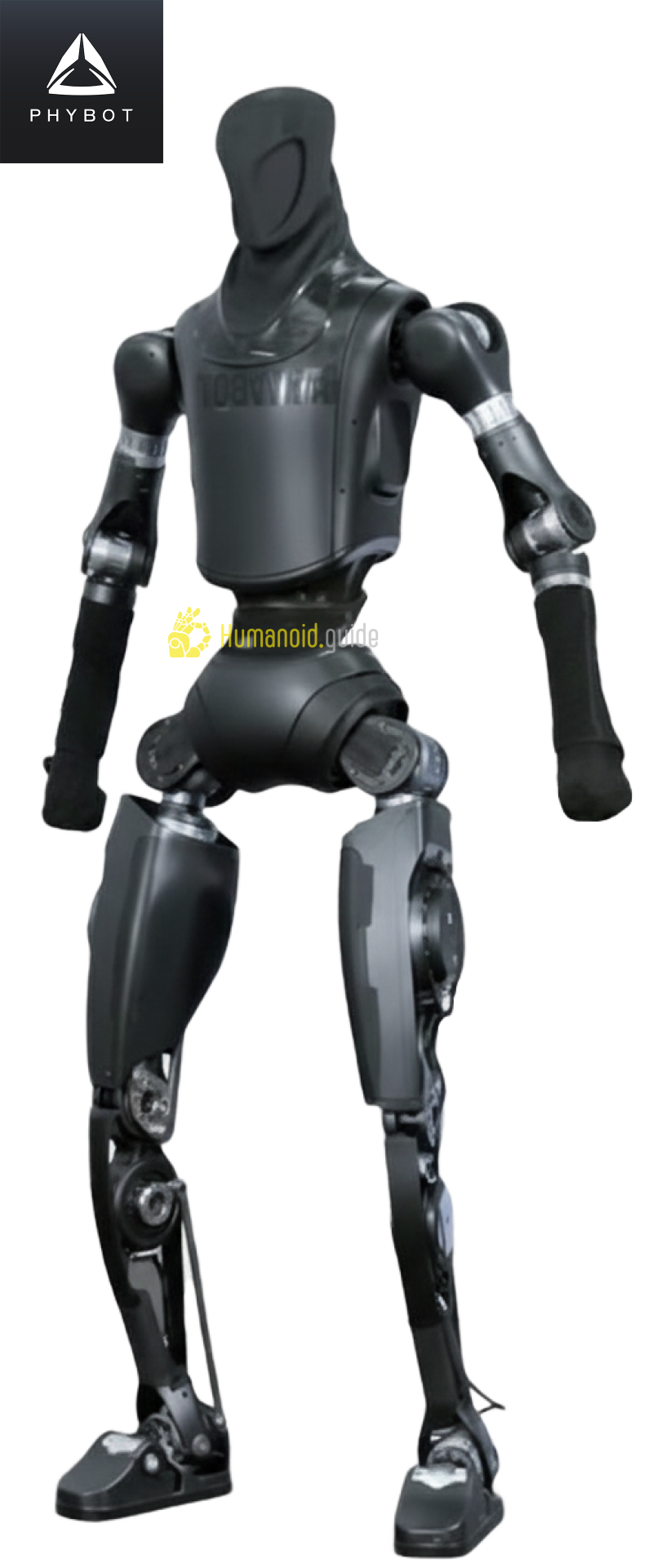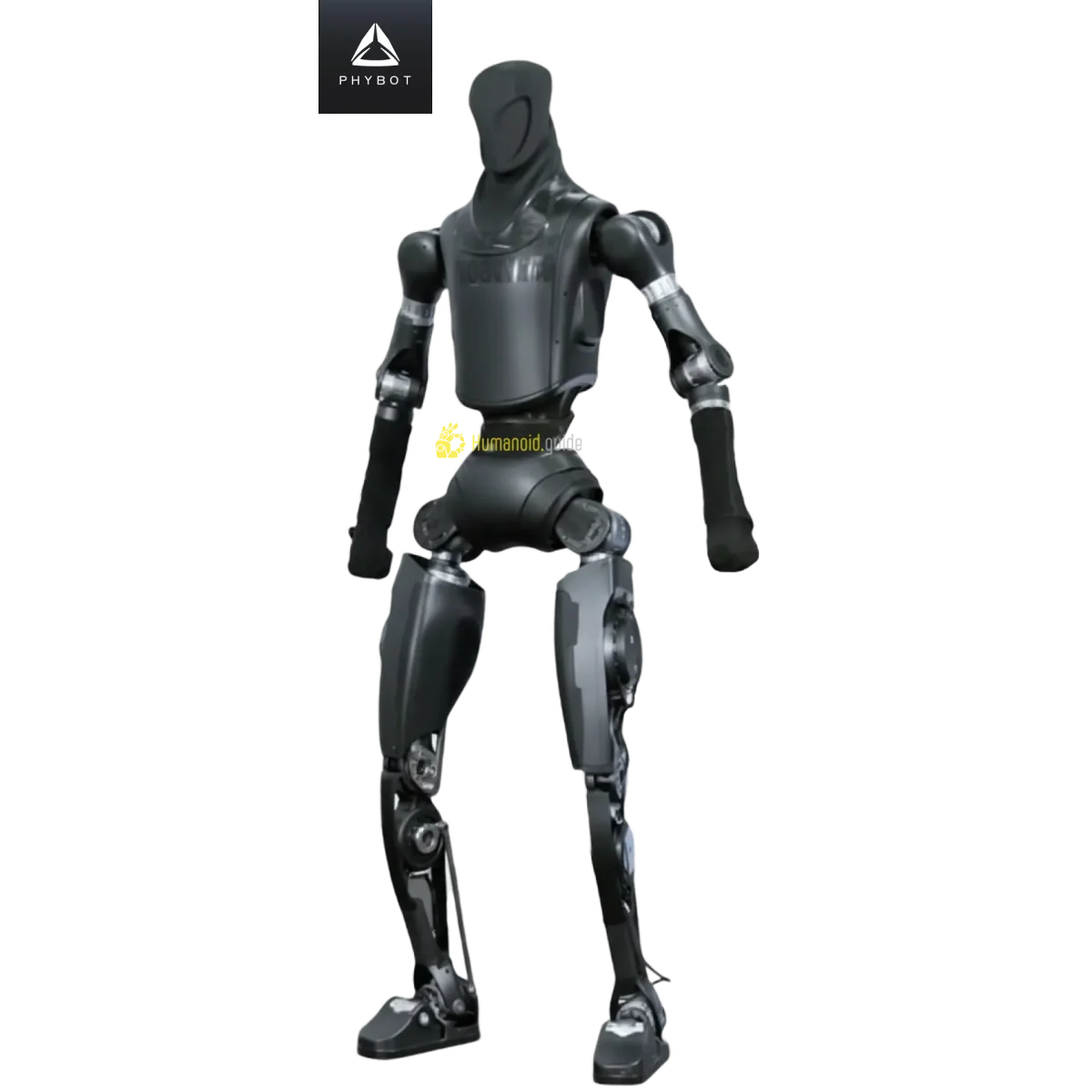
What is the Phybot M1?
The PHYBOT M1 is a full-size electric humanoid robot from PHYBOT, China, designed as a 'Robot for AI' that bridges large language models with physical action. Its standout feature is a telescoping spine, allowing it to work at both floor and shelf heights without bending. The robot integrates 32 degrees of freedom (12 in the hands), NVIDIA Jetson Orin compute, 3D LiDAR and stereo RGB cameras, and cycloidal gear drives with custom PhyArc actuators for high-torque movements. Standing 172 cm tall and weighing 60 kg, it carries up to 5 kg, walks at 5 km/h (max 10 km/h), and runs ROS2 for versatile research and light logistics. The M1 remains pre-commercial, with a target price around $39,000.
Specifications
Here are the full technical specifications.
| Spec | Value |
|---|---|
| Height | 172 cm |
| Weight | 60 kg |
| Degrees of freedom | 32 |
| Battery life | >2 hours (dual swappable 9 Ah batteries) |
| Max speed | 10 km/h (walking 5 km/h) |
| Payload | 5 kg |
| Price (new) | ~$39,000 (target, unconfirmed) |
| Price (used range) | N/A (pre-commercial) |
Price & Value
New MSRP: ~$39,000 (target)
Used range: N/A — no secondary market yet
The PHYBOT M1's target price under $42,000 positions it among the most affordable full-size humanoids, potentially undercutting competitors like the Unitree H1 (~$90,000) and Fourier GR-1 (~$150,000). However, as a pre-commercial unit, final pricing, support contracts, and delivery terms remain unconfirmed. Buyers should factor in total cost of ownership—software licensing, actuator maintenance, and onboard AI compute beyond the initial hardware price. Since the robot is still in development, resale value is purely speculative; early adopters may face rapid depreciation when commercial shipments begin. For labs needing a cost-effective platform for AI-driven manipulation research, the M1 offers compelling value, provided the company meets its specifications and timeline.
Who Is It For?
Best for: - AI research labs seeking a customizable humanoid platform with native LLM integration and ROS2 for embodied AI experiments (32-DOF dexterity enables manipulation tasks). - Industrial logistics teams needing a mobile manipulator that can pick from floor to shelf height (telescoping spine, 5 kg payload, 10 km/h speed). - Academic robotics groups looking for an affordable full-size humanoid for dexterous manipulation research (target price ~$39,000, cycloidal gear drives, open software stack).
Not for: - High-payload manufacturing cells (payload limited to 5 kg, insufficient for heavy tooling or large workpiece handling). - Outdoor or rough-terrain operations (limited to indoor flat surfaces, no weatherproofing beyond IP42). - Orders requiring immediate delivery (robot is still pre-commercial; no confirmed shipping dates).
Alternatives & Comparison
The PHYBOT M1 occupies a unique niche: a full-size humanoid at a projected price far below established players. Competitors in the light-payload, research-oriented humanoid space include the UBTECH Walker S, Fourier GR-1, and Unitree H1.
| Model | Price | Available | Key Difference |
|---|---|---|---|
| UBTECH Walker S | ~$150,000 (est.) | preorder | More mature perception stack, but 5x the cost of M1 target. |
| Fourier GR-1 | ~$150,000 (est.) | preorder | Higher payload (40 kg) but much more expensive and heavier (85 kg). |
| Unitree H1 | ~$90,000 (est.) | yes | Lighter and faster (18 km/h) but no telescoping spine and fewer hand DOF. |
Verdict: For budget-constrained research labs needing an AI-first humanoid with dexterous hands, the PHYBOT M1's target price makes it the most compelling choice—provided the company meets its delivery timeline. The Fourier GR-1 vastly out-lifts the M1 at 40 kg, making it better for heavy logistics, while the Unitree H1 offers superior speed and agility for dynamic locomotion research. However, if the M1’s telescoping spine and cycloidal drive reliability prove themselves, it could redefine value at the low end of full-size humanoid robotics.
Use Cases & Capabilities
Embodied AI & LLM Research
The M1 is purpose-built for AI integration, with onboard NVIDIA Jetson Orin, ROS2, and claimed LLM integration. Researchers can evaluate language-to-action latency (150–250 ms) and multimodal reasoning using its stereo cameras and LiDAR. Its 32-DOF platform allows dexterous manipulation experiments from floor-level to counter height via the telescoping spine. The open Linux software stack and claimed ‘Robot for AI’ philosophy encourage customization, though fully documented APIs are not yet public. This makes it ideal for teams exploring next-gen embodied foundational models without the $100K+ cost of competitors.
Industrial Logistics & Warehouse Handling
The M1’s telescoping spine lets it pick items from low shelves and place them on high racks—a unique capability that avoids needing separate floor-level and shelf-level robots. With 5 kg payload, 10 km/h speed, and swappable batteries for >2-hour shifts, it can handle light kitting, sorting, and transport tasks. Its safe-for-human collaboration rating and IP42 sealing suit clean warehouse environments. However, it lacks the ruggedness for outdoor docks and the payload for pallet-sized loads, so it must be complemented with heavier material handling equipment.
Academic Dexterity Research
The 12-DOF hands paired with cycloidal gear drives offer a platform for fine manipulation algorithms. Researchers can explore grasping, in-hand manipulation, and tool-use tasks in a 172 cm tall, fully mobile form factor. The high-torque PhyArc actuators are designed for burst movements, potentially enabling dynamic hand-object interactions. The ROS2-based system means existing libraries for MoveIt and perception can be ported, accelerating experimentation. At the target ~$39K price, multiple units could be deployed, enabling multi-robot coordination studies rarely affordable with other full-size humanoids.
Heavy Object Handling (Limited)
Although marketed for heavy object handling, the M1 is capped at 5 kg payload—far below traditional industrial manipulators. In practice, it can assist in shifting boxes weighing up to 5 kg from conveyor to cart, but cannot lift common warehouse totes. Its telescoping spine does provide a mechanical advantage for reaching high shelves without lifting overhead, reducing strain on the upper body linkages. For applications truly requiring heavy loads, the Fourier GR-1 or a dedicated industrial arm would be more appropriate. However, for light but awkward-to-reach items, the M1's expanded workspace adds value.
History & Background
PHYBOT was founded in China (exact founding year not publicly disclosed), emerging around 2024 when the M1 humanoid was first revealed. The company positions itself as a 'Robot for AI' developer, aiming to bridge digital AI with physical embodiment. After initial renderings and concept videos circulated in 2024, a physical prototype was demonstrated in early 2025, showcasing its telescoping spine and bipedal locomotion. The M1 is PHYBOT's first product, designed from the ground up for AI integration with custom PhyArc actuators and cycloidal drives. As of 2026, PHYBOT is engaging with early research partners and has not announced a commercial release date, though pre-order discussions have begun. The company maintains a low profile, with minimal press coverage beyond its website and a few robotics databases. No acquisitions or major funding rounds have been publicly confirmed.
Buying Used — What to Check
Verify actual battery runtime Spec sheet claims >2 hours but no independent testing exists; used units may have degraded dual batteries.
Check software stack maturity As a developer-focused platform, incomplete APIs or limited software support could impede integration; ensure the ROS2 integration is stable and documented.
Inspect telescoping spine mechanism The telescoping spine is a novel, unproven feature; used units might exhibit wear, misalignment, or actuator failure.