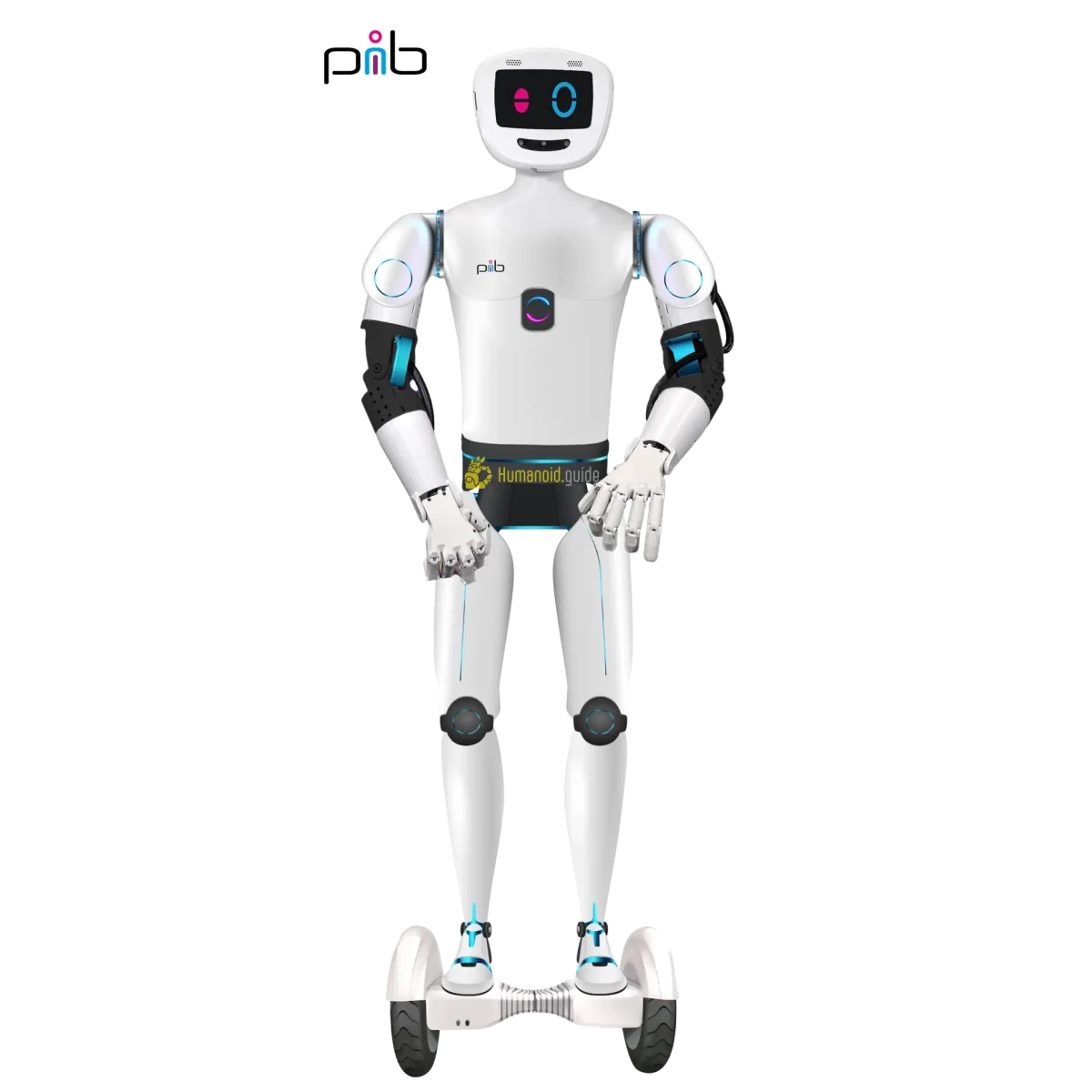
What is the Pib Pro?
pib Pro is a compact, open-source humanoid robot manufactured by isento robotics GmbH in Germany, first shipped in 2025. Standing 80 cm tall with 20 degrees of freedom, it is designed as an affordable, modular platform for robotics education and research. Its 3D-printable body uses PLA/ABS polymers, with servomotor-driven joints, a five-fingered gripper, and standard RGB cameras. Onboard compute runs Linux and ROS2, likely on a Raspberry Pi 5, with Bluetooth and Wi-Fi for connectivity. A 2-hour lithium battery powers the robot, which supports a 4 kg standing payload. The pib Pro is Europe's first ready-to-ship open-source humanoid, bridging the gap between DIY kits and professional research robots. Its design files and software are freely modifiable, fostering a growing community of makers and academics.
Specifications
Here are the full technical specifications.
| Spec | Value |
|---|---|
| Height | 80 cm |
| Weight | Not disclosed |
| Degrees of freedom | 20 |
| Battery life | 2 hours |
| Max speed | 2.5 km/h |
| Payload | 4 kg (standing) |
| Price (new) | Undisclosed (contact manufacturer) |
| Price (used range) | N/A (no secondary market yet) |
Price & Value
New MSRP: Undisclosed (contact manufacturer)
Used range: N/A (no secondary market yet)
The pib Pro’s official price is undisclosed, but as an open-source, 3D-printable platform, it is expected to sit well below the $8,000–$12,000 range of traditional educational humanoids like SoftBank NAO or Robotis Darwin-OP2. Total cost of ownership is minimal: users can self-manufacture replacement parts, and the permissive open-source license eliminates recurring software fees. Labs operating multiple units benefit significantly from bulk printing and assembly. However, without a confirmed MSRP, budgeting remains difficult; direct quotes from isento robotics are recommended. The used market is nonexistent in 2026, so depreciation patterns are unknown, but residual value will likely be low due to rapid iteration in open hardware. When comparing value, the pib Pro arguably offers the most flexibility per euro if its price approaches cost of materials—a stark contrast to closed, high-support-fee robots. Once pricing emerges, expect it to undercut the competition and become a staple in university labs.
Who Is It For?
Best for: - University robotics labs teaching ROS2 and humanoid kinematics (low cost, open-source, easily modifiable) - STEM educators needing an affordable, hands-on humanoid platform for classroom projects - Hobbyist and maker communities looking for a 3D-printable humanoid with full ROS2 support
Not for: - Applications requiring heavy payload manipulation (4 kg standing payload unsuitable for industrial lifting) - Outdoor field operations (no IP rating, delicate 3D-printed structure) - Commercial deployment where high uptime and robust support are required (reliance on community, unproven in enterprise)
Alternatives & Comparison
The pib Pro competes in the educational humanoid segment against established closed-source platforms like NAO and open-source alternatives such as Poppy. Below is a side-by-side comparison.
| Model | Price | Available | Key Difference |
|---|---|---|---|
| pib Pro (this robot) | Undisclosed | yes | Open-source hardware, 3D-printable, community-driven |
| SoftBank NAO V6 | $8,000 | yes | Pre-assembled, extensive software ecosystem, but closed-source |
| Poppy humanoid | ~€8,000 (est.) | yes | Open-source, 3D-printable, larger and less portable |
Verdict: For budget-conscious educators and researchers who value hackability, the pib Pro is the top choice—provided its final price undercuts rivals. NAO remains the best option for those needing out-of-the-box reliability and official curriculum support, despite its higher cost. Poppy is a strong contender for labs already familiar with 3D printing and open hardware, but its larger form factor may be impractical for some classrooms.
Use Cases & Capabilities
Academic Bipedal Locomotion Research
The pib Pro offers a low-cost platform for studying bipedal walking and dynamic balance. Its 20 degrees of freedom, distributed across legs, arms, and torso, allow researchers to test gait generation algorithms in a real physical system. ROS2 integration provides access to state-of-the-art locomotion libraries such as legged_gym or OCS2, and the open hardware means sensor fusion and ground reaction force estimation can be added via custom 3D-printed mounts. The robot’s 2.5 km/h walking speed is modest but sufficient for lab-scale experiments. Its 4 kg standing payload enables carrying light sensor arrays. Compared to simulation-only work, the pib Pro delivers empirical validation at a fraction of the cost of larger humanoids, though it is limited to flat indoor surfaces due to the lack of ruggedization and IP rating. Its lightweight 3D-printed frame is forgiving during falls, reducing repair costs—a critical advantage when iterating on unstable gaits. Additionally, the open-source community shares controller parameters and gait models, accelerating research.
Human-Robot Interaction (HRI) Studies
With its friendly size and modular sensor suite, the pib Pro is well-suited for HRI experiments. The standard RGB cameras and optional additional sensors over Wi-Fi enable gaze tracking, gesture recognition, and conversational AI integration via ROS2. Researchers can deploy voice-based interfaces using open-source speech recognition and synthesis stacks, making the robot approachable for children and adults. The five-fingered hands allow simple object manipulation and non-verbal communication studies. Because the robot’s hardware is fully documented, labs can easily modify its appearance—changing face plates or adding expressive LEDs—to test social acceptance hypotheses. The 2-hour runtime is adequate for session-based studies, and the small footprint (80 cm tall, light weight) simplifies transportation between labs and public demonstration spaces. The open-source nature also facilitates multi-robot HRI scenarios without prohibitive costs.
STEM Education and Classroom Kits
The pib Pro transforms robotics education by letting students physically assemble a humanoid from 3D-printed components. In a classroom setting, multiple units can be built over a semester, teaching mechanical design, electronics integration, and programming. The ROS2 software stack introduces professional-grade robotics concepts, preparing students for industry or graduate research. Teachers can design project-based modules around locomotion, sensor integration, or AI interactions. The robot’s relatively low expected cost per unit (once disclosed) could enable schools to afford several kits, unlike the $8,000+ alternatives. Furthermore, broken parts can be reprinted overnight by the students themselves, fostering a repair-and-iterate mindset. The pib community provides lesson plans and software examples, lowering the barrier for instructors without extensive robotics backgrounds. Its use of standard Raspberry Pi compute makes it familiar territory for high school computer science classes, bridging the gap between simplistic wheeled bots and advanced humanoid research.
Open-Source Customization and Community Development
One of the pib Pro’s greatest strengths is its ecosystem. Because all design files are open, makers can modify the robot’s geometry—extending arms, adding wheels, or mounting external sensors—and share their remixes on platforms like GitHub and Thingiverse. The ROS2 foundation ensures that community-developed packages remain compatible, fostering a library of applications from teleoperation to simple household tasks. This collaborative model reduces duplication of effort; for instance, a lab in Spain might contribute an optimized walking controller that a lab in Japan can immediately deploy. The low cost and standard components encourage experimentation, such as integrating RGB-D cameras for SLAM or environmental mapping in indoor spaces. While reliance on the community means support quality varies, the active pib subreddit and ROS discourse channels provide responsive peer assistance. As more users adopt the platform, the diversity of add-ons and improvements will accelerate, making the pib Pro an evolving project rather than a static product.
History & Background
The pib project originated around 2020 in Germany as a community-driven effort to design a fully 3D-printable humanoid robot for education. Early adopters built the robot from open-source plans and shared improvements through GitHub and forums. By 2024, the design had matured enough for isento robotics GmbH, a German robotics startup, to take the lead in commercializing the platform. In 2025–2026, the company launched the pib Pro — a ready-to-ship version assembled from high-quality components, still fully open-source. The Pro targets university labs and schools that lack the resources for in-house fabrication. While the original DIY kit remains available for free, the Pro adds manufacturer support, warranty, and pre-loaded software, simplifying deployment. The robot inherits the original pib’s modular architecture, allowing future upgrades like additional sensors or compute modules without requiring a complete redesign. Currently, no next-generation model has been announced, but the open community continues to contribute new applications and improvements.
Buying Used — What to Check
Verify battery health Lithium batteries degrade over time; on a used pib Pro, runtime may be less than 2 hours.
Inspect 3D-printed structure for cracks The PLA/ABS parts can become brittle with wear; check joints and chassis.
Confirm ROS2 version and software compatibility Ensure the robot runs a recent ROS2 distro and any custom packages are documented.