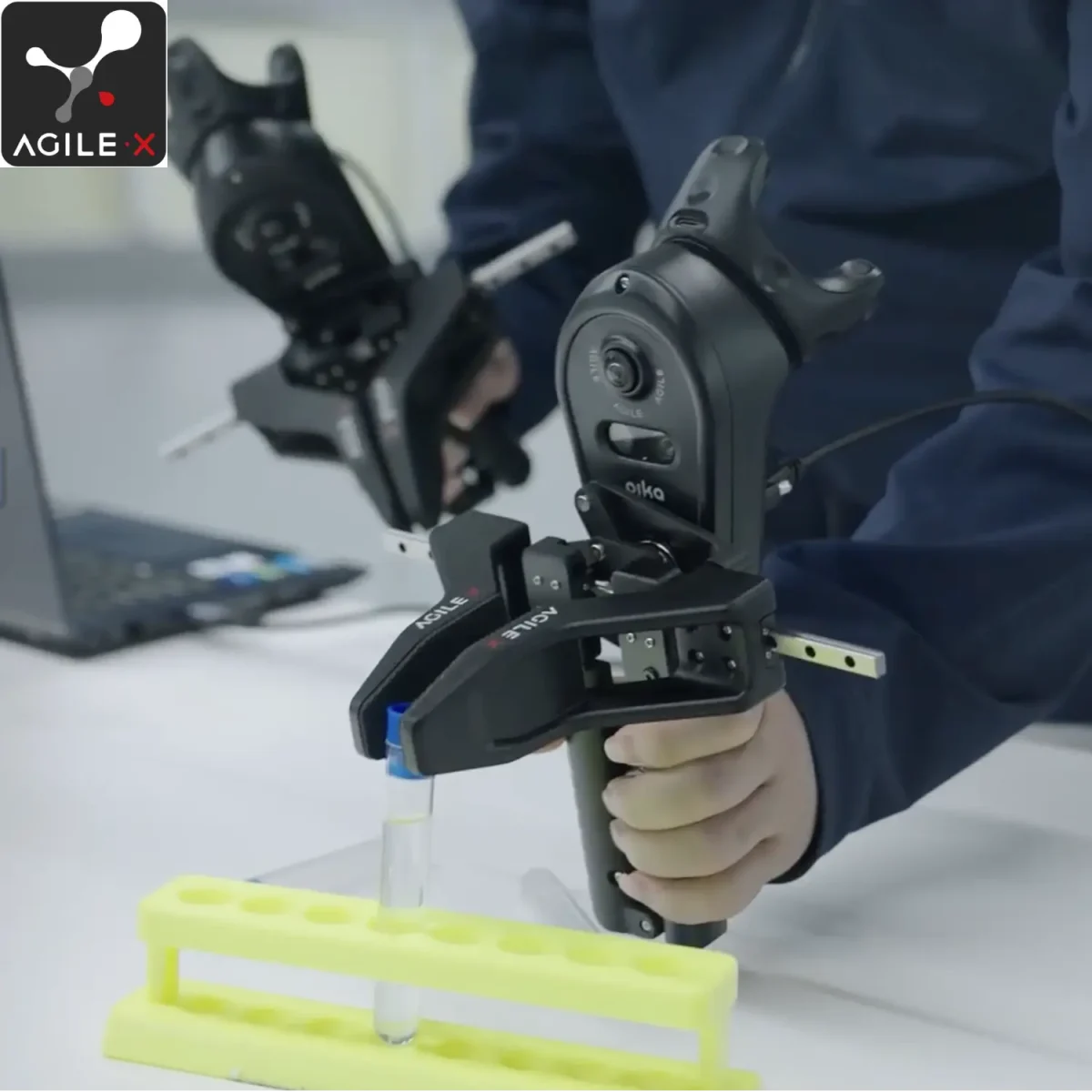
What is the Pika?
The PIKA by AgileX Robotics is a 6-DOF data collection platform purpose-built for acquiring human motion demonstrations to train robotic AI models. Designed for research and development settings, it captures high-quality kinematic data — likely through a wearable or teleoperation interface — and exports structured datasets for imitation learning and embodied AI applications. Manufactured in China, the system targets robotics researchers and AI developers seeking to teach robots manipulation skills. Unlike a traditional robot, PIKA is a training data acquisition tool, not an autonomous platform; it serves as the input device for demonstration-based learning pipelines. With a tall 2100 mm form factor, it may accommodate full-body human motions, though exact physical specifications remain sparse.
Specifications
Here are the full technical specifications.
| Spec | Value |
|---|---|
| Height | 2100 mm |
| Weight | Not specified |
| Degrees of freedom | 6 |
| Battery life | N/A (wired operation) |
| Max speed | N/A |
| Payload | Not specified |
| Price (new) | Undisclosed (contact manufacturer) |
| Price (used range) | N/A (no used units observed as of 2026) |
Price & Value
New MSRP: Undisclosed
Used range: N/A (no used units observed)
AgileX has not publicly disclosed a price for PIKA; interested buyers must contact the manufacturer directly, which is common for specialized research equipment where customization and support packages vary. Similar data collection systems, including optical motion capture suits or force-feedback teleoperation rigs, typically range from $5,000 to $50,000, placing PIKA in a competitive but uncertain pricing band. Its value proposition hinges on the quality and consistency of the motion datasets it generates, potentially saving researchers months of manual data collection and annotation. Compared to using a $14,500 Franka Panda for demonstration recording (which also serves as a full robot arm), PIKA may be less versatile but could be more cost-effective if priced below that threshold. Depreciation of niche research platforms is often steep; no used PIKA units have been observed on secondary markets, suggesting owners hold onto them. Without transparent pricing, organizations must weigh the risk of an undisclosed investment against the time savings and data quality PIKA promises.
Who Is It For?
Best for: - Robotics research labs that need a dedicated, repeatable motion capture system for imitation learning experiments, where data consistency is critical. - AI startups developing manipulation models that require large-scale human demonstration datasets and lack the budget or time to build custom teleoperation rigs. - Academic groups exploring teleoperation and haptic feedback who need a robust, pre-built 6-DOF input device with structured data output.
Not for: - Industrial manufacturers seeking an autonomous robot for production lines – PIKA is not a robot, it is a data capture peripheral. - Field research teams needing battery-powered, portable motion capture; PIKA relies on wired operation and a fixed setup. - Buyers requiring transparent, off-the-shelf pricing; the undisclosed cost and enterprise sales process may not suit small grants or rapid procurement.
Alternatives & Comparison
PIKA competes in a niche where researchers can either build custom teleoperation rigs or use adaptable robotic arms that double as demonstrators. The two closest commercial alternatives are the Franka Panda (a full 7-DOF collaborative arm) and the Shadow Teleoperation System (a dexterous hand setup).
| Model | Price | Available | Key Difference |
|---|---|---|---|
| Franka Panda | $14,500 | yes | 7-DOF collaborative arm; can be used for both demonstration recording and autonomous execution; PIKA is a dedicated data capture peripheral. |
| Shadow Teleoperation System | Undisclosed | enterprise | Dexterous hand-based teleoperation with tactile feedback; PIKA captures 6-DOF arm-level motion only. |
Verdict: For labs needing a robot that can both collect data and perform tasks, the Franka Panda offers an all-in-one solution with transparent pricing and a vast user community. If the goal is pure arm motion capture at a possibly lower cost, PIKA’s specialization could be attractive—provided the price is right. Without independent reviews or public deployments, however, the Franka Panda remains the lower-risk, better-documented choice for most research programs.
Use Cases & Capabilities
Imitation Learning Data Pipeline
PIKA directly addresses the bottleneck in imitation learning: acquiring high-quality human demonstrations. By capturing 6-DOF trajectory data in real time, it produces the kind of synchronized, structured data that frameworks like Robosuite or Gym expect. Researchers can record complex tasks—such as peg insertion, object handovers, or drawer opening—and immediately feed the data into behavior cloning models. The consistent recording environment ensures minimal noise compared to makeshift setups with multiple cameras. Since PIKA is a specialized tool, it avoids the calibration and synchronization headaches of generic motion capture. However, its limited to arm-level motion capture and may not capture finger dexterity unless supplemented.
Academic Robotics Research
University labs often need simple, reliable equipment to run student projects and publish papers. PIKA’s turnkey design allows students to begin recording demonstrations within hours of unboxing, skipping the integration of separate sensors and software. It also offers a standardized data format, which facilitates collaboration between different research groups. The tall form factor accommodates various human operators, making it accessible for diverse demographics. The wired connection eliminates battery concerns during long recording sessions. Nevertheless, the undisclosed price can be a barrier for grant-funded labs that require cost transparency from the start.
Embodied AI Model Training
Embodied AI requires models to generalize across environments, and data diversity is key. PIKA can be used to capture thousands of variations of a single task, creating a rich dataset that improves robustness. AI companies training foundation models for robots can integrate PIKA into their data pipelines, where it becomes a piece of the larger data collection infrastructure. Its structured output eases the transformation into neural network input tensors. The platform’s 2100 mm height suggests it may incorporate a visual or depth sensor array, further enriching the data with contextual information. However, the lack of published sensor details means developers must verify that the data streams align with their model inputs.
Teleoperation System Integration
PIKA can serve as the master device in a bilateral teleoperation system, translating an operator’s motions to a slave robot while recording the demonstration. Pairing it with a low-cost robotic arm allows a lab to quickly assemble a data collection and execution loop. The 6-DOF motion capture is sufficient for most arm-based tasks, though fine dexterity may require additional gloves. Its wired connection provides deterministic latency, which is critical for real-time teleoperation. As more labs adopt shared teleoperation interfaces, PIKA could become a standard input device. Still, the lack of force feedback might limit tasks that rely on tactile sensing.
History & Background
AgileX Robotics, founded in the 2010s in China, began as a developer of autonomous mobile robot platforms like the LIMO and RANGER MI, which support education and research. As the robotics field pivoted toward data-driven AI methods, AgileX identified a need for high-quality demonstration data and launched the PIKA data collection platform. While the exact release date is not publicly documented, PIKA has been in production since at least 2023, positioning it as an early mover in the embodied AI infrastructure space. The company capitalized on the growing popularity of imitation learning and foundation models, offering researchers a purpose-built hardware alternative to makeshift teleoperation setups using consumer VR controllers or expensive motion capture systems. AgileX’s global website lists PIKA alongside its mobile robots, reflecting its strategic importance. As part of the company’s ‘mobile the world’ vision, PIKA aims to integrate data collection, autonomous navigation, and manipulation. No generational updates have been announced, and the platform remains a niche offering within AgileX’s portfolio.
Buying Used — What to Check
Confirm sensor configuration PIKA may have optional modules (e.g., vision sensors) that drastically affect functionality; ensure the used unit includes all needed components.
Request data output format sample Compatibility with your existing ML pipeline is essential; verify that the structured data format matches your requirements.
Inspect cabling and mounting hardware Missing or damaged proprietary cables can be costly to replace and make the unit unusable without manufacturer support.