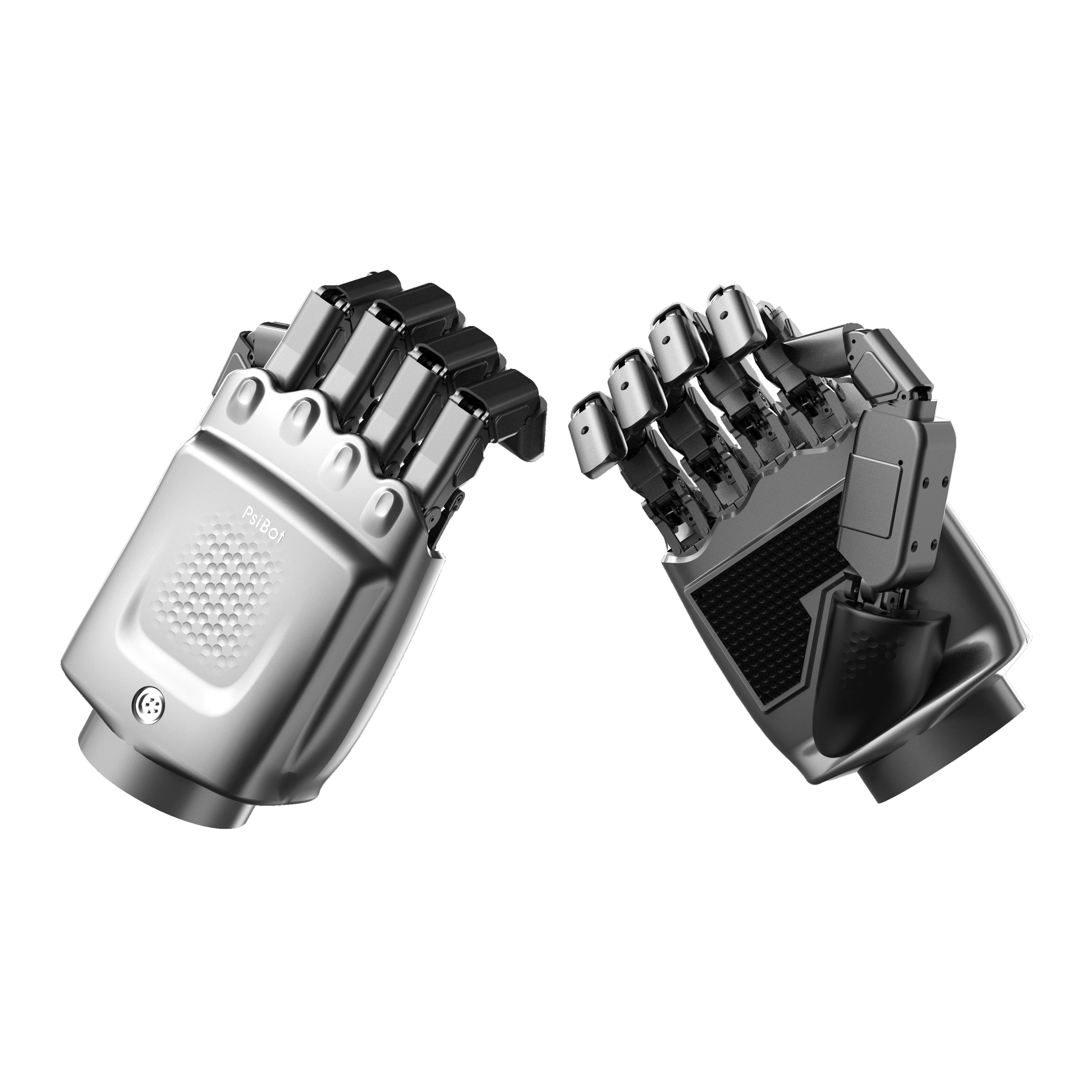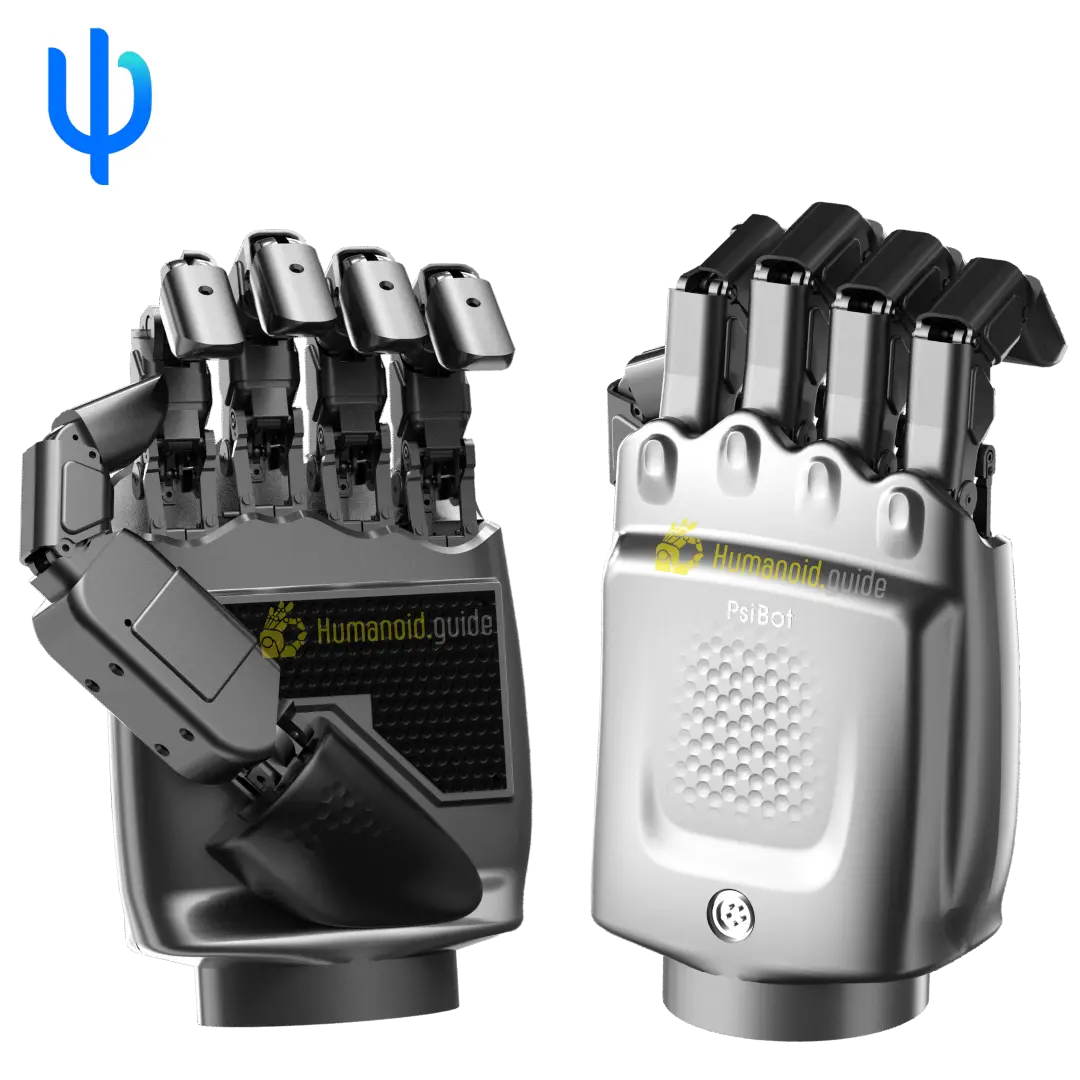
What is the Psi H1?
The PsiBot Psi-H1 is a dexterous robotic hand engineered for advanced manipulation tasks. Developed by Chinese robotics firm PsiBot, it is part of the company’s 2025 product lineup that includes the Psi V1 humanoid robot. The hand features five articulated fingers with a total of 16 degrees of freedom, driven by precision electric servo actuators with force feedback. Its lightweight aluminum alloy and reinforced polymer construction keeps total mass to just 0.6 kg, yet it can exert a gripping force of up to 20 kg. Integrated tactile sensors enable delicate object handling, making the hand suitable for research, light industrial, and domestic assistance applications.
Specifications
Here are the full technical specifications.
| Spec | Value |
|---|---|
| Height | N/A |
| Weight | 0.6 kg |
| Degrees of freedom | 16 |
| Battery life | N/A (externally powered) |
| Max speed | N/A (hand only) |
| Payload | 20 kg (grip strength) |
| Price (new) | Undisclosed (contact manufacturer) |
| Price (used range) | N/A |
Price & Value
New MSRP: Undisclosed (contact manufacturer)
Used range: N/A
PsiBot has not published official pricing for the Psi-H1, which is typical for B2B robotics components. Industry observers note that high-DOF dexterous hands generally range from $20,000 to over $100,000 depending on complexity and sensing. The Psi-H1’s combination of 16 DOF, 20 kg grip strength, and only 0.6 kg weight positions it competitively among lightweight hands. Without a price anchor, buyers must request quotes, but the design suggests cost-conscious engineering through the use of aluminum and polymers rather than full titanium. Used units are unlikely to appear soon given the hand’s recent release, but eventual second-hand values may follow a similar depreciation curve as research-grade manipulators.
Who Is It For?
Best for: - Robotics researchers developing dexterous manipulation algorithms (16 DOF and force sensing enable complex grasps) - Industrial automation integrators needing a lightweight hand for collaborative robots (0.6 kg minimizes arm payload impact)
Not for: - Heavy material handling tasks (max grip strength limited to 20 kg, not suited for >50 kg payloads) - Battery-powered mobile robots (hand is externally powered, no onboard battery integration)
Alternatives & Comparison
The Psi-H1 competes in the dexterous hand market alongside established research tools and industrial grippers. Its 16-DOF, five-fingered design targets the upper tier of manipulation capability while keeping weight extremely low.
| Model | Price | Available | Key Difference |
|---|---|---|---|
| Shadow Dexterous Hand | ~$120,000 (est.) | yes | 24 DOF with full tendon actuation, but weighs 4.2 kg and is larger |
| Schunk SVH | ~$70,000 (est.) | yes | 9 DOF, heavier at 1.95 kg, proven industrial integration |
| Robotiq 3-Finger Gripper | ~$18,000 (est.) | yes | Only 4 DOF, focus on pick-and-place, not human-like dexterity |
Verdict: For researchers needing maximum dexterity per gram, the Psi-H1’s 16 DOF and 0.6 kg weight are unmatched. The Shadow Hand offers higher DOF but at seven times the weight and likely a higher cost. For industrial integrators, the Schunk SVH provides a rugged, established alternative but with fewer DOF. The Psi-H1 is a compelling choice if its price falls below $50,000; if quoted above that, the Shadow Hand’s extra DOF may justify the premium.
Use Cases & Capabilities
Academic Research
University labs can use the Psi-H1 to study dexterous grasping and reinforcement learning. Its force sensors and 16 DOF allow complex policies like in-hand manipulation. The low weight simplifies mounting on lightweight arms like the Franka Emika Panda. Open-architecture control via position, speed, and voltage modes supports custom algorithms. Researchers can benchmark against the Shadow Hand at potentially lower cost.
Light Assembly
In electronics assembly, the Psi-H1 can handle small components with precision. The tactile feedback enables delicate insertion of connectors without damage. Its 20 kg grip strength is more than adequate for typical assembly parts. The hand’s 5-finger design mimics human dexterity, allowing it to pick odd-shaped items. Integration with NVIDIA Jetson-based controllers enables quick deployment of vision-guided grasping.
Assistive Robotics
Prosthetics and assistive devices may benefit from the Psi-H1’s lightweight, dexterous design. The hand can be used in teleoperation setups for remote manipulation in hazardous environments. Its force feedback gives operators a sense of touch. The hand’s compact size suits human-scale interaction scenarios. However, external power requirements may limit mobile applications.
History & Background
PsiBot is a Chinese robotics company that emerged around 2024-2025 with a family of humanoid and manipulation products. The Psi-H1 hand was unveiled alongside the Psi-V1 full-size humanoid as part of a 2025 product wave. The company focuses on integrating large AI models with edge computing, as demonstrated by the NVIDIA Orin AGX in its humanoid platform. The hand’s development appears to have drawn on expertise in lightweight actuator design. As of 2026, the Psi-H1 is in production and offered as a standalone component for external customers.
Buying Used — What to Check
Verify actuator calibration 16 DOF hands require precise calibration; misalignments cause grasping errors.
Check finger wear Tendon/cable wear or polymer joint fatigue could reduce grip strength.
Confirm compatibility Ensure communication protocol matches your robot arm; some hands require proprietary controllers.