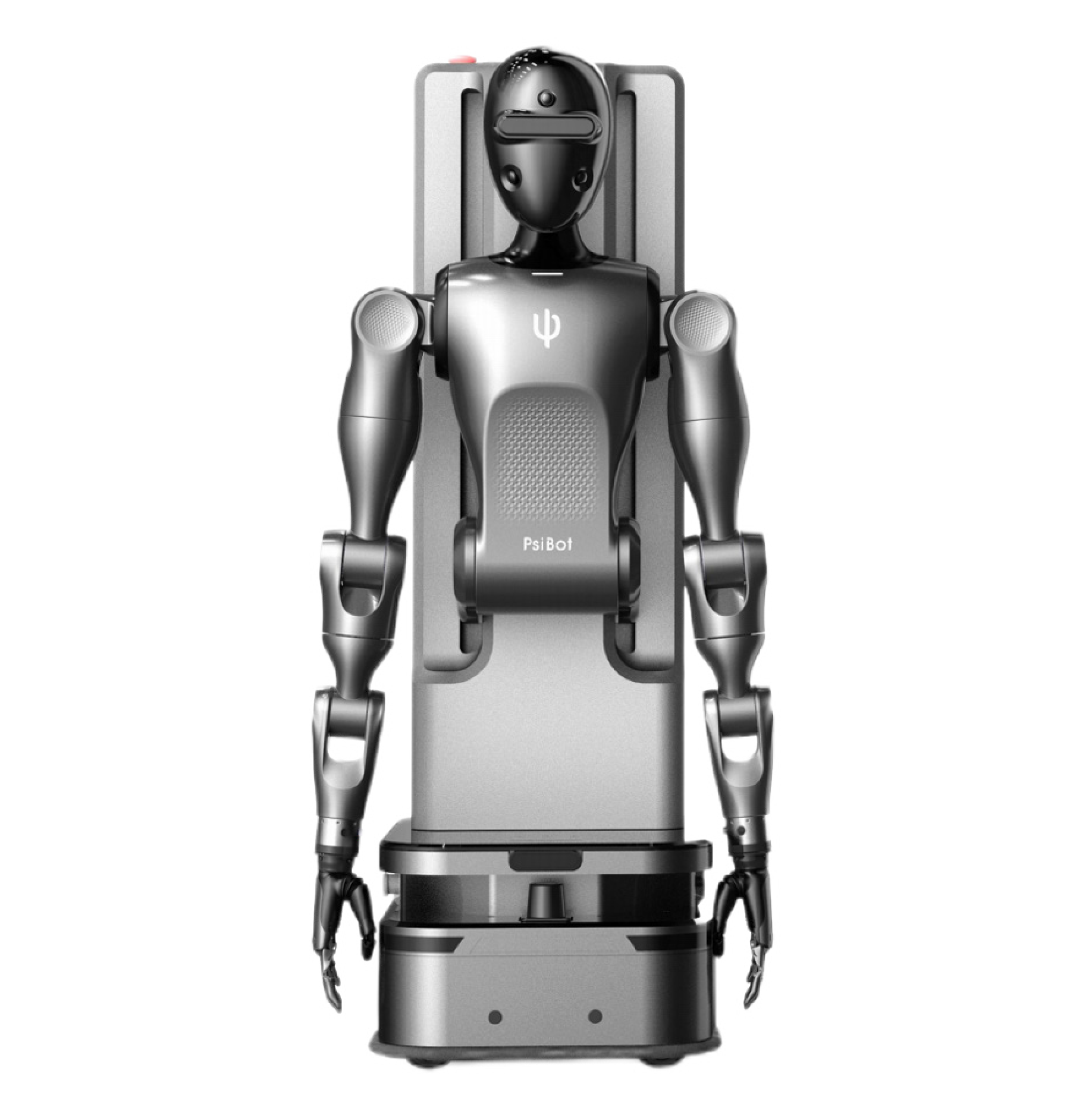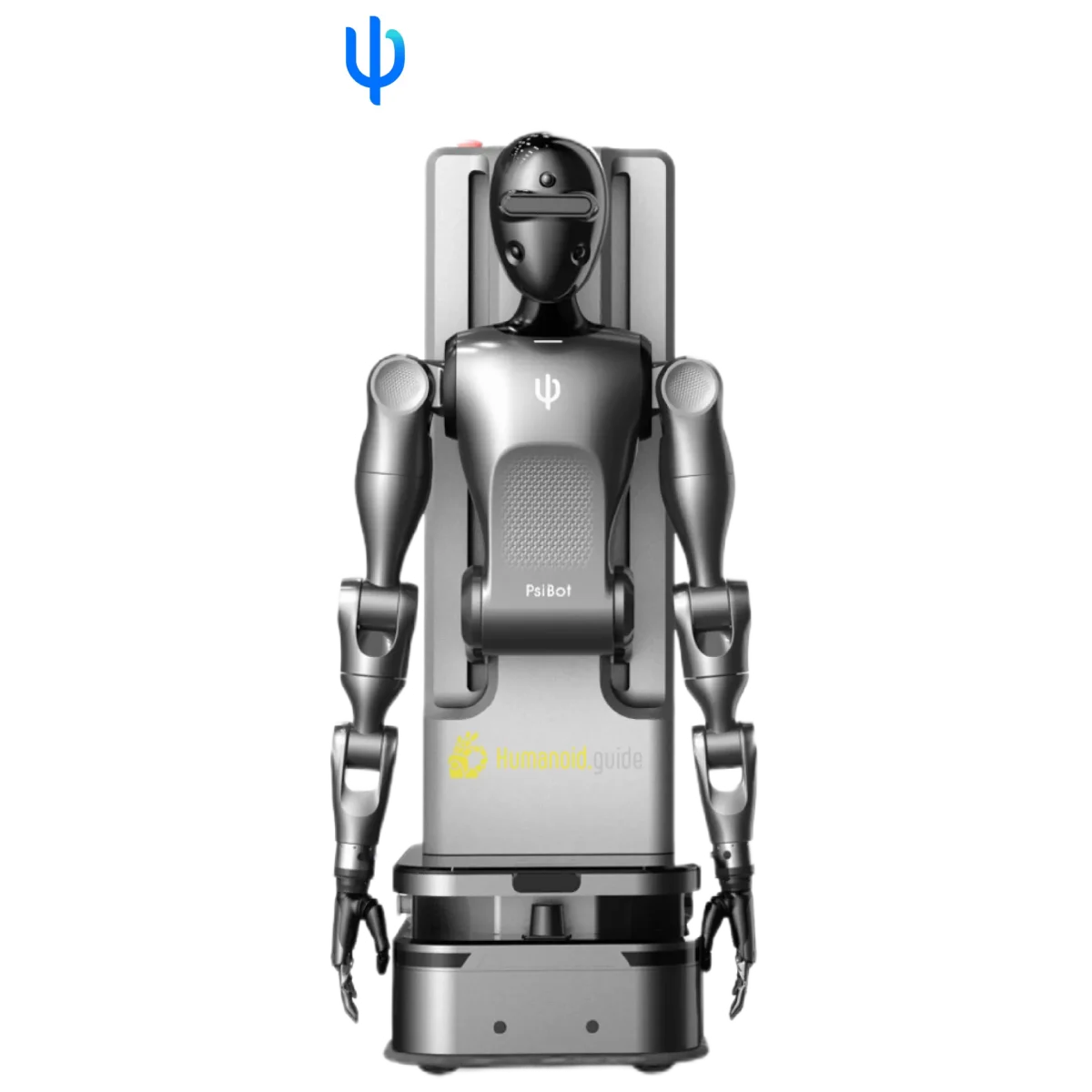
What is the Psi V1?
The PsiBot Psi-V1 is a full-size humanoid robot designed for light industrial automation, developed by PsiBot, a Chinese robotics company. Standing 175 cm tall and weighing 150 kg, it packs 42 degrees of freedom—including 22 in its dexterous hands—enabling complex manipulation. Powered by an NVIDIA Orin AGX computing module (275 TOPS), it supports edge AI large language model deployment. The robot walks at 4 km/h, operates for 5 hours per charge, and lifts up to 10 kg. Targeted at sectors like assembly, material handling, and inspection, the Psi-V1 enters the market as an affordable option in the humanoid space. It is manufactured in China and in serial production as of 2026.
Specifications
Here are the full technical specifications.
| Spec | Value |
|---|---|
| Height | 175 cm |
| Weight | 150 kg |
| Degrees of freedom | 42 |
| Battery life | 5 hours |
| Max speed | 4 km/h |
| Payload | 10 kg |
| Price (new) | $9,300 |
| Price (used range) | N/A (new product, no secondary market yet) |
Price & Value
New MSRP: $9,300
Used range: N/A
At $9,300, the Psi V1 is one of the most affordable full-scale humanoids on the market, undercutting alternatives like Unitree G1 ($16,000) by a wide margin. This low price makes it accessible to small and medium enterprises testing humanoid automation, though buyers should consider that payload (10 kg) and speed (4 km/h) are modest. Total cost of ownership is expected to be low given the use of standard electric servo motors and harmonic drive reducers, though battery replacement and hand maintenance may add recurring expenses. Because no used units exist yet, depreciation curves are unknown; early adopters may face significant value loss if a second generation arrives quickly. Still, for budget-conscious industrial buyers needing a versatile manipulator, the Psi V1 offers compelling value.
Who Is It For?
Best for: - Small-to-medium manufacturers exploring humanoid automation for light payload tasks (up to 10 kg) - Research labs needing an affordable platform for dexterous hand manipulation and AI integration
Not for: - Heavy-duty lifting or high-speed logistics (max payload 10 kg, walking speed only 4 km/h) - Operations requiring rugged outdoor mobility or IP-rated water/dust resistance (ingress protection not specified)
Alternatives & Comparison
The Psi V1 competes in the emerging low-cost humanoid segment, where few alternatives exist. The closest comparable robot is Unitree G1, another Chinese-developed biped aimed at light tasks.
| Model | Price | Available | Key Difference |
|---|---|---|---|
| Unitree G1 | $16,000 | yes | 3 kg arm payload and dynamic running, but lower dexterity (23 DOF vs Psi V1's 42) and almost double the price |
Verdict: For pure value in a dexterous manipulator, the Psi V1 wins hands down — it’s far cheaper and has vastly more hand DOF. However, if your application requires faster, more athletic movement or higher arm payload (3 kg direct arm lift vs Psi V1’s likely lower arm payload), the Unitree G1 is the better choice. Schools and light manufacturing floors with manipulation-focused workflows will get the most out of the Psi V1.
Use Cases & Capabilities
Light Industrial Parts Handling
The Psi V1 can pick, sort, and move small-to-medium components on factory floors. With 22 hand DOF, it handles delicate or irregularly shaped objects with precision, reducing the need for custom grippers. Its 10 kg payload allows moving boxes, bins, or raw materials between workstations. Battery life of 5 hours supports a half-shift before recharging, and a simple aluminum/steel frame keeps maintenance straightforward. Limitations arise with larger, heavier parts or high-speed conveyor belt synchronization.
Assembly Line Assistance
On assembly lines, the Psi V1 can perform repetitive tasks like fastening, inserting, or aligning components that require high dexterity. The 42 DOF body, especially the two 5-finger hands, enables near-human manipulation of screws, clips, and small electronic parts. Its NVIDIA Orin AGX platform allows on-edge AI inference for quality checks mid-assembly. Restricted mobility (4 km/h) means it’s best suited to stationary or short-range tasks rather than traversing large assembly halls. Companies can deploy multiple units at a fraction of the cost of a single premium humanoid.
Quality Inspection and Testing
Equipped with high-precision force feedback and dexterous fingers, the Psi V1 can execute intricate check routines: pressing buttons, turning dials, and applying controlled forces. The robot’s LLM integration allows natural-language instruction for varying test protocols, reducing programming overhead. It can operate for hours in a constrained inspection cell, performing visual and tactile checks. However, the lack of a specified camera resolution means add-on vision systems may be needed for high-resolution defect detection. Overall, it offers a programmable quality-assurance asset at a disruptive price.
Academic and Dexterity Research
University labs can leverage the Psi V1 as a cost-effective platform for whole-body manipulation and AI research. The 22 hand DOF and force-feedback servos let researchers experiment with grasping, in-hand manipulation, and shared autonomy. Integration with large language models via the Orin AGX opens possibilities for interactive instruction-following studies. At under $10,000, it’s far more accessible than other full-size humanoids, democratizing access to advanced hardware. Researchers should plan for the robot’s 150 kg weight—it requires sturdy flooring and careful transport logistics.
Warehouse Picking and Kitting
For e-commerce and kitting operations, the Psi V1 can pick diverse items from shelves and assemble customer orders. Its 5-hour runtime covers a morning or afternoon sorting shift, and the electric servo motors with harmonic drives promise reliable, quiet operation in shared spaces. The 42 DOF body navigates narrow aisles and reaches multiple shelf heights, complementing conveyor or mobile-base systems. Payload constraints cap it at small-to-medium items; bulky or heavy products above 10 kg will require alternative automation. Nevertheless, its low upfront cost makes it an attractive entry point for semi-automated warehousing.
History & Background
PsiBot, a Chinese robotics firm likely based in Beijing, emerged as a developer of diverse humanoid form factors. The Psi product family—spanning R0, R0.5, R1, V1, H1, and E1—was developed throughout 2025, with the Psi V1 first shown that year as the company’s affordable, dexterity-focused model. By April 2026, it had entered serial production for industrial customers, marking one of the earliest sub-$10k full-size humanoids on the market. PsiBot has remained tight-lipped about its founding date and exact headquarters, but its rapid product rollout signals deep engineering capability. No major ownership changes or discontinuations have been reported as of mid-2026; the V1 continues to target light industrial automation markets globally.
Buying Used — What to Check
Verify battery health A 5-hour battery may degrade quickly if cycled daily; replacement cost and availability should be confirmed.
Inspect hand actuators With 22 DOF per hand, complex harmonic drives and servos are expensive to repair; any signs of wear or play could indicate future failure.
Confirm software/firmware version Early units may lack important updates for LLM integration or motor control; ensure the robot can run the latest edge AI stack.