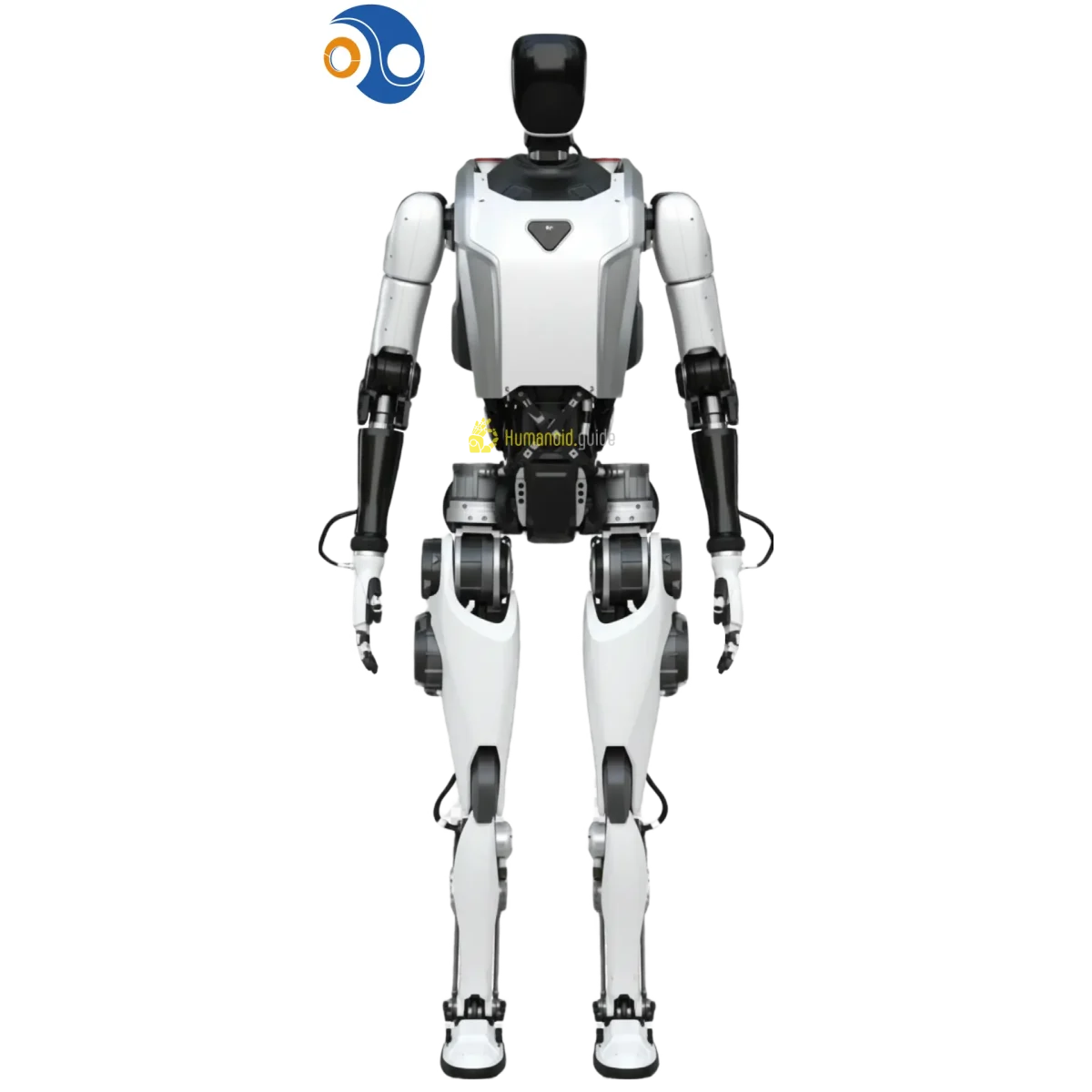
What is the Qinglong V3 Openloong?
The OpenLoong Qinglong V3.0 is a full-scale humanoid research robot developed by OpenLoong in Shanghai, China. Standing 185 cm tall and weighing 85 kg, it offers 43 degrees of freedom—including 16 in the hands, 14 in the arms, 12 in the legs, and a single waist joint—all driven by custom rotary electric actuators with harmonic drives. Built on an open-source hardware and software philosophy, the V3.0 is freely documented for academic and industrial R&D labs. It integrates dual-arm manipulation, bipedal locomotion (up to 1 m/s), and a full sensor suite: stereo RGB-D cameras, 9-axis IMU, 6-axis force/torque sensors at wrists and ankles, and joint torque sensors. The robot is not sold commercially; units are allocated to research partners through the OpenLoong initiative.
Specifications
Here are the full technical specifications.
| Spec | Value |
|---|---|
| Height | 185 cm |
| Weight | 85 kg |
| Degrees of freedom | 43 |
| Battery life | 2.5 hours |
| Max speed | 3.6 km/h |
| Payload | 5 kg per arm |
| Price (new) | Undisclosed |
| Price (used range) | N/A (no secondary market) |
Price & Value
New MSRP: Undisclosed
Used range: N/A
As an open-source reference platform, the Qinglong V3.0 does not have a published retail price; it is not sold commercially. Instead, OpenLoong provides full hardware CAD, schematics, and software free of charge, with limited real units built for research partners. For a lab, the cost to replicate one robot from open-source designs is estimated at roughly $150,000–$250,000 based on component costs and low-volume manufacturing, but that figure is highly variable. Compared to closed-source alternatives like the Unitree H1 ($90,000), the Qinglong V3.0’s total cost of ownership is higher if you build yourself, but the open intellectual property and full-stack customizability may justify the investment for universities developing novel control algorithms. Because no secondary market exists and units are allocated rather than sold, depreciation is not a meaningful metric. This robot is best understood as a research tool whose value lies in the publicly available design data, not a purchasable product.
Who Is It For?
Best for: - University robotics labs (43 DOF and full torque sensing enable dexterous manipulation research) - Open-source humanoid locomotion and control algorithm developers - Human-robot interaction researchers needing a full-scale platform with stereo vision and force sensing
Not for: - Manufacturing deployment (no industrial certifications, payload limited to 5 kg per arm) - Startups wanting an off-the-shelf turnkey robot (must be self-built or obtained via partnership) - Outdoor field operations (no IP rating, open electronics)
Alternatives & Comparison
The Qinglong V3.0 belongs to the emerging class of full-size research humanoids. Its open-source nature sets it apart from most competitors, but it also removes the guarantee of a turnkey purchased product. Here’s how it stacks up against other 2026 research and pre‑commercial options.
| Model | Price | Available | Key Difference |
|---|---|---|---|
| Unitree H1 | $90,000 | yes | Higher dynamic locomotion (3.3 m/s) and 15 kg arm payload, but closed-source software |
| Fourier GR-1 | Undisclosed | preorder | Lighter (55 kg), bimanual manipulation focus, fewer DOF (40), closed ecosystem |
| Tesla Optimus (Gen 2) | Undisclosed | no | Mass-production plans, full autonomy ambitions, fully closed IP |
| AGIBOT RAY | Undisclosed | no | Wheeled dual-arm platform, no legs, industrial focus, closed software |
Verdict: Choose the Qinglong V3.0 if your lab’s primary goal is to modify and publish every layer of a humanoid’s hardware and software—it’s the only truly open-source full-scale humanoid in 2026. For labs that just need reliable walking and manipulation out of the box without hardware tinkering, the Unitree H1’s proven locomotion and commercial support are a better fit. The Fourier GR-1 and AGIBOT RAY serve narrower manipulation-centric research, while Tesla Optimus remains a closed fantasy. No other platform matches the V3.0’s combination of open IP and 43 DOF.
Use Cases & Capabilities
Academic humanoid research
The Qinglong V3.0 is purpose-built for university labs exploring full‑body torque‑controlled movement. With 43 DOF, researchers can implement whole‑body control, reinforcement learning policies, and zero‑moment point walking directly on the hardware. The open‑source CAD files let labs modify limb lengths, sensor placements, or even actuator mounts for specific experiments. All joint‑level torque sensors give precise feedback, making the platform well‑suited for compliant manipulation studies. However, assembling the robot requires significant mechanical engineering effort and a budget of around $200,000 for parts.
Locomotion algorithm development
The V3.0’s 12 leg DOF and custom harmonic‑drive actuators provide the torque density needed for dynamic walking and trotting. Its open‑source ROS 2 stack allows researchers to swap controllers, integrate learned policies, and benchmark performance without license restrictions. The 9‑axis IMU and ankle force/torque sensors feed real‑state estimation, enabling push recovery and rough‑terrain walking experiments. The platform’s max speed of 3.6 km/h is modest compared to the H1’s 11.9 km/h, so extreme dynamic locomotion is not its strength. Nevertheless, for labs that publish locomotion research and want full data access, no other humanoid is as transparent.
Human‑robot interaction and cognitive studies
With dual stereo RGB‑D cameras, five‑fingered underactuated hands with soft pads, and a full‑body force‑sensing suit, the Qinglong V3.0 is a strong candidate for HRI research. Its 16 hand DOF allow grasp studies and dexterous manipulation demonstrations, while the open UI stack enables integration with external LLM modules for conversational experiments. The robot’s 185 cm height places it at human scale, making interaction studies more natural for participants. The lack of an IP rating and open electronics limit deployment in uncontrolled environments, but controlled lab setups are ideal for proxemics, gesture recognition, and shared autonomy studies.
Custom open‑source robotics education
Advanced undergraduate and graduate programs can use the Qinglong V3.0 as a hands‑on platform to teach mechatronics, control theory, and humanoid kinematics. Because all design files are public, students can assemble a simplified version or modify sub‑systems like grippers or sensor mounts. The Ubuntu/ROS 2 software environment is standard in education, lowering the learning curve. Component costs and fabrication complexity are high, so this use case is feasible mainly at well‑funded engineering universities. Institutions that build one robot can use it across multiple research groups, sharing the investment over years.
History & Background
OpenLoong was formed around 2023 as an initiative to advance open‑source humanoid robotics, likely affiliated with China’s National Local Joint Humanoid Robot Innovation Center and Humanoid Robots (Shanghai) Co., Ltd. The original Qinglong V1 was demonstrated in early 2024 as a full‑size humanoid with 43 DOF and open hardware designs, attracting attention for its licensing‑free approach in a field dominated by proprietary systems. By mid‑2024, the V3.0 version was announced, featuring refinements in actuation (moving to custom rotary electric actuators with harmonic drives), compute (an Intel Core i7‑1265U paired with an NVIDIA Jetson Orin NX 16 GB), and software (a full ROS 2 Humble stack on Ubuntu 22.04). As of 2026, Qinglong remains a reference design only; no commercial sales have occurred, and units are allocated strictly to research partners through the OpenLoong consortium.
Buying Used — What to Check
Verify origin and IP compliance As an open‑source platform, any used unit must have been built from the official OpenLoong repository; cloned hardware may miss safety or performance features.
Assess actuator and gear condition Harmonic drive and rotary electric actuators are critical for precise torque control; worn components degrade research value significantly.
Confirm sensor calibration and compute stack The Intel/NVIDIA compute module and IMU/force‑sensor calibration are not field‑replaceable by users; verify functionality before purchase.