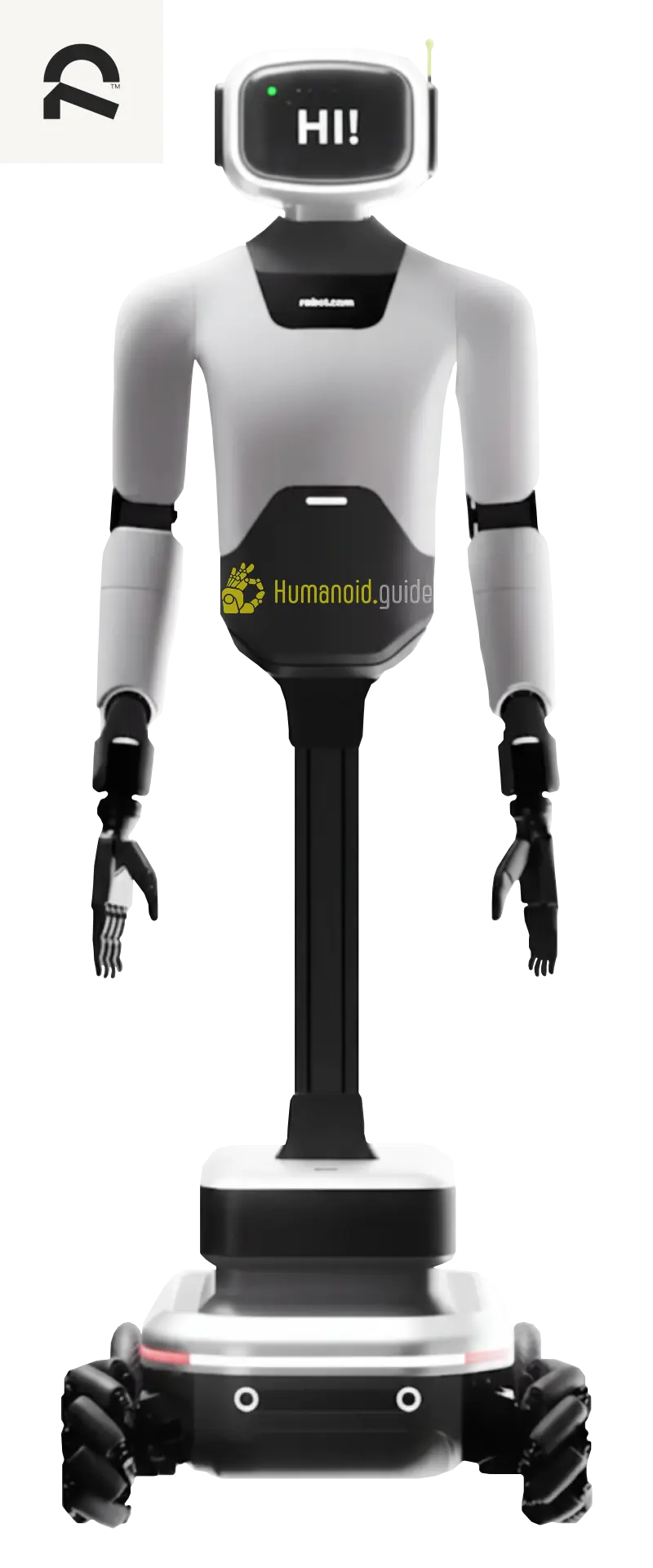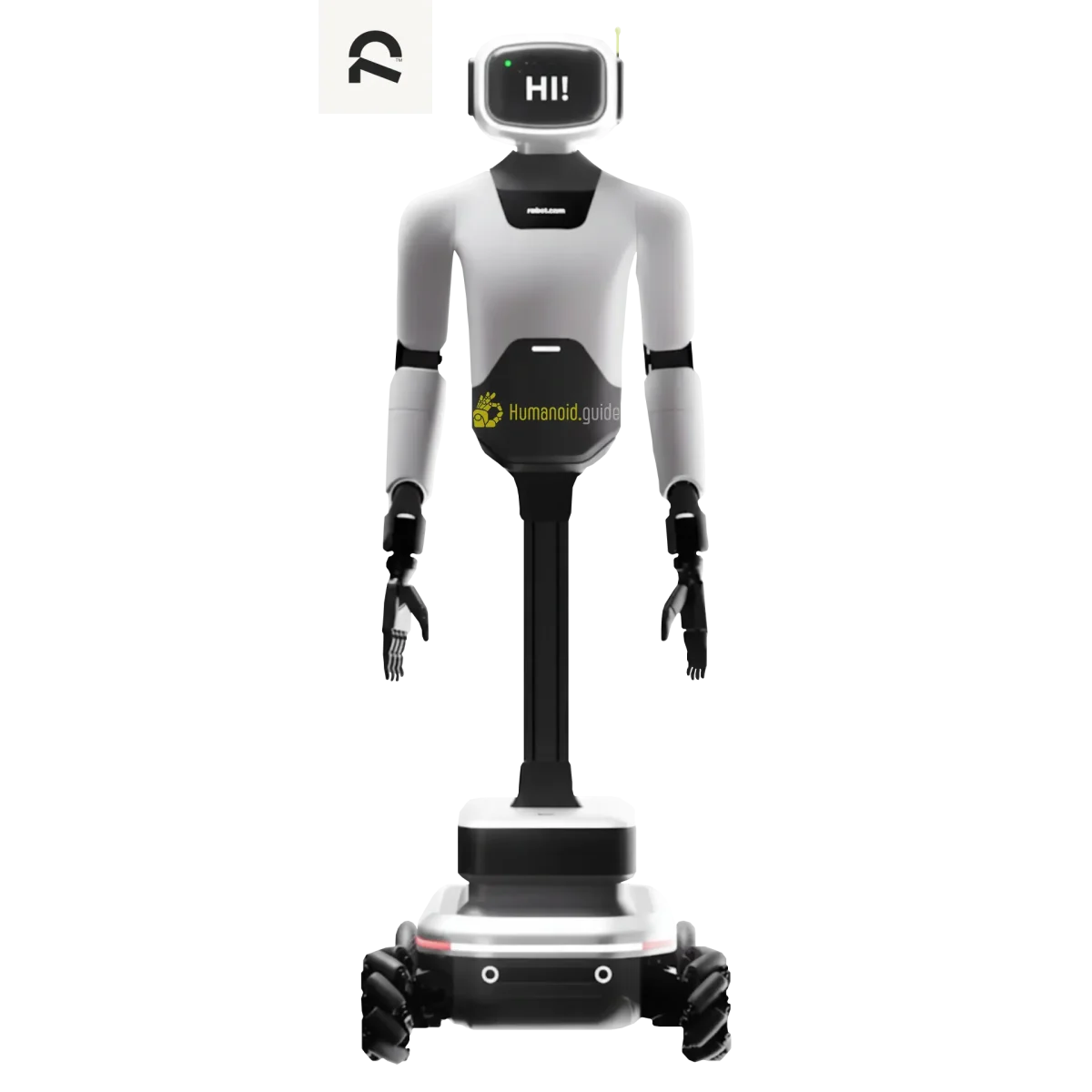
What is the R Noid?
The R-noid is a compact humanoid service robot developed by robot.com, a US-based robotics company. Standing 160 cm tall and weighing 50 kg, it is designed for social interaction in hospitality, reception, education, and light logistics environments. With 32 degrees of freedom (22 body + 10 hands) and a 9 kg payload capacity, the R-noid can perform light manipulation tasks and navigate at up to 6 km/h. It integrates a cloud-based large language model for natural dialogue, runs on a Linux-based OS with AI acceleration, and supports Wi-Fi, Bluetooth, and 5G connectivity. First built in 2024, the R-noid is currently available for pre-order, targeting early-stage commercial pilots.
Specifications
Here are the full technical specifications.
| Spec | Value |
|---|---|
| Height | 160 cm |
| Weight | 50 kg |
| Degrees of freedom | 32 DOF (22 body + 10 hands) |
| Battery life | 6 hours |
| Max speed | 6 km/h |
| Payload | 9 kg |
| Price (new) | $19,000 (pre-order) |
| Price (used range) | N/A (no used units yet) |
Price & Value
New MSRP: $19,000 (pre-order)
Used range: N/A — pre-commercial, no used market yet
At $19,000, the R-noid sits in an unusual price bracket for humanoids—far below the $150k+ research platforms but above educational toys. This makes it potentially attractive for pilot deployments in hospitality and reception where conversational AI is the main draw. However, buyers should note that the robot is still pre-commercial, with no track record of reliability or support. A direct comparison is difficult, but the closest alternative social humanoid, the Ubtech Walker S, is priced around $150,000 (est.), making the R-noid a low-cost entry for conversational tasks. Given the early stage, depreciation could be steep once commercially mature units arrive. Total cost of ownership will depend on maintenance contracts and software subscriptions.
Who Is It For?
Best for: - Hospitality venues testing AI-powered reception (LLM dialogue reduces staff load) - Educational labs studying human-robot interaction (32 DOF and cloud AI) - Light logistics and office assistance with 9 kg payload - Pilot programs needing low-cost service humanoid for customer-facing tasks
Not for: - Heavy industrial tasks (max payload 9 kg, no rugged design) - High-precision manipulation (harmonic drives not designed for sub-mm accuracy) - Continuous heavy use in harsh environments (IP32 rating, plastic shells) - Buyers seeking immediate availability (pre-order, no commercial support network)
Alternatives & Comparison
The R-noid competes in a niche of affordable social humanoids, but the market is sparse. We compare it to a bipedal research platform, a wheeled social robot, and a high-end industrial humanoid to highlight trade-offs.
| Model | Price | Available | Key Difference |
|---|---|---|---|
| Unitree G1 | $16,000–$28,000 | yes | Lighter, more modular, less social AI emphasis |
| SoftBank Pepper | $20,000 | discontinued but used units available | Wheeled, no manipulation, mature ecosystem |
| Ubtech Walker S | ~$150,000 (est.) | preorder | Heavy-duty, manufacturing-focused, not conversational |
Verdict: For a hospitality pilot seeking a humanoid receptionist with conversational AI, the R-noid’s price and LLM integration make it a unique value play, though it remains unproven. The Unitree G1 offers a more established bipedal platform at a similar price, but lacks the built-in dialogue capabilities. If mobility is less critical, a refurbished Pepper provides a safer, proven social robot for under $20k. Choose the R-noid only if you’re willing to be an early adopter and need a bipedal form factor.
Use Cases & Capabilities
Hospitality reception
The R-noid can greet guests at hotel lobbies or corporate receptions, answer questions using cloud-based LLM, and guide visitors to their destinations. Its 5-fingered hands allow it to hand out brochures or small items, while the 6-hour battery covers a standard shift. The 160 cm height gives it a natural presence without being intimidating. However, the IP32 rating limits its use to dry indoor environments, and the reliance on cloud AI requires a stable internet connection.
Light logistics
In office or laboratory settings, the R-noid can transport light items up to 9 kg, such as documents, small parcels, or components. Walking at 6 km/h, it moves at a brisk human pace and can navigate standard corridors and doorways. The bipedal design eliminates the need for ramps or floor modifications. Limitations include a lack of ruggedness for rough floors and no outdoor use, and the payload capacity may be insufficient for heavier deliveries.
Education
Universities and research labs can use the R-noid for human-robot interaction studies thanks to its 32 DOF and programmable Android-like Linux OS. The integrated LLM enables experiments in conversation and social behavior, while the 5G connectivity allows real-time data streaming. At $19,000, it is far more accessible than $100k+ research platforms like the iCub or TALOS. However, as a pre-commercial unit, long-term support and spare parts availability are unknown, which may deter multi-year research commitments.
Workplace assistance
Deployed in corporate lobbies or tech company offices, the R-noid can assist with visitor check-ins, badge scanning, and meeting room guidance. The 5G and Wi-Fi connectivity allow integration with building management systems for real-time information. Its humanoid form factor creates a memorable brand impression. On the downside, the lack of a built-in screen (interaction via voice only) may frustrate users who prefer visual interfaces, and the robot’s performance in noisy environments with multiple people is untested.
History & Background
Robot.com, founded in the United States, developed the R-noid as a compact social humanoid first revealed in 2024. Early prototypes underwent pilot testing in South Korean retail environments in 2023 under a Korean partner, as noted by MERA Robotics. The robot was publicly listed on humanoid.guide in 2024 with detailed specifications. As of 2026, the R-noid remains in pre-commercial stage, with units available for pre-order directly from robot.com. There is no indication of multiple generations or variants. The company’s focus has been on integrating cloud-based LLM for natural interaction, positioning the R-noid as a reception and hospitality assistant.
Buying Used — What to Check
Verify pre-order terms As a pre-commercial unit, delivery timelines, warranty, and return policies are critical and may be limited.
Confirm LLM functionality The robot’s main draw is cloud-based dialogue; ensure ongoing server access and language support are included in the price.
Assess hardware reliability With no long-term field data, inspect demo units for wear on harmonic drives and sensor accuracy before committing.