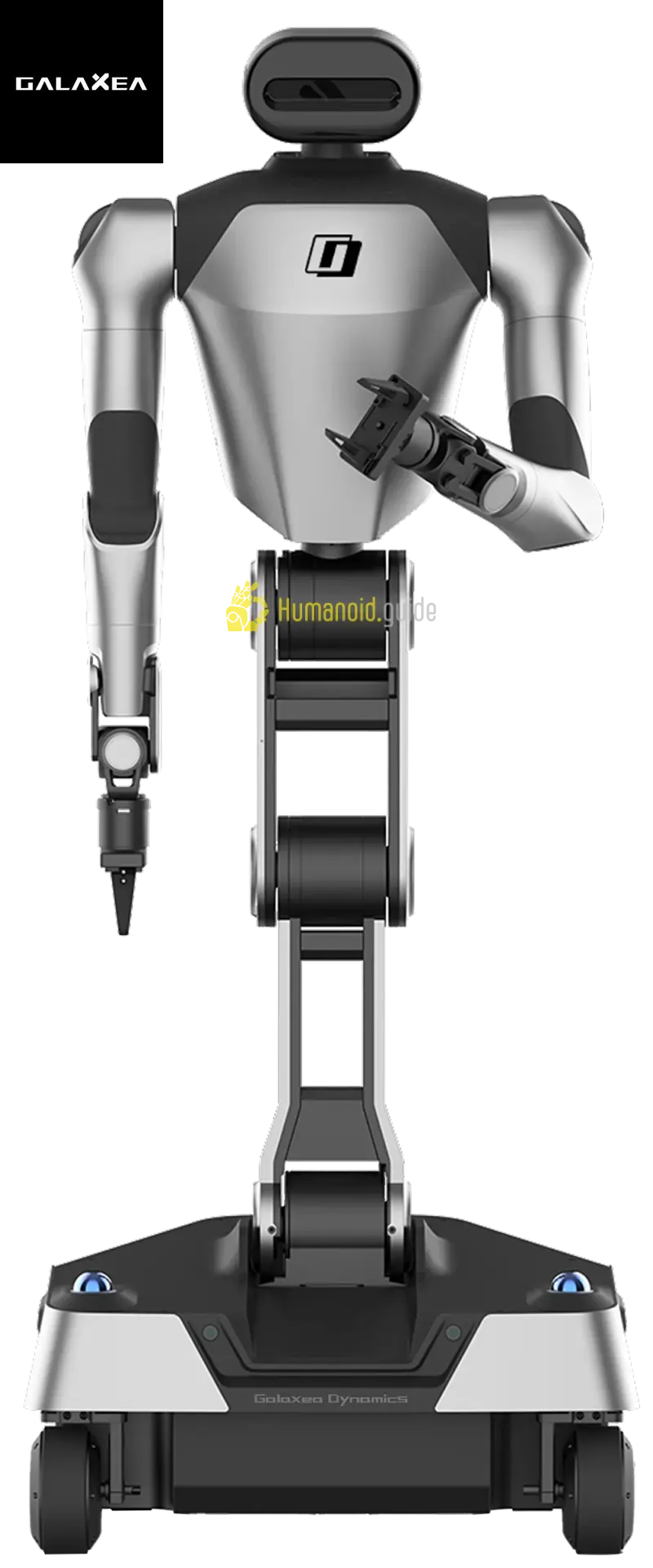
What is the R1 Pro Galaxea?
The Galaxea R1 Pro is an enhanced, wheeled humanoid robot from China’s Galaxea Dynamics. It rides on a three-wheel omnidirectional vector chassis, enabling high-speed, stable movement on factory floors and warehouse aisles. Its 40 degrees of freedom (DOF) span the entire body; each arm can handle a rated 3.5 kg (max 5 kg) at a 500 mm reach. Equipped with a faster CPU, improved LiDAR, and factory-grade sealing, the R1 Pro targets research, manufacturing, logistics, and commercial service. Standing 175 cm tall and weighing 60 kg, it occupies a middle ground between nimble mobile manipulators and full-size bipedal humanoids.
Specifications
Here are the full technical specifications.
| Spec | Value |
|---|---|
| Height | 175 cm |
| Weight | 60 kg |
| Degrees of freedom | 40 |
| Battery life | Not specified |
| Max speed | Not specified |
| Payload | 3.5 kg |
| Price (new) | $69,999 |
| Price (used range) | N/A |
Price & Value
New MSRP: $69,999
Used range: N/A (pre-order)
The R1 Pro carries an MSRP of $69,999, positioning it between the budget R1 Lite (starting at ~$27,400) and higher‑end bipedal humanoids. For researchers and integrators, the Pro’s high DOF and factory‑sealed design offer compelling value, especially compared to general‑purpose humanoids that often cost $100,000+. Because the 40‑DOF arm system enables precise manipulation tasks, the robot may replace multiple fixed automation modules, potentially lowering total cost of ownership. The wheeled base is a trade‑off – it limits terrain versatility but provides stable, high‑speed movement ideal for factory floors. As production scales, we anticipate modest depreciation; early adopters may see used units resell for around $40,000–$50,000 in 2027, though battery and sensor health will heavily influence pricing.
Who Is It For?
Best for: - Research institutions developing dexterous manipulation algorithms (40 DOF enables complex grasp and task studies) - Manufacturers automating line‑feeding, kitting, or bin‑picking (factory‑sealed design handles dusty/moist shop floors) - Logistics centers needing a stable, wheeled mobile manipulator (omnidirectional base moves quickly across smooth surfaces)
Not for: - Outdoor or rough‑terrain tasks (wheeled base, no all‑terrain capability) - Heavy‑payload operations exceeding 5 kg per arm - Applications requiring explosion‑proof certifications
Alternatives & Comparison
The R1 Pro competes in the wheeled mobile manipulator space alongside similar humanoid‑like platforms.
| Model | Price | Available | Key Difference |
|---|---|---|---|
| Unitree H1 | ~$90,000 (est.) | yes | Bipedal locomotion for unstructured terrain vs. R1 Pro’s wheeled stability |
| Fourier GR-1 | ~$150,000 (est.) | yes | Fully bipedal with advanced hand dexterity; R1 Pro offers sealed, wheeled design for factory floors |
Verdict: For factory floors where speed and payload consistency matter, the R1 Pro’s wheeled base and sealed design give it a clear edge over bipedal competitors like the H1 and GR‑1. Researchers focused on manipulation may prefer the R1 Pro’s 40‑DOF arms, but those needing legged mobility in unstructured environments should look at bipedal options.
Use Cases & Capabilities
Research & Embodied AI Development
With 40 DOF, high‑resolution cameras, LiDAR, and a powerful onboard CPU, the R1 Pro serves as a versatile platform for embodied AI and manipulation research. Labs can program complex grasping, tool use, and human‑robot interaction tasks. The wheeled base simplifies navigation experiments without the mechanical complexity of legs. Its factory‑sealed design allows long‑term operation in lab environments with minimal maintenance.
Industrial Manufacturing (Assembly, Kitting, Bin‑picking)
The R1 Pro’s dexterity and sealed body make it suitable for manufacturing cells where dust, oil, or coolant are present. Each arm lifts 3.5 kg (5 kg peak), enough for small parts handling, screwdriving, or material transfer. Vision‑guided bin‑picking benefits from the onboard LiDAR and processing power. The omnidirectional base moves precisely around conveyors and workstations, reducing the need for fixed automation.
Logistics & Warehousing
In warehouses, the R1 Pro can autonomously pick items from shelves, place them in totes, and transport them between stations. The wheeled chassis provides stable movement on smooth floors, while the arms’ reach and gripper options accommodate varied packaging. Its compact footprint (175 cm tall) navigates standard aisle widths. The robot can be integrated with warehouse management systems for end‑to‑end sortation and line‑feeding tasks.
Commercial Service Robotics
Hotels, retail stores, and hospitals can deploy the R1 Pro for guided customer service, inventory management, or light delivery. The humanoid‑like form factor and expressive head (if implemented) help in public‑facing roles. The 3.5 kg payload per arm allows handling of typical service items like drinks, documents, or small packages. Reliable wheeled navigation and obstacle avoidance via LiDAR ensure safe operation in crowded spaces.
History & Background
Galaxea Dynamics, a Chinese robotics startup, emerged from stealth in early 2024 with the reveal of the R1 wheeled humanoid platform. The company targets industrial and research applications with a design philosophy emphasizing dexterity and affordability. The R1 Pro, introduced later in 2024 as an enhanced model, adds faster processing, better LiDAR, and factory‑grade sealing for harsher environments. The full R1 series includes the budget R1 Lite (starting at ~$27,400) and the R1 Pro at $69,999. As of early 2026, the R1 Pro is in pre‑production with pre‑orders open; first deliveries are expected in mid‑2026. Galaxea has not announced any acquisitions or major ownership changes.
Buying Used — What to Check
Verify payload & battery Payload rating and runtime are critical; request manufacturer‑certified specs before purchase.
Request demo or FAT report Since no production units are deployed, ask for a factory acceptance test video to confirm mechanical and sensor health.
Confirm spare‑parts support Early‑generation robots often have limited aftermarket parts; ensure Galaxea offers service contracts.