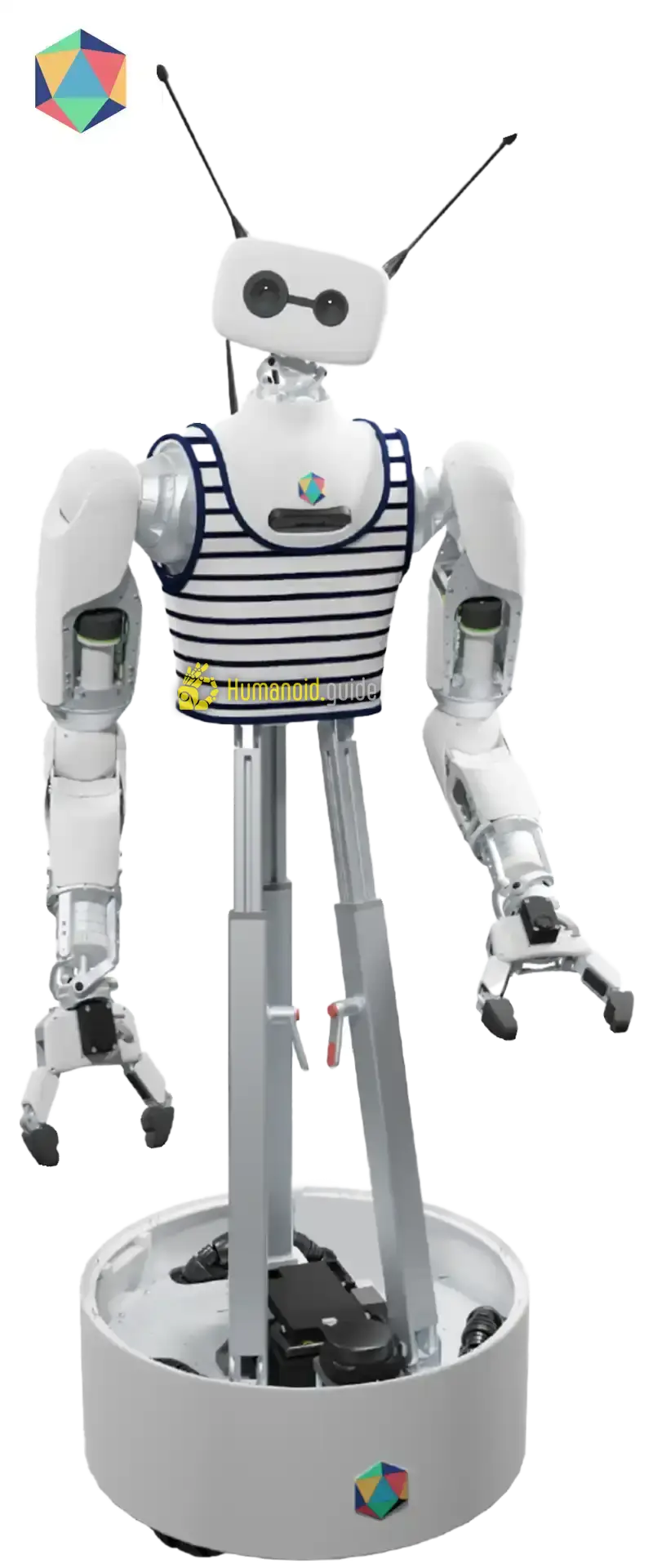
What is the Reachy 2?
The Pollen Robotics Reachy 2 is a modular humanoid robot designed for research, education, and customer-facing applications. Built in Paris, France, it inherits the open-source philosophy of the original Reachy, featuring fully articulated arms, a dexterous two-finger gripper, and an expressive head with an RGB camera and speaker. The robot sits on a wheeled mobile base and runs Linux with ROS, enabling teleoperation, human-robot interaction studies, and AI development. Key differentiators include Dynamixel servo actuation, 17 total degrees of freedom, and an 8-hour runtime. Pre-orders are now accepted, targeting academic labs and hospitality sectors who need a open, customizable platform.
Specifications
Here are the full technical specifications.
| Spec | Value |
|---|---|
| Height | 140 cm |
| Weight | 40 kg |
| Degrees of freedom | 17 |
| Battery life | 8 hours |
| Max speed | 3 km/h |
| Payload | 3 kg |
| Price (new) | ~$70,000 (distributor pre-order) |
| Price (used range) | N/A |
Price & Value
New MSRP: From $70,000 (distributor pre-order; no official MSRP)
Used range: N/A (not yet released)
Reachy 2 sits at a mid-range price point for research humanoids, positioned above single-arm systems like Franka Panda ($11k) but below enterprise platforms like UBTECH Walker. The $70,000 pre-order price from a reseller makes it accessible for well-funded labs. Given its open-source nature and modular design, total cost of ownership may be lower due to community support and upgradeability. Depreciation is uncertain as the platform is new, but strong demand in research and service robotics could sustain value. For institutions seeking a turnkey, ROS-ready humanoid, this price—though significant—is competitive. Financing options are not yet available, so budgetary planning should account for sensor and accessory add-ons.
Who Is It For?
Best for: - University AI and robotics labs needing an open-source humanoid for teleoperation and human-robot interaction research.
Not for: - Heavy industrial tasks (no safety certifications or high payload), or buyers seeking a ready-to-deploy commercial kiosk without customization.
Alternatives & Comparison
Although Reachy 2 is a full humanoid with a mobile base, many research teams evaluate arm-only platforms for similar applications. The following competitors are prominent in the research arm market.
| Model | Price | Available | Key Difference |
|---|---|---|---|
| Franka Panda | $11,000 | yes | 7-DOF collaborative arm with torque sensing and large research community |
| Kinova Gen3 | $30,000 | yes | 6/7-DOF lightweight arm, integrated 2D/3D vision |
| UFACTORY xArm 7 | $8,000 | yes | 7-DOF desktop robotic arm, high payload-to-weight ratio |
| Rethink Robotics Sawyer | Discontinued | no | 7-DOF collaborative robot with series elastic actuators, now discontinued |
Verdict: For labs that absolutely require a humanoid form factor and open-source stack, Reachy 2 is unmatched at its price. However, if arm manipulation is the sole focus, the Franka Panda or xArm 7 offer comparable dexterity at a fraction of the cost. Buyers should weigh the need for an expressive head and mobile base against pure manipulation capabilities.
Use Cases & Capabilities
Research and Education
Reachy 2 is purpose-built for academic settings, offering a fully open-source hardware and software stack that enables students and researchers to explore human-robot interaction, manipulation, and teleoperation. The modular design allows labs to swap sensors and actuators, while the ROS compatibility simplifies integration with existing robotics workflows. Its expressive head and anthropomorphic arms make it ideal for studying social robotics and cognitive models. However, the 3 kg payload limits heavy lifting experiments.
Teleoperation and Remote Presence
With dual 7-DOF arms and a 3-DOF head, Reachy 2 excels in telepresence applications, allowing a remote operator to see, hear, and interact through the robot. The embedded RGB camera, microphone array, and speaker enable natural communication, while the 8-hour battery supports full-day deployments. Hospitals, remote factories, or even retail kiosks can leverage this setup to provide human-like interaction without physical presence. The mobile base adds navigation, though its 3 km/h speed is best for indoor environments.
Customer Service and Hospitality
Pollen Robotics targets hospitality and retail sectors with Reachy 2’s friendly design and interactive capabilities. It can greet visitors, answer questions, and even perform simple object handovers using its 2-finger adaptive gripper. The open-source platform allows businesses to customize behaviors and integrate with their own backend systems. While not yet certified for public spaces without supervision, its safe, compliant servos make it suitable for closely monitored environments. Early adopters may need to invest in custom application development.
AI and Machine Learning Development
The robot serves as a powerful testbed for reinforcement learning, imitation learning, and large language model integration. Its full ROS framework and embedded computer (Raspberry Pi / UP board) allow researchers to deploy custom AI agents directly on the robot. The combination of vision, speech, and manipulation capabilities enables multimodal experiments in embodied intelligence. However, the onboard compute may require offloading heavy models to external servers, adding latency.
History & Background
Pollen Robotics was founded in 2016 in Paris, France, with a mission to democratize humanoid robotics. The first-generation Reachy, launched as an open-source platform around 2019, gained traction in academic circles for its modular design and affordable entry point. In early 2024, the company unveiled Reachy 2 at major tech events, showcasing improved actuators, enhanced runtime, and a refined mobile base. The robot has not yet entered mass production, remaining in pre-order status as of 2026. Pollen Robotics continues to iterate based on community feedback, aiming to bridge the gap between research and real-world deployment.
Buying Used — What to Check
Verify payload specs Payload is critical for your application; ensure the arm can handle intended loads.
Test battery runtime Runtime can degrade with use; demand proof of 8-hour life under typical load.
Inspect actuator condition Dynamixel servos are durable but may need replacement if heavily used; check for play or noise.