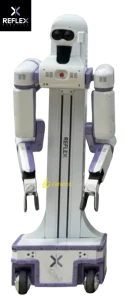
What is the Reflex?
Reflex is a wheeled humanoid mobile manipulator designed for warehouse and logistics applications. Built by Reflex Robotics, a US-based startup, the robot uses a wheeled base and a telescoping central spine to adjust its reach from floor to high shelves without a fixed standing height. It is primarily teleoperated, allowing remote human operators to perform picking, placing, and other material handling tasks with low latency. The design emphasizes a compact footprint (under 2 ft × 2 ft / 0.6 m × 0.6 m) for navigating narrow aisles. Reflex combines a rugged industrial form with dexterous manipulation capabilities, targeting an estimated price point of $50,000 to compete with traditional automation solutions.
Specifications
Here are the full technical specifications.
| Spec | Value |
|---|---|
| Height | Adjustable (telescoping spine) |
| Weight | Not specified |
| Degrees of freedom | Not specified |
| Battery life | 16 hours |
| Max speed | Not officially published |
| Payload | Not specified |
| Price (new) | ~$50,000 (est.) |
| Price (used range) | N/A (no used market yet) |
Price & Value
New MSRP: ~$50,000 (est.)
Used range: N/A
The Reflex is priced at an estimated $50,000, positioning it as an affordable entry point for a wheeled humanoid manipulator, comparable to simplified mobile cobots but with added height adjustability. This price is speculative and may change once full production begins. As a pre-order product, there is currently no used market, so depreciation cannot be assessed. When compared to alternatives like the $150k Agility Digit or the ~$45k 1X EVE, Reflex’s value proposition lies in its teleoperated simplicity and unique telescoping spine that eliminates the need for a complex bipedal system or fixed-height arm. Buyers should consider the ongoing operating costs of remote operators and potential maintenance on the dynamic spine mechanism. For warehouse operators experimenting with automation, the Reflex’s lower upfront cost and rapid deployment potential could offset the lack of full autonomy.
Who Is It For?
Best for: - Warehouse operators seeking affordable, teleoperated picking for low-to-medium complexity tasks (the adjustable spine eliminates the need for multiple fixed-arm robots). - Research institutions developing humanoid teleoperation interfaces.
Not for: - Facilities requiring full autonomous operation without human oversight (Reflex is primarily teleoperated). - Outdoor or multi-floor environments (wheeled base cannot climb stairs without assistance).
Alternatives & Comparison
For warehouse operators evaluating wheeled humanoid mobile manipulators, the Reflex competes against both bipedal logistics robots and other wheeled telepresence platforms.
| Model | Price | Available | Key Difference |
|---|---|---|---|
| Agility Robotics Digit | ~$150,000 (est.) | yes | Digit has bipedal legs for navigating stairs, Reflex uses a wheeled base with telescoping spine for adjustable height. |
| 1X EVE | ~$50,000 (est.) | preorder | EVE has a humanoid upper body with dexterous hands and full autonomous capabilities, Reflex primarily relies on teleoperation. |
Verdict: If your primary need is teleoperated warehouse picking with adjustable height at a budget-conscious price, Reflex offers a compelling niche but remains unproven. Digit’s bipedal mobility opens multi-level environments, while EVE provides a more humanoid, potentially autonomous future. Reflex wins on simplicity and low estimated cost, but lacks the dexterous manipulation and autonomy of its competitors.
Use Cases & Capabilities
E-Commerce Order Fulfillment
Reflex can be teleoperated to pick and place items from bins onto conveyor belts or packing stations. Its adjustable spine allows the operator to reach different shelf heights without repositioning the base. The wheeled design enables quick movement along aisles common in e-commerce warehouses. This reduces the need for fixed robot arms and can be deployed alongside human workers for item sorting.
Mixed Palletizing
Operators remotely control Reflex to build heterogeneous pallets from mixed SKU boxes. The telescoping spine adapts to layers as the pallet height changes, maintaining an optimal working position. Its compact base maneuvers between pallet stations without requiring fixed infrastructure. The 16-hour battery supports full-shift operation in dynamic warehouse environments.
High-Shelf Picking in Distribution Centers
Reflex’s ability to dynamically adjust its vertical reach from floor to high shelves makes it suitable for retrieving items in tall racking systems. Instead of using a fixed-height robot arm or requiring a lift, the spine extends to access top shelves directly. Teleoperation allows fine control for fragile or awkwardly placed goods. This use case can improve safety by removing the need for workers on ladders or order pickers.
History & Background
Reflex Robotics quietly entered the humanoid arena in 2024, unveiling the Reflex prototype designed for warehouse material handling. The company, believed to be founded by engineers with experience in robotics and logistics, set out to solve the reach and flexibility issues in order fulfillment centers. The Reflex’s standout feature is a telescoping spine that allows the robot to dynamically adjust its vertical reach from floor level to high shelves, eliminating the need for a fixed-height arm. The first prototype was demonstrated with a wheeled base under 2 ft by 2 ft, capable of navigating tight warehouse aisles. While full specifications remain undisclosed, early footage showed teleoperated picking and placing. The robot was made available for pre-order in the US market, with manufacturing expected to ramp up based on demand. Reflex Robotics continues to refine the platform, with no generational variants announced as of 2026.
Buying Used — What to Check
Verify payload rating Payload and arm strength are not yet published; used units should be confirmed for your specific task demands.
Inspect telescoping spine The dynamic spine mechanism is unique – check for wear, smooth operation, and seal integrity before purchase.
Confirm teleoperation software Ensure the teleoperation license and warehouse management integration software are transferable to your network.