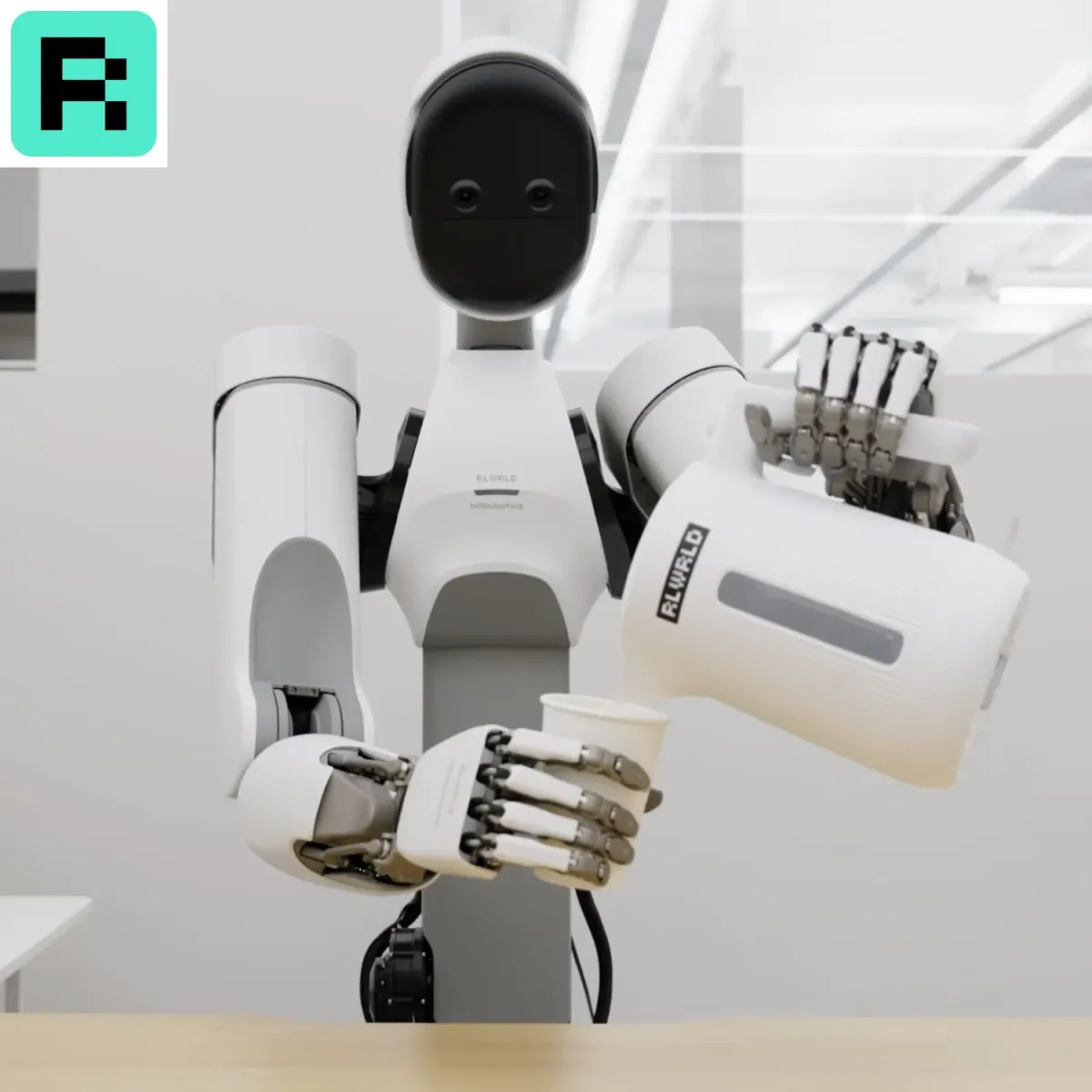
What is the Rldx 1?
RLWRLD RLDX-1 is an open-source, dexterity-first foundation model for robotic hands, released in May 2026 by South Korea-based physical AI company RLWRLD. Unlike a physical humanoid robot, RLDX-1 is a software model that enables contact-rich manipulation—grasping, pouring, tool use—across diverse embodiments including bimanual arms, single-arm manipulators, and humanoid platforms. Trained via reinforcement learning, the model provides 36 degrees of freedom control and is designed to run on existing robot hardware, making advanced dexterity accessible without the need to build a custom AI stack. Its public weight and checkpoint release targets academia, startups, and industrial R&D teams seeking a ready-made manipulation brain.
Specifications
Here are the full technical specifications.
| Spec | Value |
|---|---|
| Height | N/A (software model) |
| Weight | N/A (software model) |
| Degrees of freedom | 36 |
| Battery life | N/A (not a battery-powered robot) |
| Max speed | N/A (hardware dependent) |
| Payload | N/A (model has no intrinsic payload) |
| Price (new) | Undisclosed |
| Price (used range) | N/A (no used market) |
Price & Value
New MSRP: Undisclosed
Used range: N/A
RLDX-1 is released as a free, open-source foundation model—its weights and checkpoints carry no license fee for research and non-commercial use. For industrial deployment, RLWRLD has not disclosed commercial licensing terms; users must contact the company for deployment agreements. Compared to building an equivalent dexterity model in-house, RLDX-1 offers immense cost and time savings, potentially shaving years off R&D cycles. The total cost of ownership depends solely on the robot hardware a team chooses to pair with the model, which can range from a $10,000 research arm to a $200,000+ humanoid. Given its open nature, there is no depreciation in the traditional sense, though one must monitor version updates to ensure continued compatibility. For cash-strapped labs, the model’s zero-cost entry point is a game changer in the dexterous manipulation domain.
Who Is It For?
Best for: - Robotics researchers and labs needing an open-source foundation for dexterous manipulation policy development - Startups integrating advanced grasping and tool use into humanoid or dual-arm robots without a dedicated RL team - Industrial R&D departments exploring next-gen assembly and logistics where contact-rich tasks are critical
Not for: - Firms seeking an off-the-shelf physical robot—RLDX-1 is a software model only, requiring external hardware - Applications demanding high-speed mobility or navigation—the model focuses exclusively on manipulation and has no locomotion support - Organizations requiring guaranteed commercial support and SLAs (licensing and support structures are still nascent)
Alternatives & Comparison
RLDX-1 competes with a handful of robot foundation models, although it is uniquely positioned as the first publicly available, dexterity-specific model. Alternatives are primarily generalist vision-language-action models or closed research efforts.
| Model | Price | Available | Key Difference |
|---|---|---|---|
| Google RT-2 | Undisclosed (cloud API) | yes | General VLA model; not open-source |
| Physical Intelligence π0 | Not publicly available | no | Research only, limited access |
| NVIDIA GR00T | Free with NVIDIA ecosystem | yes | Broad platform, less dexterity-specific |
Verdict: RLDX-1 is the clear winner for teams that need an open, plug-and-play dexterity brain and are comfortable with minimal commercial support. Its 36-DOF reinforcement-learned policies come ready to deploy, drastically lowering the barrier to sophisticated manipulation. Google RT-2 and NVIDIA GR00T offer broader integration ecosystems but sacrifice that dexterity-first edge; they’re better suited for projects where manipulation is only part of a larger autonomous stack. Physical Intelligence’s π0 remains inaccessible to most. For pure dexterous manipulation, RLDX-1 is unmatched today.
Use Cases & Capabilities
Dexterous Grasping for Logistics
In warehouse and logistics environments, RLDX-1 can be loaded onto a bimanual robot or humanoid torso to handle a wide variety of items, from small polybags to oddly shaped consumer goods. The model’s reinforcement-learned policies excel at adapting grip on the fly, even when objects are partially occluded or irregular, reducing the need for custom end-effector tooling. Because RLDX-1 supports seamless grasp transitions and regrasping strategies, it can pick from totes or conveyors without pre-programmed poses. This versatility lowers integration costs for e-commerce fulfillment centres, where SKU variety changes frequently. However, the model does not provide motion planning for arm base movement, so it must be paired with a navigation stack for mobile robots.
Precision Assembly in Manufacturing
RLDX-1 brings contact-rich insertion and alignment capabilities to manufacturing lines, where traditional robots rely on rigid fixtures and force-torque sensors. The model can control a dual-arm robot or a humanoid to perform tasks like gear meshing, peg-in-hole, or snap-fit assembly, using tactile feedback from sensorized grippers. By learning from simulation and fine-tuning on real hardware, RLDX-1 adapts to part tolerances and can recover from jams without explicit error handling code. This drastically reduces programming time per new product variant, making it attractive for high-mix, low-volume production. Engineers must still integrate the model with the robot’s low-level controllers; RLWRLD provides APIs and example stacks to bridge that gap.
Contact-Rich Tool Use in Maintenance
For industrial robot maintenance, RLDX-1 equips a humanoid or mobile manipulator to operate tools like screwdrivers, wrenches, or grease guns with minimal supervision. The model’s dexterous control policies handle the complex interplay of forces required for tasks such as unscrewing a bolt at an awkward angle or pouring lubricant into a narrow port. Because policies generalize across similar tool geometries, a single RLDX-1 instance can switch between multiple maintenance operations without retraining. This makes it a strong candidate for hazardous environments where teleoperation is impractical. Deployment on outdoor or dirty equipment may require additional vision pre-processing, as RLDX-1 currently assumes a clean, structured scene from its training domain.
Research and Development of Dexterous Policies
Academic and corporate labs can use RLDX-1 as a starting point for studying transfer learning, sim-to-real adaptation, or multi-task dexterity. Its open-source weights allow researchers to probe the limits of 36-DOF control, benchmark new algorithms against a known high-performance baseline, and fine-tune on novel tasks like knot-tying or fine assembly. The model’s modular architecture separates perception from action, so it can be paired with off-the-shelf object detectors or new vision encoders. RLDX-1 thus acts as a community platform, accelerating the entire field of dexterous manipulation. However, the model’s heavy reliance on RL may pose a steep learning curve for groups without reinforcement learning expertise.
History & Background
RLWRLD is a relatively young physical AI startup founded in South Korea (exact year unconfirmed). The company focused on reinforcement learning for contact-rich manipulation, a notoriously difficult subfield of robotics. Their work culminated in the RLDX-1 model, publicly released on May 7, 2026, first reported by The Robot Report. RLDX-1 represents the first foundation model specifically designed for dexterity—able to handle tasks like grasping, pouring, and tool use—trained across multiple robot embodiments. The initial release included pre-trained weights and checkpoints for 36-DOF control on a variety of dexterous tasks, made open to the community. No prior generations exist; RLDX-1 is the debut model from the firm. As of 2026, RLWRLD continues to refine the model, with commercial deployment terms yet to be fully disclosed.
Buying Used — What to Check
Verify model version Only the latest checkpoint (v1.0 as of May 2026) is recommended; older versions may lack critical fixes or features.
Check commercial licensing While free for non‑commercial use, deploying RLDX‑1 in a revenue-generating product may require a license from RLWRLD—confirm terms before scaling.
Hardware compatibility list The model requires a compatible robot with sufficient DOF and a supported API; verify your robot is on RLWRLD’s validated hardware list to avoid integration issues.