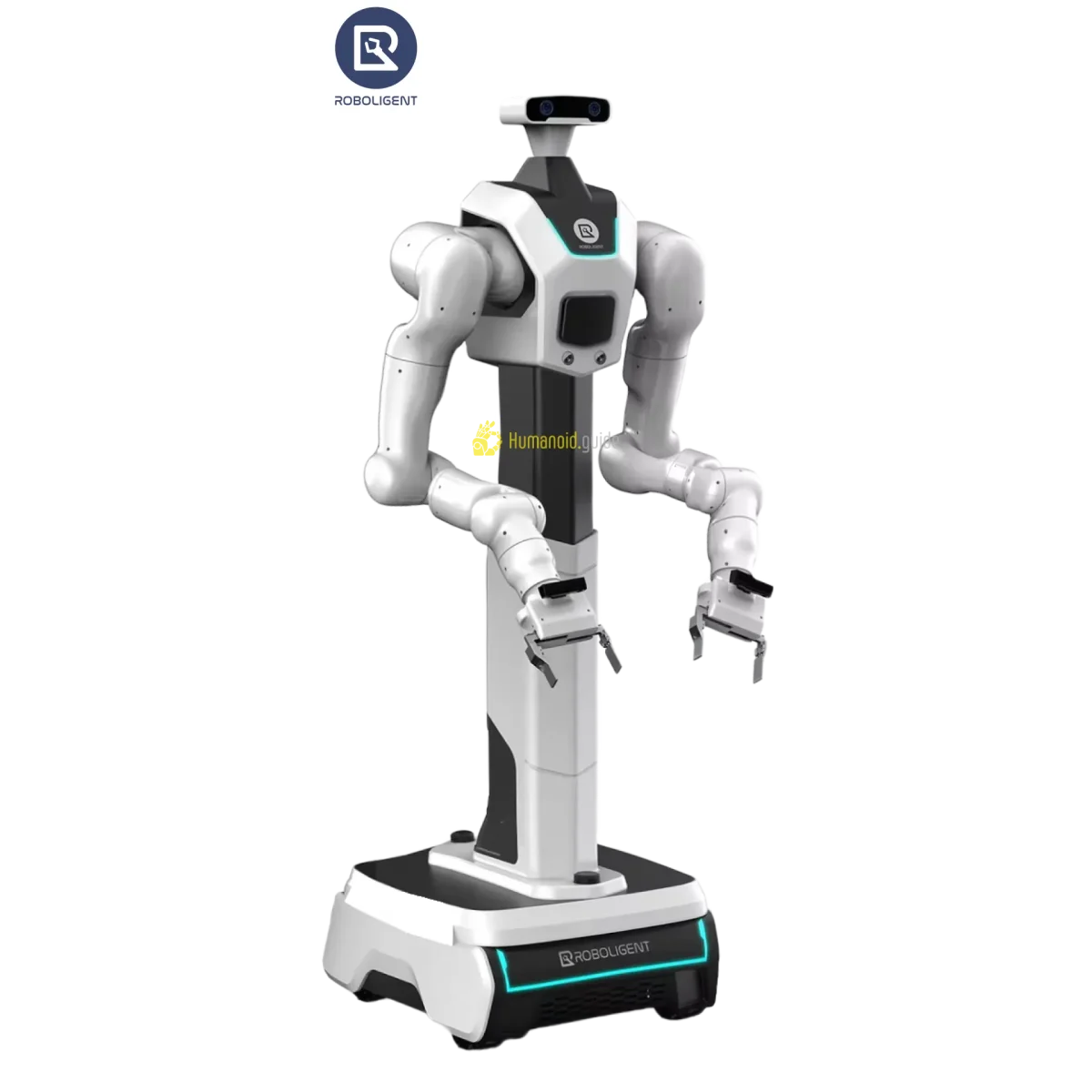
What is the Robin Roboligent?
The Roboligent Robin is a 6-axis collaborative robot arm designed for light industrial automation. Manufactured by Roboligent Inc., founded in 2019 in Hefei, Anhui, China, the Robin targets small to medium enterprises with its 6 kg payload capacity and 900 mm reach. It features a repeatability of ±0.03 mm, IP54 ingress protection, and supports floor, ceiling, or wall mounting. The robot is equipped with a proprietary teaching pendant and a software development kit (SDK) for easy integration. A key differentiator is its compliance and force-sensing actuators, enabling safe physical human-robot interaction without external safety fencing.
Specifications
Here are the full technical specifications.
| Spec | Value |
|---|---|
| Height | 1500 mm |
| Weight | 22 kg |
| Degrees of freedom | 6 |
| Battery life | N/A (mains powered) |
| Max speed | 4.5 km/h |
| Payload | 6 kg |
| Price (new) | Undisclosed (contact manufacturer) |
| Price (used range) | N/A (too new for secondary market) |
Price & Value
New MSRP: Undisclosed (contact manufacturer)
Used range: N/A (no used units observed)
Roboligent does not publicly list a price for the Robin, requiring direct inquiry for quotes. Based on comparable Chinese-made collaborative arms like the Dobot CR5 (~$12,700) and the Elite Robots EC66 (~$13,000), the Robin is likely positioned in the $10,000–$15,000 range. Its 6 kg payload, 900 mm reach, and 0.03 mm repeatability place it on par with these competitors, so aggressive pricing would give it an edge. Depreciation on collaborative robots is generally moderate, with well-maintained units retaining 60–70% of their value after three years. Total cost of ownership is low thanks to standard AC power and simple maintenance, with only periodic checks of cables and encoders. Overall, the Robin represents a solid value proposition for cost-conscious buyers comfortable with sourcing direct from a Chinese manufacturer.
Who Is It For?
Best for: - Small manufacturers adopting their first cobot for assembly tasks (6 kg payload, easy programming via pendant) - Machine shops needing flexible tending for CNC mills or lathes (wall/ceiling mounting, IP54 dust resistance) - Quality inspection stations requiring high repeatability (0.03 mm) and Ethernet connectivity for vision integration - Educational labs and R&D teams exploring collaborative robotics with an open SDK
Not for: - Heavy palletizing or lifting (payload limited to 6 kg) - High-speed pick and place (maximum speed 1.25 m/s trails faster competitors) - Harsh wet or corrosive environments (IP54 is not fully sealed) - Buyers needing immediate US/Europe support infrastructure (Roboligent’s service network is still developing)
Alternatives & Comparison
The Roboligent Robin competes in the crowded 6 kg collaborative robot market against established Chinese and international brands. Below is how it stacks up against three direct rivals with similar payload and reach.
| Model | Price | Available | Key Difference |
|---|---|---|---|
| Dobot CR5 | ~$12,700 | yes | Lighter payload (5 kg) but longer reach (1,000 mm) and wider global service |
| JAKA Zu 5 | ~$15,000 | yes | Higher speed and stronger brand recognition, but 5 kg payload |
| Elite Robots EC66 | ~$13,000 | yes | Identical 6 kg payload, 914 mm reach, and robust EU/US dealer network |
Verdict: For buyers focused on cost and open to direct Chinese sourcing, the Robin is an excellent value, matching core specs of the Dobot and Elite Robots while likely undercutting them on price. The JAKA Zu 5 remains the pick for high-speed operations and those requiring a proven, globally supported platform. Ultimately, if local technical support and after-sales service are not major concerns, the Robin is the budget-friendly winner.
Use Cases & Capabilities
Light Assembly & Pick-and-Place
The Robin excels at repetitive pick-and-place tasks in electronics, automotive components, and consumer goods assembly lines. Its 6 kg payload allows handling of typical plastic or metal parts, while the 0.03 mm repeatability ensures accurate placement in tight-fixtured stations. The compliant arms minimize the risk of damaging sensitive components during insertion. With a reach of 900 mm, it can cover a generous work envelope without repositioning. Integration is streamlined via Ethernet and a dedicated pendant, reducing setup time to a single shift.
Machine Tending
CNC operators can deploy the Robin to load and unload parts, freeing human workers for more complex tasks. Its IP54 rating protects against dust and minor coolant splashes, making it suitable for typical machining floors. The robot’s wall or ceiling mounting options allow it to be positioned optimally relative to the machine door. Built-in force sensing prevents crashes and ensures gentle part handling. A 900 mm reach is adequate for most benchtop and small vertical mills, and the robot can be reprogrammed in minutes via the teach pendant for different part families.
Quality Inspection
Paired with a vision system over Ethernet, the Robin can perform automated dimensional gauging and surface inspection with ±0.03 mm accuracy. It can present parts to fixed cameras or move a sensor over stationary workpieces. The soft-touch actuators are especially beneficial when holding delicate optics or PCBs. The open SDK allows custom inspection routines and data logging, integrating with Factory 4.0 architectures. For small-batch production, quick changeover via the pendant makes it practical to inspect multiple part numbers in one shift.
Research & Education
Universities and corporate R&D labs value the Robin for its open control interface and full SDK, enabling advanced robotics research at a lower capital cost than many Western cobots. Its 6-axis architecture and compliant actuators provide a rich testbed for force-controlled assembly, human-robot collaboration studies, and AI-driven motion planning. The robot’s lightweight (22 kg) and multiple mounting options allow flexible lab setups. While documentation and community examples are still growing, the accessible price point makes it feasible to acquire multiple units for multi-robot experiments.
History & Background
Roboligent was founded in 2019 in Hefei, Anhui Province, China, with the goal of developing affordable collaborative robots for small and medium enterprises. The company initially focused on core actuator and controller technology. The Robin model, its first commercial 6-axis cobot, was unveiled in 2024 after several years of R&D. Drawing on China’s extensive supply chain, Roboligent aimed to undercut competitors like Universal Robots while maintaining industrial-grade repeatability and reliability. The Robin features proprietary compliant actuators, setting it apart from many entry-level cobots that use standard harmonic drives without force feedback. As of 2026, the Robin is in active production, with units shipping primarily to Chinese domestic factories and a growing number of international buyers. The company plans to expand its cobot lineup with higher payload variants and a dedicated US/EU distribution channel.
Buying Used — What to Check
Verify payload and repeatability Early production batches may have minor calibration drift; request a recent test report or video run.
Inspect cables and connectors Although IP54 rated, connectors can wear in dusty machine shops, leading to intermittent communication faults.
Confirm software version and SDK compatibility Early adopters might be on older firmware; ensure it can be updated to the latest release and that the SDK supports your intended application.