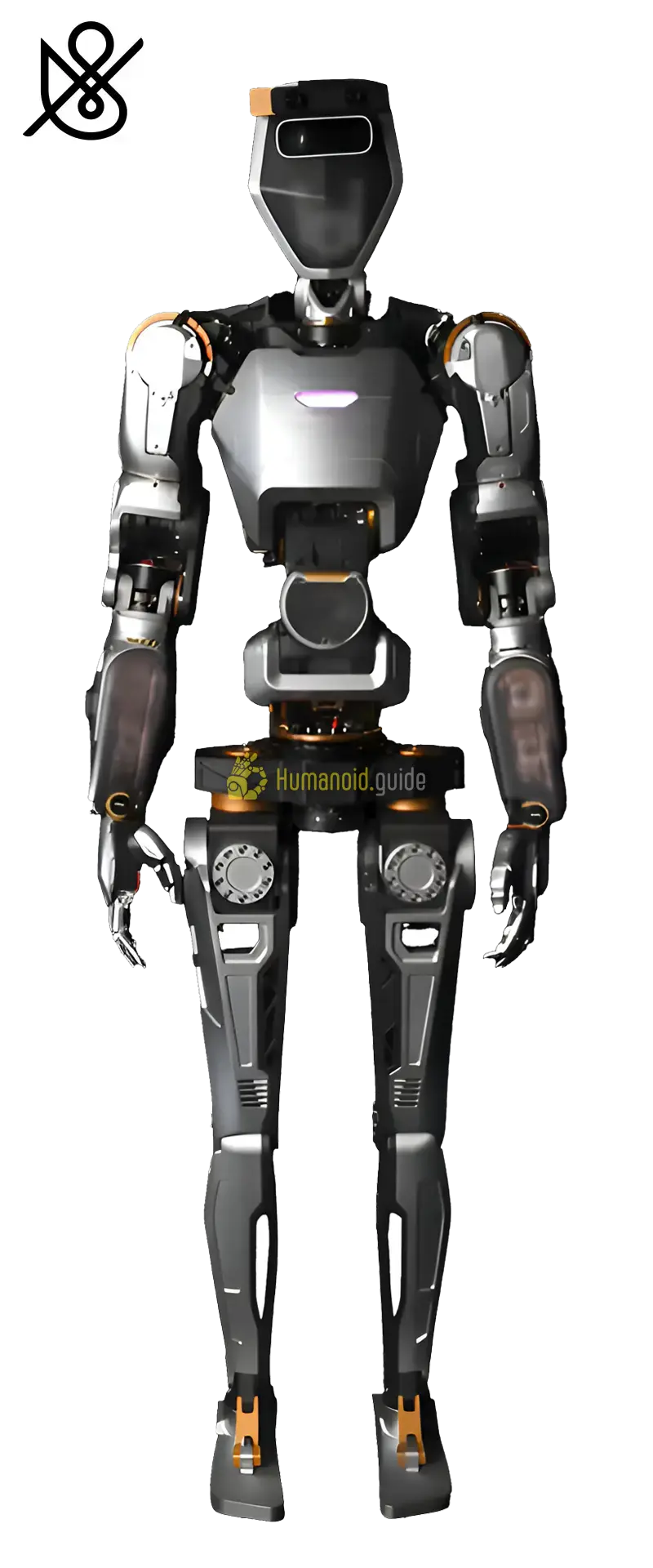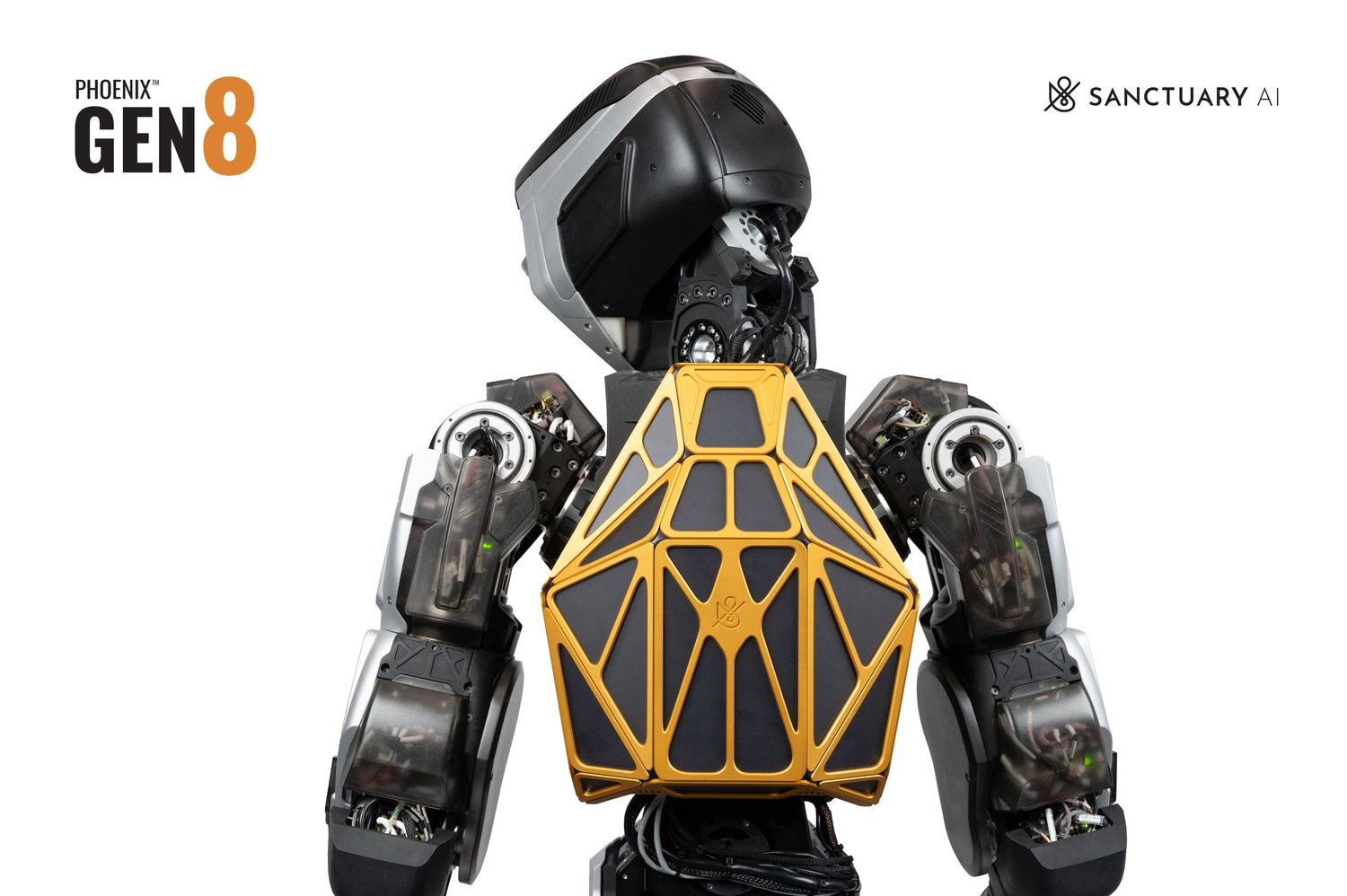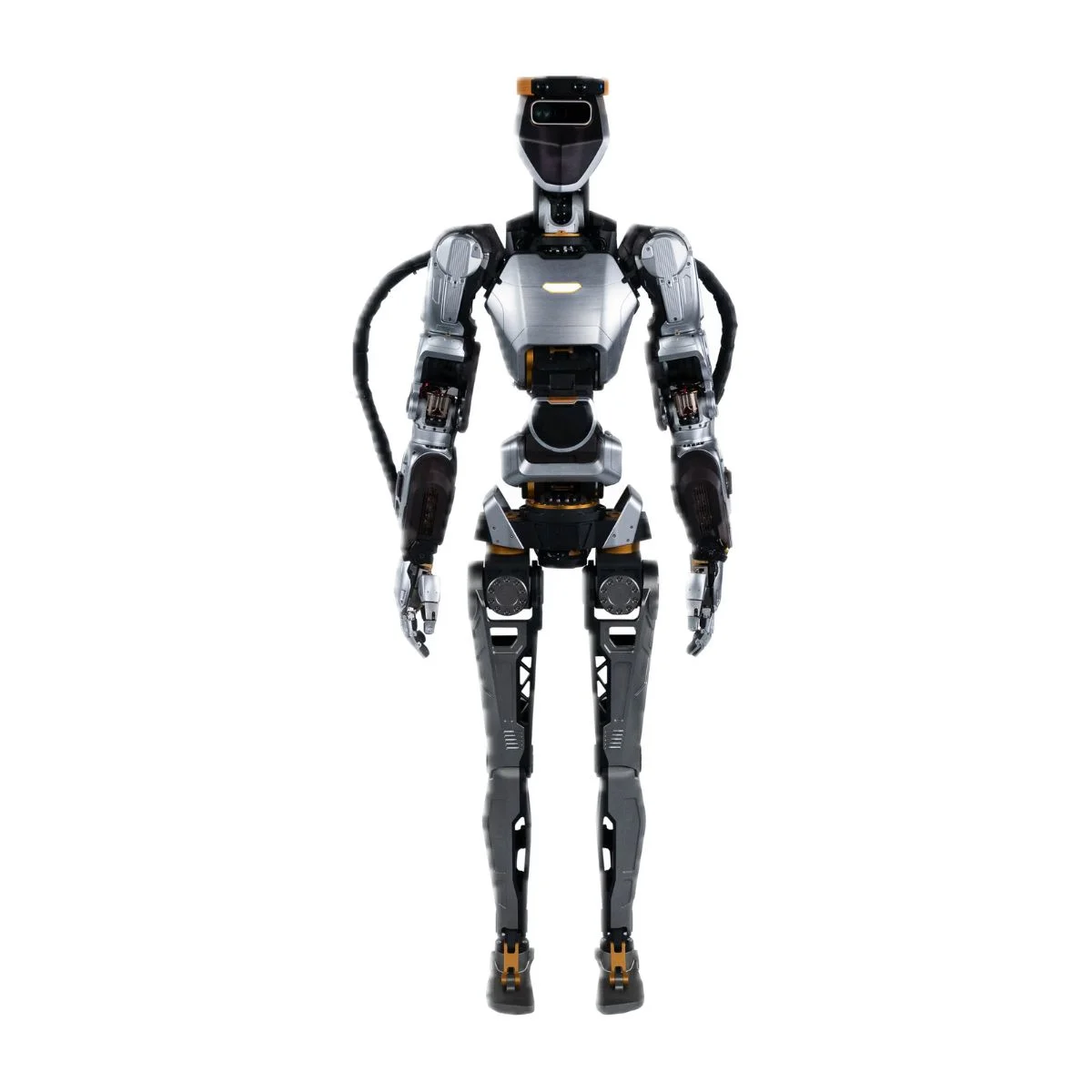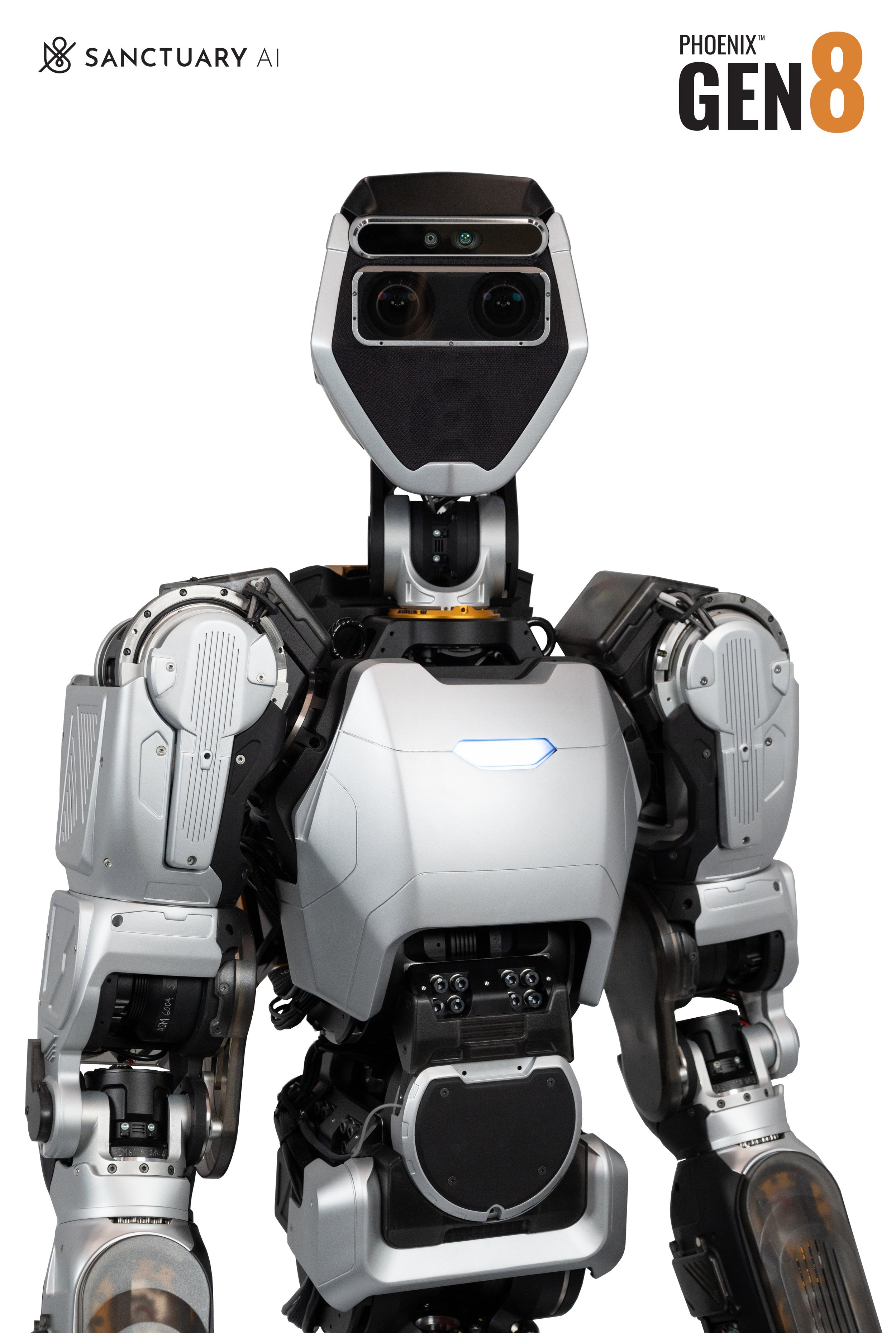
What is the Sanctuary Ai Phoenix?
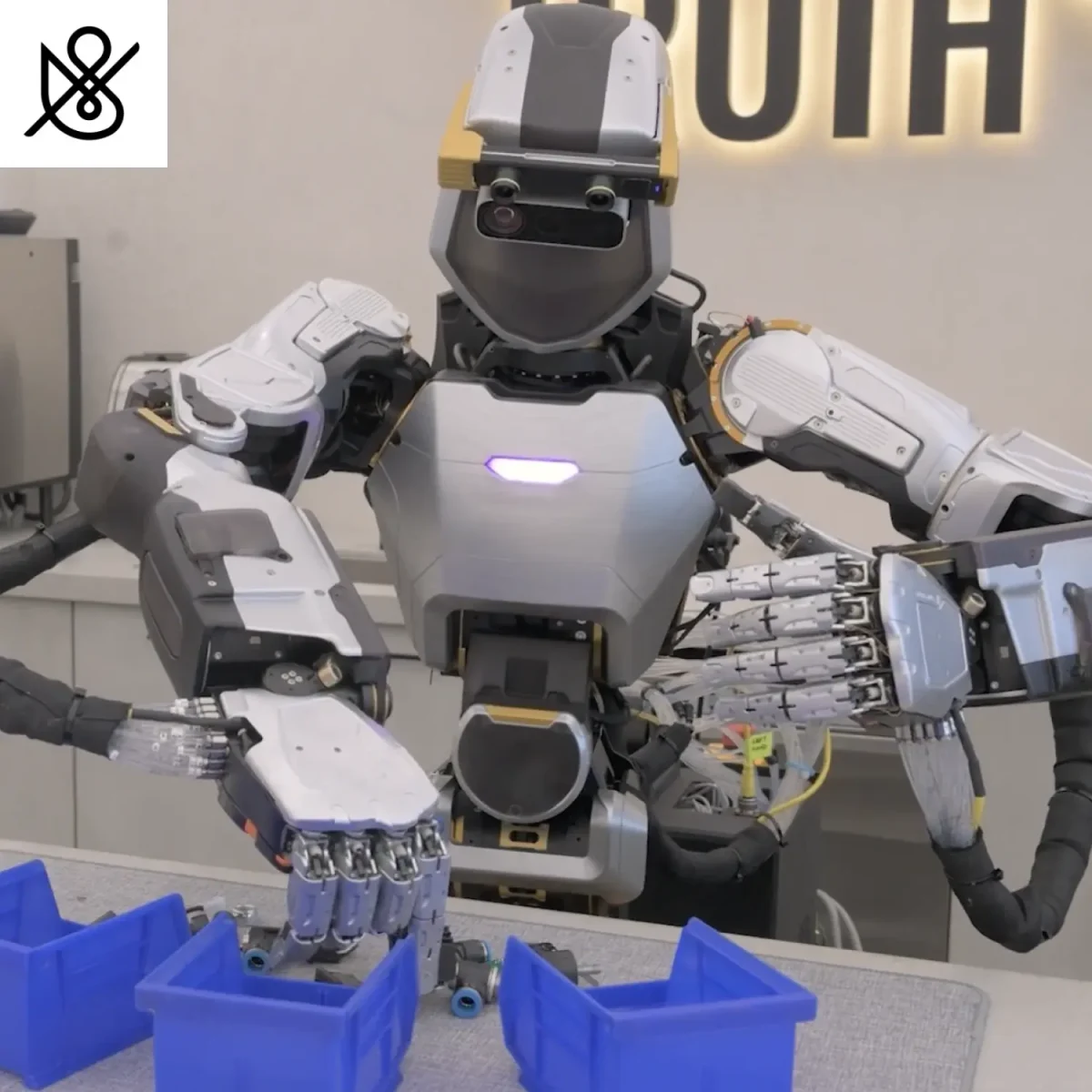
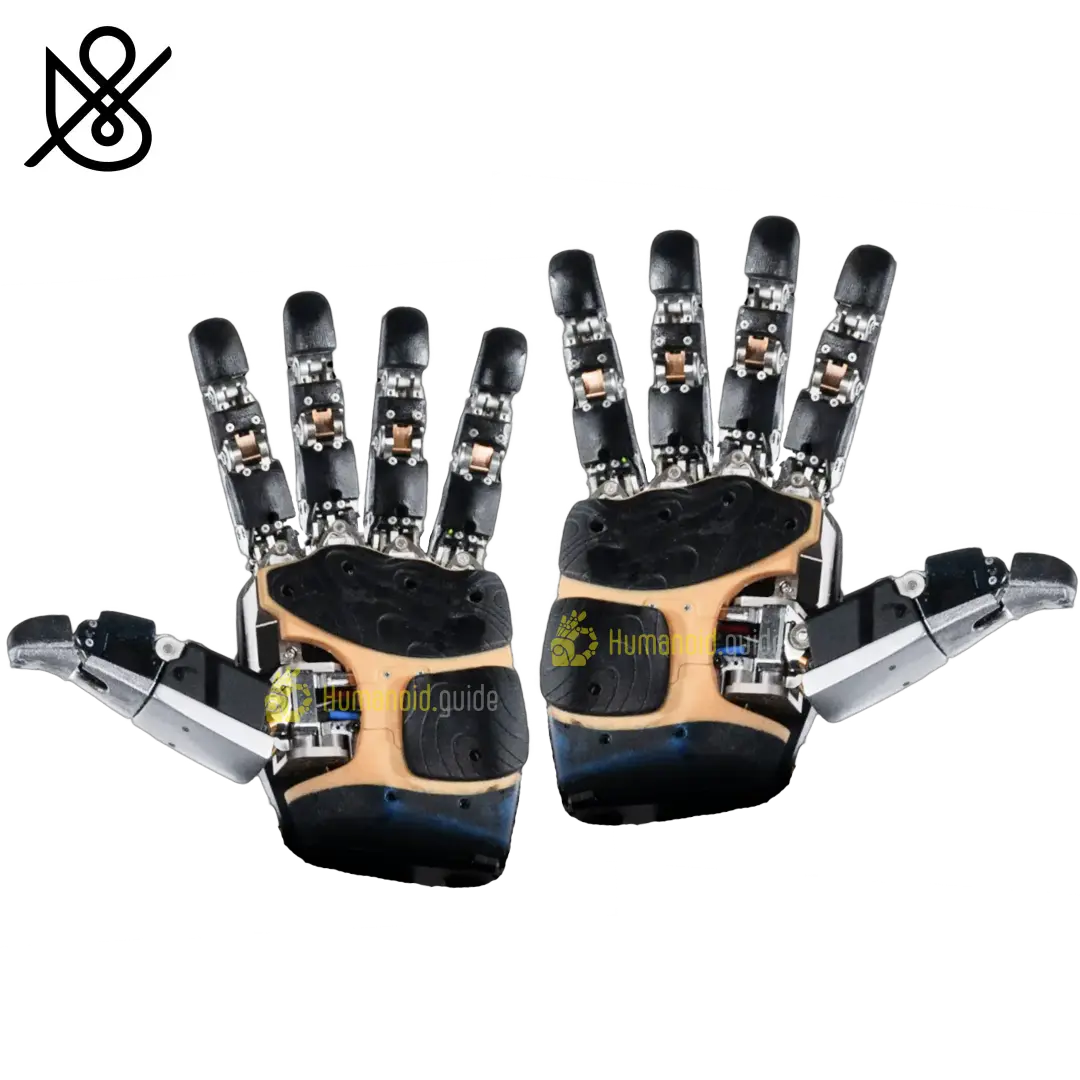
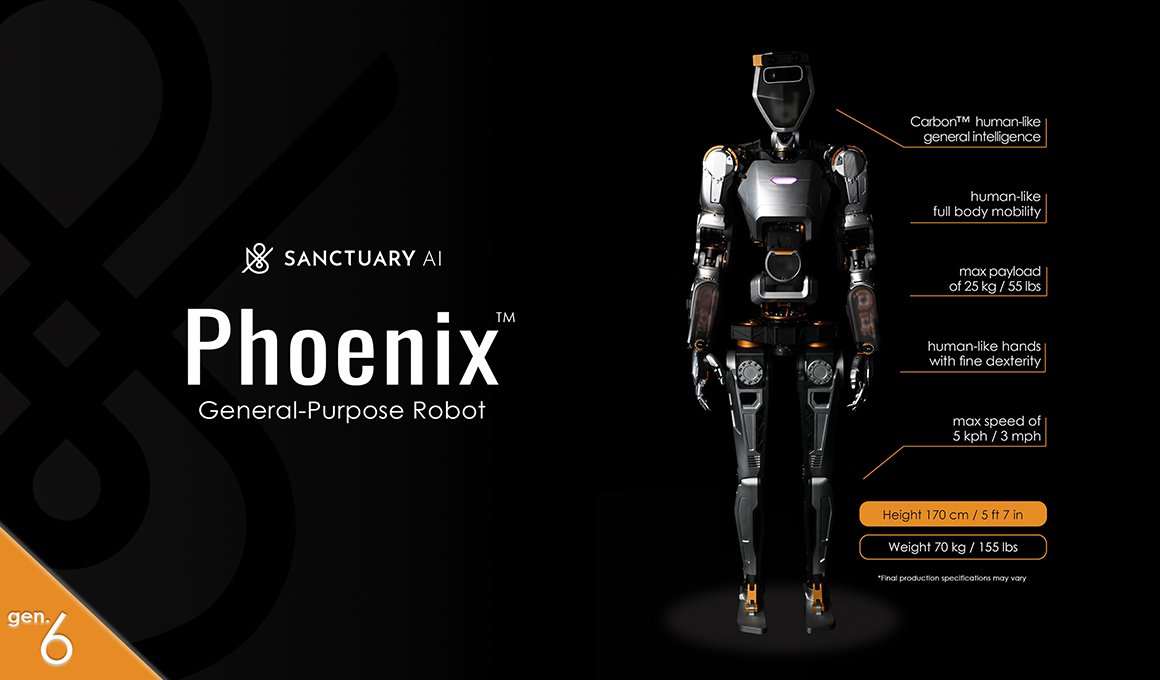
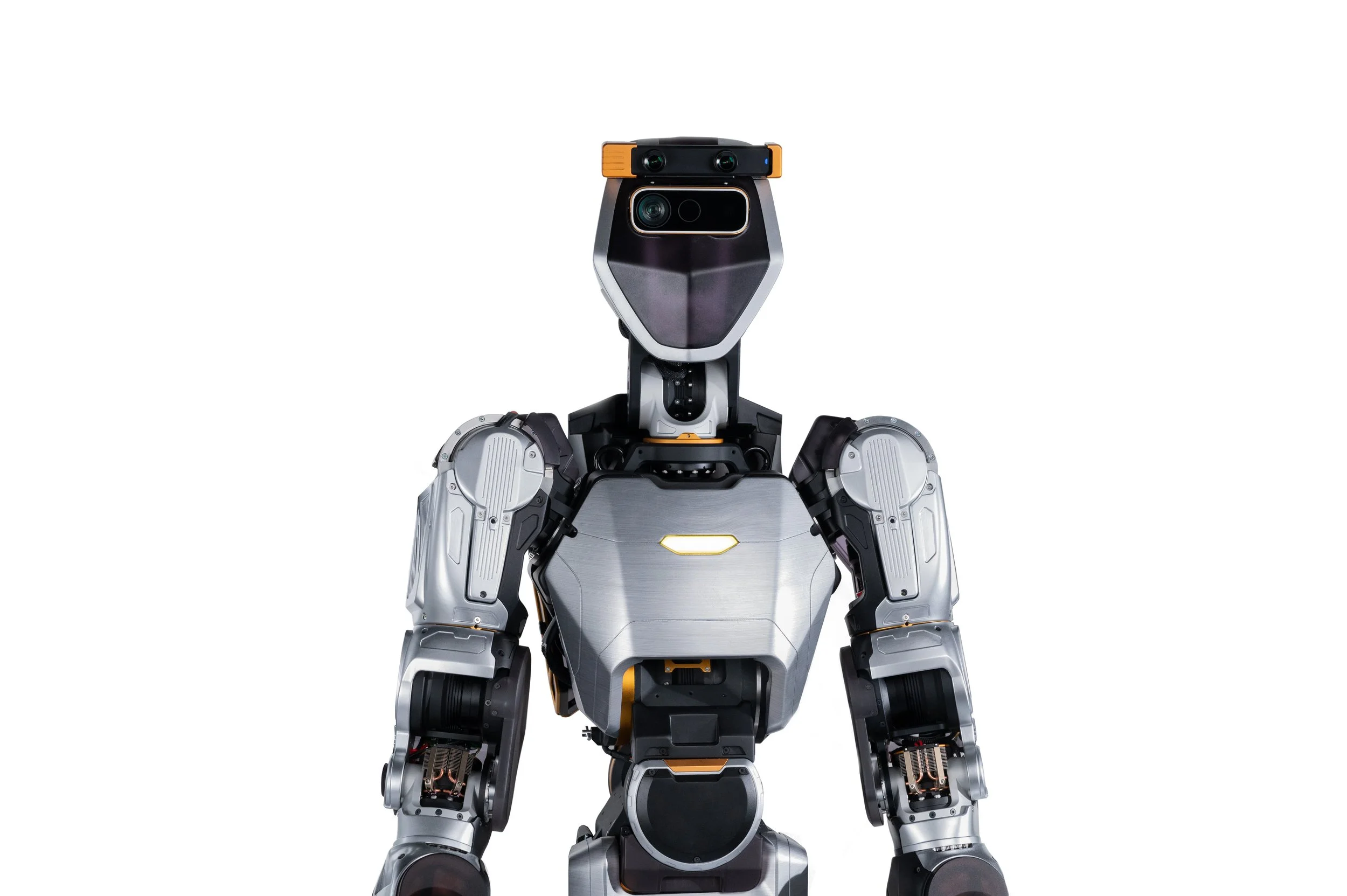
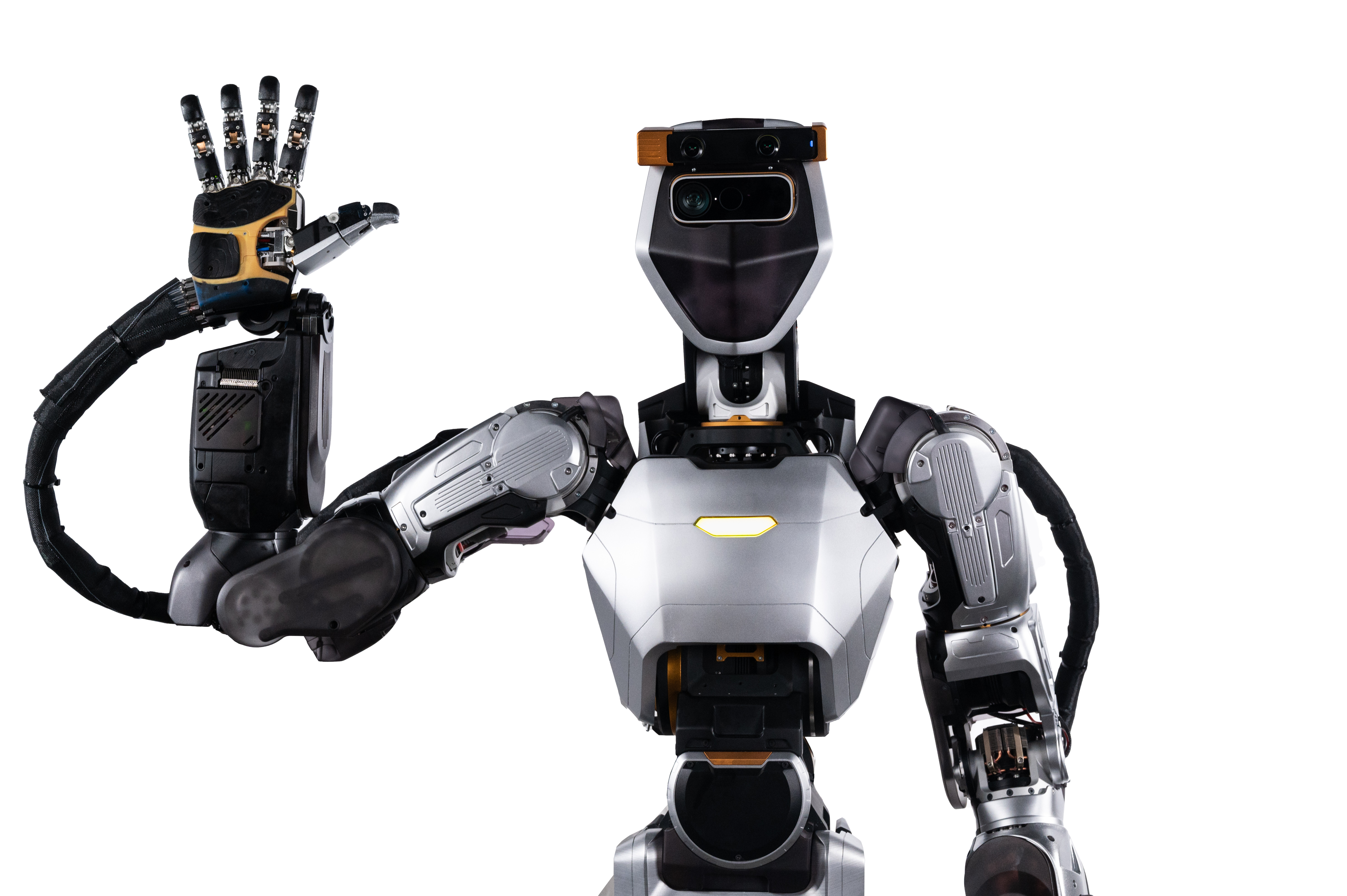
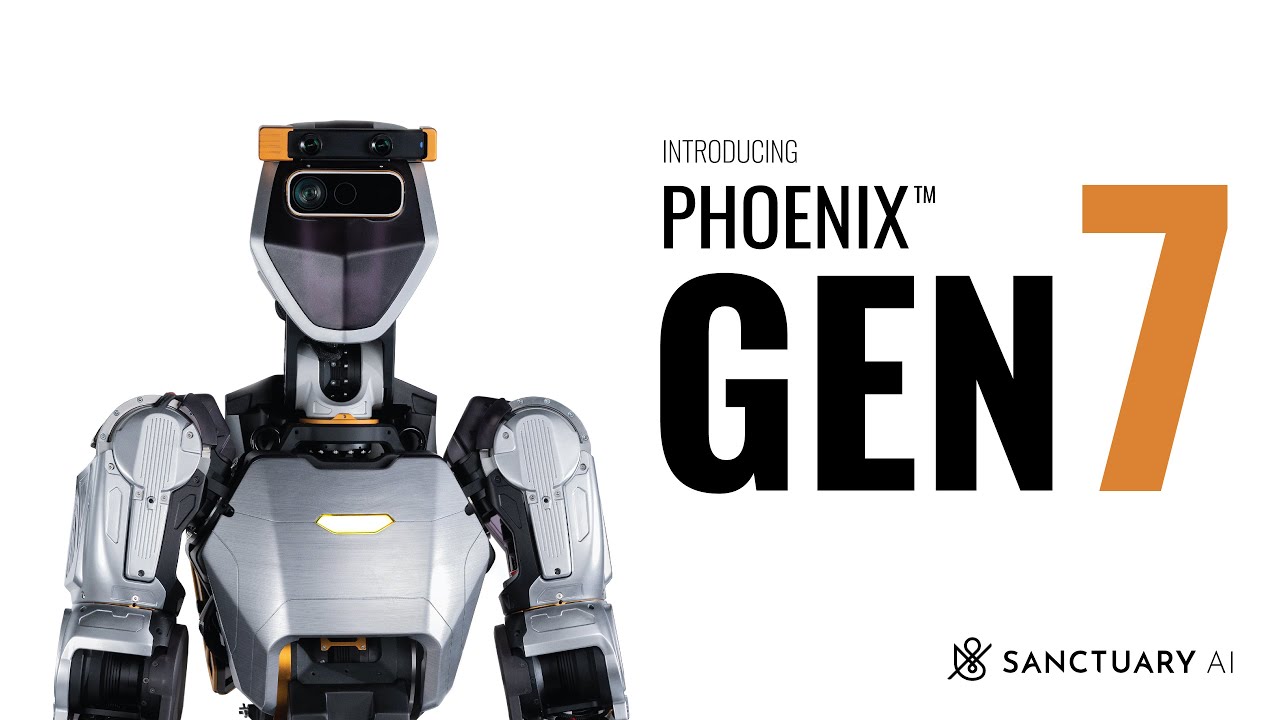
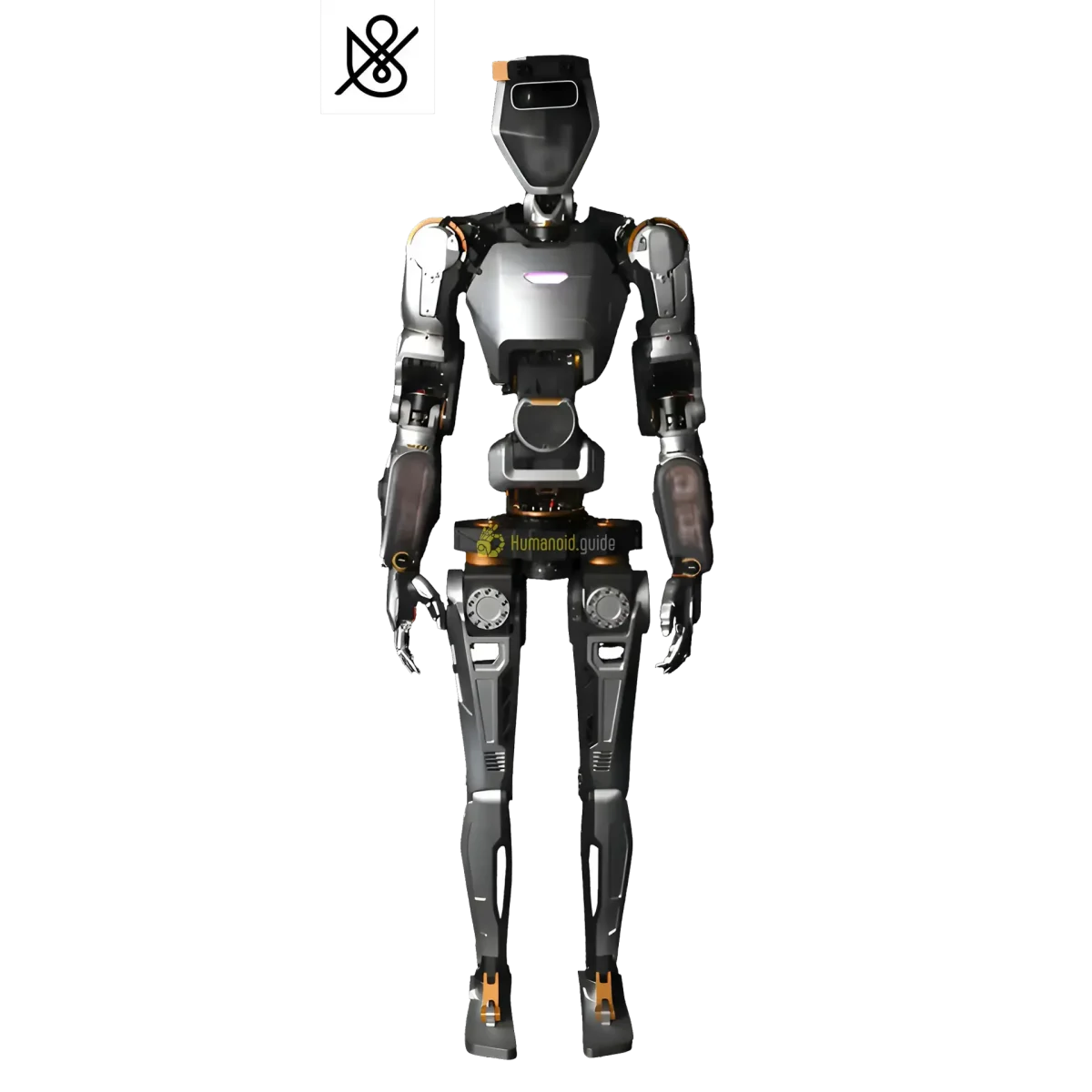
Sanctuary AI Phoenix is a general-purpose humanoid robot developed by Sanctuary AI in Vancouver, Canada, targeting logistics, manufacturing, and retail. It features a wheeled base for stability—a deliberate Gen 8 design choice based on customer feedback—and 75 total degrees of freedom, including 20 per hand with proprietary miniaturized hydraulic valves. Its Carbon AI cognitive architecture integrates large language models, deep learning, reinforcement learning, and symbolic reasoning to produce explainable task and motion plans. The hands achieve 5 mN tactile sensitivity using 7-cell micro-barometer arrays, matching near-human fingertip resolution. Phoenix automates new tasks in under 24 hours from human demonstrations via teleoperation, operating in supervised autonomous, teleoperated, or fully autonomous modes.
Specifications
Here are the full technical specifications.
| Spec | Value |
|---|---|
| Height | 170 cm |
| Weight | 70 kg |
| Degrees of freedom | 75 (total, incl. 20 per hand) |
| Battery life | 8 hours |
| Max speed | 3 km/h |
| Payload | 25 kg |
| Price (new) | Undisclosed (~$6.5M pilot) |
| Price (used range) | Est. $50,000–$100,000 (target) |
Price & Value
New MSRP: Undisclosed (~$6.5M pilot)
Used range: Est. $50,000–$100,000
Sanctuary AI has not published an official MSRP. Early pilot unit pricing has been quoted at $6.5 million, reflecting low-volume, custom-integrated deployments. The company’s stated goal is to reduce costs to $50,000–$100,000 at scale, which would position Phoenix competitively against industrial robotic arms for high-dexterity tasks. At current pilot pricing, Phoenix is a capital-intensive investment suitable only for large enterprises with significant automation budgets and a need for human-like fine manipulation. When compared to contenders like Tesla Optimus (expected <$20,000) or Figure 02, the hydraulic dexterity and advanced tactile sensing justify a premium for applications where precision is critical. Buyers should anticipate rapid depreciation as production scales and newer generations arrive, but pre-owned units may appear at the target cost range once commercial shipments begin.
Who Is It For?
Best for: - Pilot programs in logistics and manufacturing seeking state-of-the-art dexterous manipulation - Research labs studying tactile sensing and human-robot interaction (hydraulic hands with 5 mN sensitivity) - Enterprises testing automation for high-mix, low-volume tasks that demand human-like adaptability
Not for: - Price-sensitive operations: pilot pricing of $6.5M is prohibitive for most businesses - Outdoor or rough-terrain applications: the wheeled base is optimized for flat, indoor floors - Applications requiring fast walking: mobility tops out at 3 km/h and no bipedal locomotion is available
Alternatives & Comparison
The Phoenix competes in the emerging humanoid robot market, offering a unique wheeled-based, hydraulic‑hand approach against bipedal, fully electric rivals.
| Model | Price | Available | Key Difference |
|---|---|---|---|
| Tesla Optimus | Undisclosed (expected <$20,000 at scale) | preorder | Bipedal, electric hands, lower expected cost |
| Figure 02 | Undisclosed | preorder | Fully electric, GPT-based AI, bipedal |
| Agility Digit | $250,000 | yes | Bipedal with dynamic stability, legged mobility for stairs |
Verdict: For tasks demanding the highest dexterity and tactile sensitivity—such as delicate assembly or handling fragile goods—Phoenix’s hydraulic hands and 5 mN haptic feedback give it a clear edge over electric-only rivals like Optimus and Figure 02. However, companies needing rough-terrain mobility or faster walking should consider Agility Digit, while those with extreme budget constraints may wait for Optimus’ mass production. Phoenix remains the top choice for dexterity-intensive pilot programs where cost is secondary to capability.
Use Cases & Capabilities
Precision Assembly
Phoenix’s hydraulic hands, with 20 degrees of freedom and 5 mN tactile sensitivity, allow it to reliably handle small, delicate components during assembly. The robot can sense and adjust grip force in real time, reducing part damage, and it learns complex insertion tasks from human demonstrations in under 24 hours. Its explainable Carbon AI system logs every motion plan, making it suitable for regulated industries like electronics or aerospace where process traceability is required.
Machine Tending
In CNC machine tending or injection molding, Phoenix can load/unload parts, press cycle buttons, and inspect surfaces using its wrist‑mounted micro cameras. The wheeled base provides stable positioning beside fixed machinery without the fall risk of bipedal designs, while the 25 kg payload capacity is sufficient for typical workpieces. Teleoperation allows a human operator to train the robot quickly for a new production line, minimizing downtime.
Order Fulfillment
Phoenix excels at picking and placing a wide variety of items in warehouses, thanks to its ability to reorient objects in-hand even under unexpected 500 g loads. Its RGB cameras and embedded close‑range vision enable accurate item recognition, while the Carbon AI can parse natural language commands like ‘pick the red box from the top shelf.’ The wheeled robot can operate continuously for 8 hours, fitting standard shift patterns.
Research Platform
Academic and corporate R&D labs value Phoenix for its unique combination of hydraulic hands, symbolic-reasoning AI, and teleoperation‑to‑autonomy pipeline. Researchers can study fine manipulation, tactile feedback control, and multi‑modal AI integration on a physical platform that provides the same sensitivity as a human fingertip. The explainable decision logs allow researchers to debug AI behavior and publish reproducible results.
History & Background
Sanctuary AI was founded in 2018 in Vancouver, British Columbia, with the mission to build general-purpose humanoid robots. The Phoenix robot was first unveiled in 2022, focusing on dexterous manipulation and featuring hands with 20 degrees of freedom. Early generations experimented with bipedal mobility, but customer feedback pushed a redesign; Generation 8, announced in December 2024, adopted a wheeled base for superior stability in industrial settings. The Carbon AI cognitive architecture, a unified foundation model, was introduced alongside the robot. Sanctuary AI has completed eight hardware generations as of 2026 and announced a successor platform—Carbon—designed for full commercial deployment, while Phoenix continues in pilot/pre-order programs.
Buying Used — What to Check
Verify hydraulic hand condition Proprietary miniature valves wear over time; loss of tactile sensitivity (5 mN) could affect performance.
Confirm software license transfer Carbon AI and teleoperation software may require a paid license transfer from Sanctuary AI.
Inspect wheelbase motor hours Wheeled base motor life can indicate remaining service life and upcoming maintenance costs.