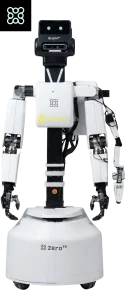
What is the Sean Zeroth?
The ZeroTh Sean is a compact, AI-native humanoid robot from ZeroTh Robotics, a Chinese startup. Revealed in 2024, it stands 155 cm tall and weighs 45 kg, positioned for AI development, retail, home assistance, and research. Its wheeled differential-drive base provides smooth, quiet motion indoors, while 3-finger hands (22 total degrees of freedom—16 overall plus 6 in hands) allow basic object handling. An onboard edge AI processor, likely NVIDIA Jetson-class, enables local LLM inference without cloud dependency. Unlike many heavy humanoids, Sean’s small footprint and moderate speed (3 km/h) suit collaborative spaces. The robot remains in an early pre-order stage, with few units built and no mass-production yet. ZeroTh has not published detailed payload, IP rating, or official pricing, making Sean a speculative platform for early adopters willing to invest in unreleased hardware and software.
Specifications
Here are the full technical specifications.
| Spec | Value |
|---|---|
| Height | 155 cm |
| Weight | 45 kg |
| Degrees of freedom | 22 |
| Battery life | 2 hours |
| Max speed | 3 km/h |
| Payload | Not specified |
| Price (new) | Undisclosed |
| Price (used range) | N/A (pre-order) |
Price & Value
New MSRP: Undisclosed (contact manufacturer)
Used range: Not yet available; speculative
ZeroTh has not disclosed a retail price for Sean, reflecting its early pre-order status. Because it is a small, China-built humanoid, market observers project a competitive price in the $30,000–$50,000 bracket, aiming to undercut mid-sized humanoids like the UBTECH Walker S (~$150,000) and Fourier GR-2 (~$200,000). If that pricing materializes, Sean could open the door for university robotics labs, retail franchises, and AI startups to afford a humanoid platform with local LLM capability. However, value hinges on production quality, API maturity, and payload specifications—none of which are confirmed. Depreciation is unpredictable without a secondary market; used units may emerge only after commercial shipments, likely at steep discounts due to rapid obsolescence in AI hardware. Total cost of ownership includes potential costs for software licenses, repairs, and replacement parts for a low-volume product. Buyers should treat the purchase as an experimental investment rather than a production-ready asset.
Who Is It For?
Best for: - AI development labs testing local LLM on humanoid hardware (22 DOF, onboard edge compute) - Indoor retail or museum kiosks needing a small, approachable humanoid - Home automation enthusiasts with technical skills (low weight, wheeled base, quiet operation)
Not for: - Industrial heavy lifting (no published payload) - Outdoor or harsh environment use (no IP rating, likely indoor only) - Precise dexterous manipulation (3 fingers, limited hand DOF)
Alternatives & Comparison
The Sean sits in a narrow niche of compact, affordable humanoids for light indoor service. Competitors primarily differ in size, dexterity, and price.
| Model | Price | Available | Key Difference |
|---|---|---|---|
| Fourier GR-2 | ~$200,000 (est.) | no (pre-order) | 5 kg per arm payload, 39 DOF, heavy-lift capability |
| UBTECH Walker S | ~$150,000 (est.) | yes | Bipedal walking, higher dexterity, 3 kg payload |
| Engineered Arts Ameca | ~$250,000 | yes | Expressive human-like face, for social robots only |
Verdict: For budget-conscious developers who want a wheeled humanoid for edge LLM prototyping, the Sean is a compelling gamble if priced below $50,000. However, those requiring robust manipulation or human-like interaction should invest in the UBTECH Walker S or Engineered Arts Ameca, respectively. The Fourier GR-2 remains a heavy-duty industrial option for well-funded pilots.
Use Cases & Capabilities
AI Development & Edge LLM Testing
Sean’s native AI compute and support for local large language models make it ideal for developers testing conversational AI or autonomous decision-making on real hardware. Its 22 DOF allow basic gesture and object interaction, enabling physical-world grounding of language models. Labs can benchmark performance of fine-tuned LLMs without cloud dependency, relying on the robot’s onboard Jetson-class processor. The wheeled base and manageable 45 kg size reduce safety hazards, allowing indoor use in shared spaces. However, developers must verify the SDK maturity and software stack availability before committing to a platform that may lack a large community.
Retail & Hospitality Greeter
With a 155 cm height and approachable design, Sean can serve as an information kiosk or greeter in retail stores, museums, or hotels. Its quiet, wheeled locomotion lets it traverse smooth floors to guide customers or perform product demonstrations. The 2-hour battery life allows multiple short interactions per shift, though it would require frequent recharging in busy settings. The 3-finger hands can hold brochures or small items, but lack the dexterity for serving or detailed tasks. For venues seeking an AI-powered conversational agent beyond a static screen, Sean offers a mobile, embodied platform at a fraction of larger humanoid costs.
Home Assistance & Companion (Experimental)
As a small, light humanoid, Sean is pitched for home environments—performing reminders, controlling smart devices, or engaging in basic conversation. Its wheeled base works on level floors, avoiding stairs. The AI-native design can personalize interactions via local LLMs, appealing to privacy-conscious users. However, without a known payload, it cannot carry heavy groceries or open doors. Battery life limits continuous operation, and the early-stage software means reliability for daily home use is unproven. Enthusiasts and early adopters may see it as a platform for building custom home automation routines.
History & Background
ZeroTh Robotics, also branded as Zeroth, emerged in 2023–2024 in China with the Sean humanoid as its debut product. The company maintains a minimalistic web presence at zeroth0.com, offering no corporate history or team details. The robot was first seen on specialized databases in 2024, listed as a 155 cm, wheeled platform with a three-finger gripper design. A smaller 90 cm variant may have been mentioned in some references, but primary specifications point to the 155 cm model. No venture funding rounds, manufacturing partnerships, or regulatory certifications have been announced. As of 2026, Sean remains a prototype/pre-order item without evidence of mass-produced units. ZeroTh appears to target the emerging market for compact AI-service robots, competing indirectly with UBTECH, Fourier Intelligence, and Engineered Arts. The robot’s reliance on onboard edge AI compute and local LLM processing suggests a design philosophy centered on privacy and low-latency interaction, though actual performance benchmarks are unavailable.
Buying Used — What to Check
Verify condition of wheelbase motors and battery health Wheeled locomotion wears with use; a degraded battery will cut the already short 2-hour runtime.
Confirm onboard compute specs and software support Early units may have beta-revision hardware and drivers; ensure manufacturer still provides SDK updates.