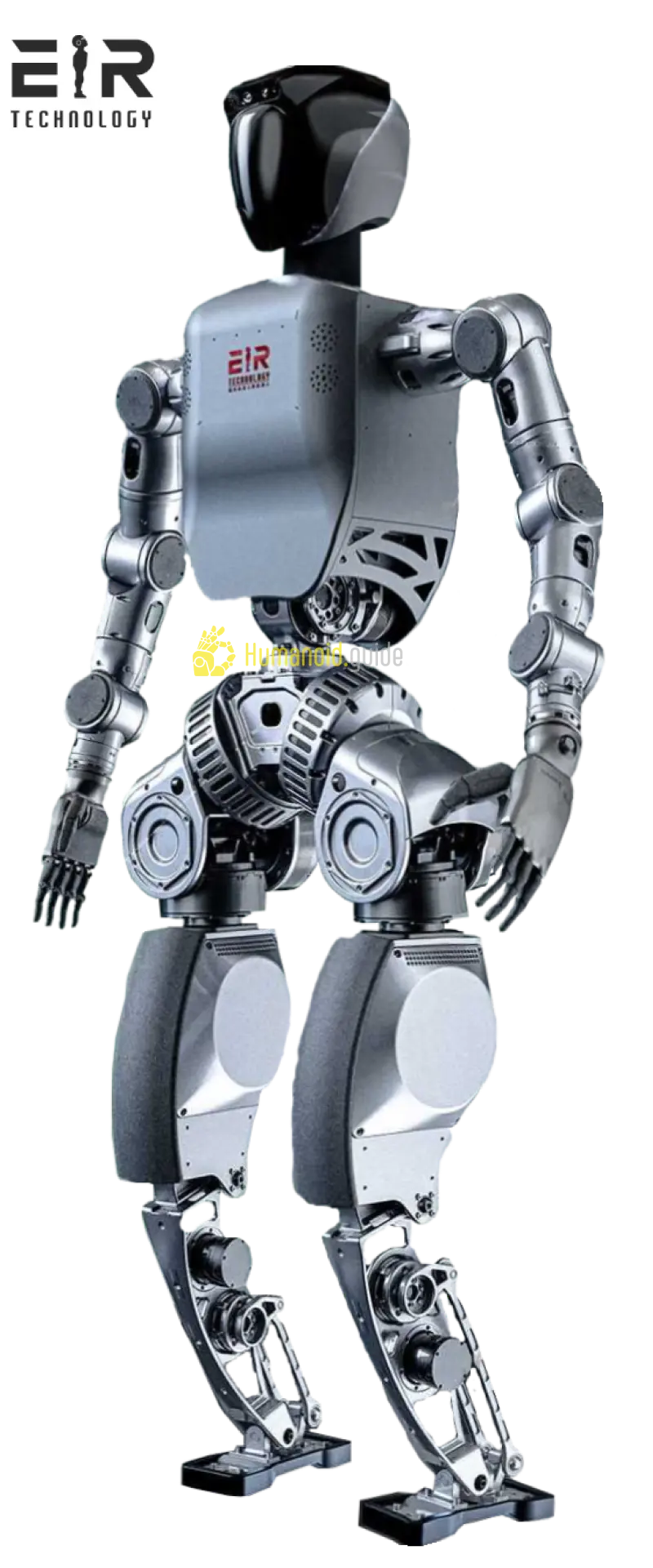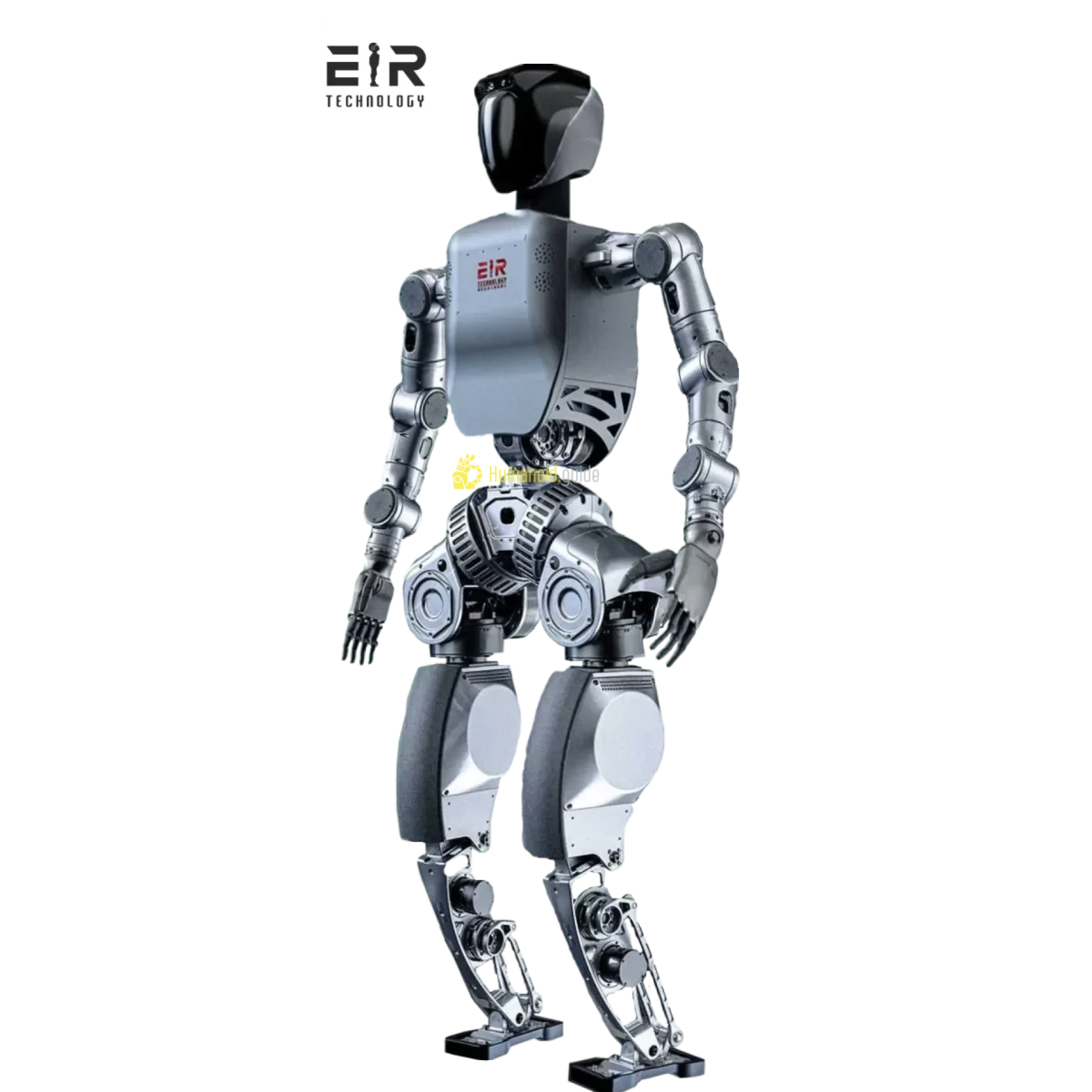
What is the Skywalker 2 Eir?
The SkyWalker 2 is a second-generation bipedal humanoid robot developed by EIR Technology (Sichuan Embodied Humanoid Robot Technology Co.) in China. Unveiled in 2024, it stands 165 cm tall, weighs 55 kg, and boasts 55 degrees of freedom — including 12 in each five-fingered hand — enabling dexterous manipulation and agile locomotion. Its bionic waist joints and lightweight servo motors allow for human-like movements at speeds up to 7 km/h. Equipped with RGB-D cameras, environment sensors, and onboard high-performance computing with optional cloud integration, SkyWalker 2 targets equipment inspection, elder care, and intelligent service roles in factories and industrial parks. It is currently in early commercial deployment.
Specifications
Here are the full technical specifications.
| Spec | Value |
|---|---|
| Height | 165 cm |
| Weight | 55 kg |
| Degrees of freedom | 55 |
| Battery life | 3 hours |
| Max speed | 7 km/h |
| Payload | Not specified |
| Price (new) | Undisclosed (contact manufacturer) |
| Price (used range) | N/A |
Price & Value
New MSRP: Undisclosed (contact manufacturer)
Used range: N/A
EIR Technology has not publicly disclosed pricing for the SkyWalker 2, reflecting its pre-order status and early commercial phase. Without a listed MSRP, prospective buyers must contact the manufacturer directly to negotiate based on configuration and deployment scale. In the broader humanoid market, comparable models like the Fourier GR-2 or UBTECH Walker S also lack transparent pricing, so direct cost comparison is impossible. Value for early buyers will depend heavily on reliability and support, as the robot is unproven in extended field use. Given the rapid evolution of humanoid robotics, any early units may depreciate quickly as improved versions emerge. Total cost of ownership will include likely high maintenance and potential service contracts.
Who Is It For?
Best for: - Early-adopter manufacturing plants seeking humanoid inspection and monitoring (55 DOF enables dexterous data collection) - Elder care and assisted-living facilities evaluating humanoid interaction (anthropomorphic design and LLM integration support social services)
Not for: - Heavy lifting or industrial manipulation (payload is not officially specified, likely low) - Continuous long-shift operation (battery life of 3 hours limits use without hot-swapping or frequent charging)
Alternatives & Comparison
The SkyWalker 2 enters a competitive landscape of bipedal humanoid robots targeting industrial and service applications. Below, we compare it to similarly sized and positioned models.
| Model | Price | Available | Key Difference |
|---|---|---|---|
| UBTECH Walker S | Undisclosed | preorder | Broader AI platform with more established service robot ecosystem. |
| Fourier GR-2 | Undisclosed | preorder | 34 hands DOF vs. SkyWalker 2's 12; superior dexterity. |
| Figure 02 | Undisclosed | preorder | Advanced reinforcement learning for walking on rough terrain. |
Verdict: For buyers prioritizing low cost and low risk, the SkyWalker 2’s lack of public pricing and unproven field record makes it a gamble. UBTECH Walker S offers a more developed software stack and broader support, making it the safer choice for industrial inspection. However, if you need immediate humanoid interaction for elder care trials and can wait for unit delivery, SkyWalker 2's LLM integration and bionic design may offer a more natural presence. While the SkyWalker 2’s 12-fingered hands and LLM integration are impressive on paper, it lacks the proven reliability of established competitors like UBTECH’s Walker S, which has undergone thousands of hours of testing. Figure 02’s rough-terrain locomotion also outperforms the SkyWalker for outdoor inspection. Ultimately, the SkyWalker 2 may be a cost-effective entry for Chinese companies already within EIR’s service network, but international buyers face higher risk.
Use Cases & Capabilities
Equipment Inspection in Factories
SkyWalker 2 navigates factory floors at 7 km/h, using RGB-D cameras and environment sensors to detect anomalies in machinery. Its 55 DOF, including 12-fingered hands, allows it to manipulate diagnostic tools or open panels. With a latency of 350 ms glass-to-action, it can report findings in real time. The robot’s IP rating is unspecified, so it may not be suitable for dusty or wet environments without protection. Nonetheless, it can replace human inspectors for routine rounds in controlled industrial spaces.
Elder Care Assistance
In assisted living facilities, SkyWalker 2 leverages LLM integration to converse with residents and provide cognitive engagement. Its anthropomorphic design and 165 cm height make it approachable, and its 3-hour battery allows for extended social interactions. It can carry lightweight items up to 15 kg (implied strength) to assist with daily tasks. However, safety protocols for close human interaction must be verified, as no ISO certifications are listed. Early pilots in elder care could gather valuable data on human-robot trust.
Intelligent Service Roles
Retail or hospitality deployments can use SkyWalker 2 for customer guidance, information delivery, and inventory scanning. Its bipedal mobility lets it navigate crowded spaces, and onboard computing supports localized decision-making. With optional cloud compute, it can tap into updated databases. However, the lack of ingress protection means it should avoid spills, and battery life may limit all-day use without swapping. Successful implementation would require integration with existing facility management systems.
Warehouse Material Handling
In a warehouse or logistics center, the SkyWalker 2 can transport light components or tools between stations. Its bipedal navigation allows it to move in human-centric environments without modifying infrastructure. The robot’s 7 km/h speed enables efficient travel across large floors, but the 3-hour battery may require charging stations along routes. Payload of 15 kg limits it to small-package handling, not pallet moving. Integration with WMS would be custom, adding deployment cost.
History & Background
EIR Technology, officially Sichuan Embodied Humanoid Robot Technology Co., Ltd., was founded in September 2024 in China. The SkyWalker 2, its second-generation bipedal robot, was unveiled in the second half of 2024 and represents a significant engineering leap with 55 degrees of freedom and bionic joint design. Created to meet demand for versatile humanoids in inspection, elder care, and services, it quickly moved from lab prototypes to early commercial trials in 2025. The company has remained low-profile, with limited public information available about its funding or manufacturing capacity. By 2026, the SkyWalker 2 is offered on a pre-order basis while production ramps up.
Buying Used — What to Check
Verify runtime and battery cycles Battery degradation could reduce the already modest 3-hour endurance.
Inspect joint wear and torque consistency The 55 DOF in a new robot may have long-term reliability unknown.
Confirm software update support EIR is a small company; continued updates for used units may be limited.