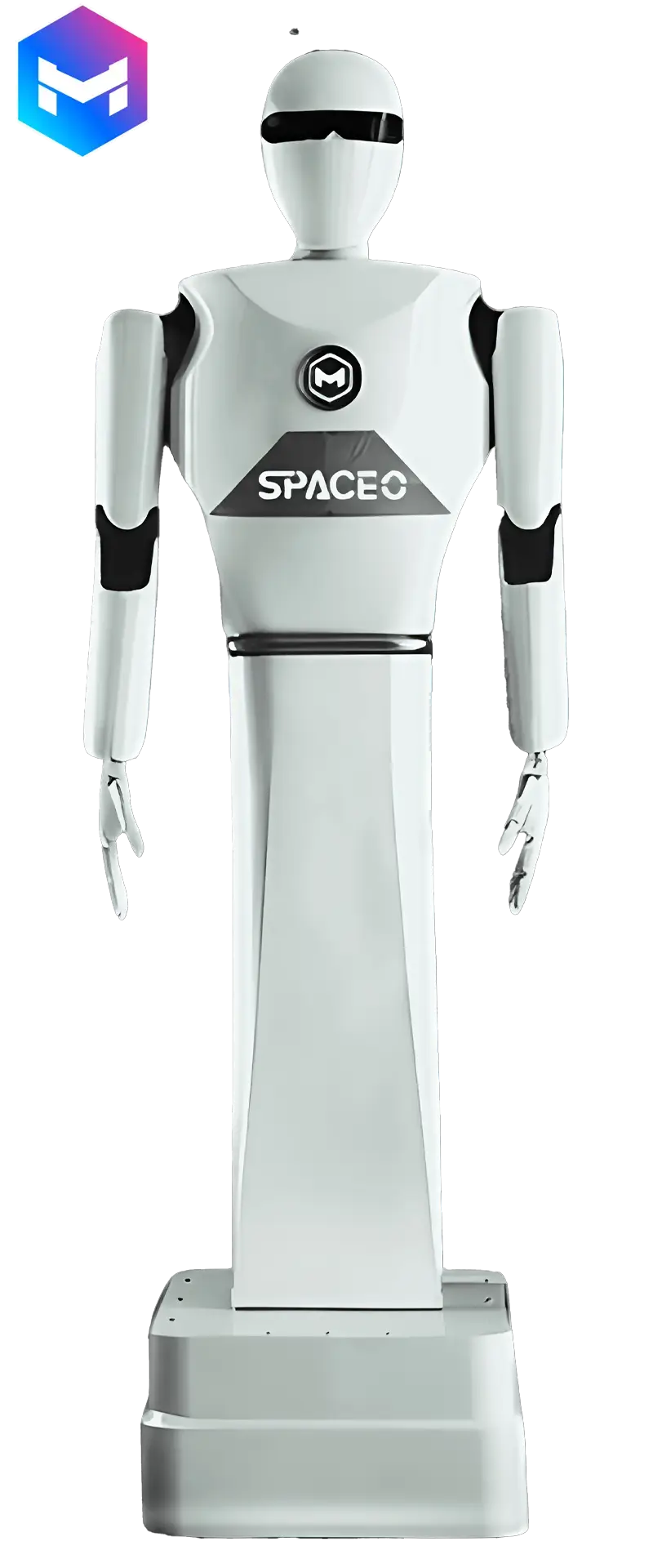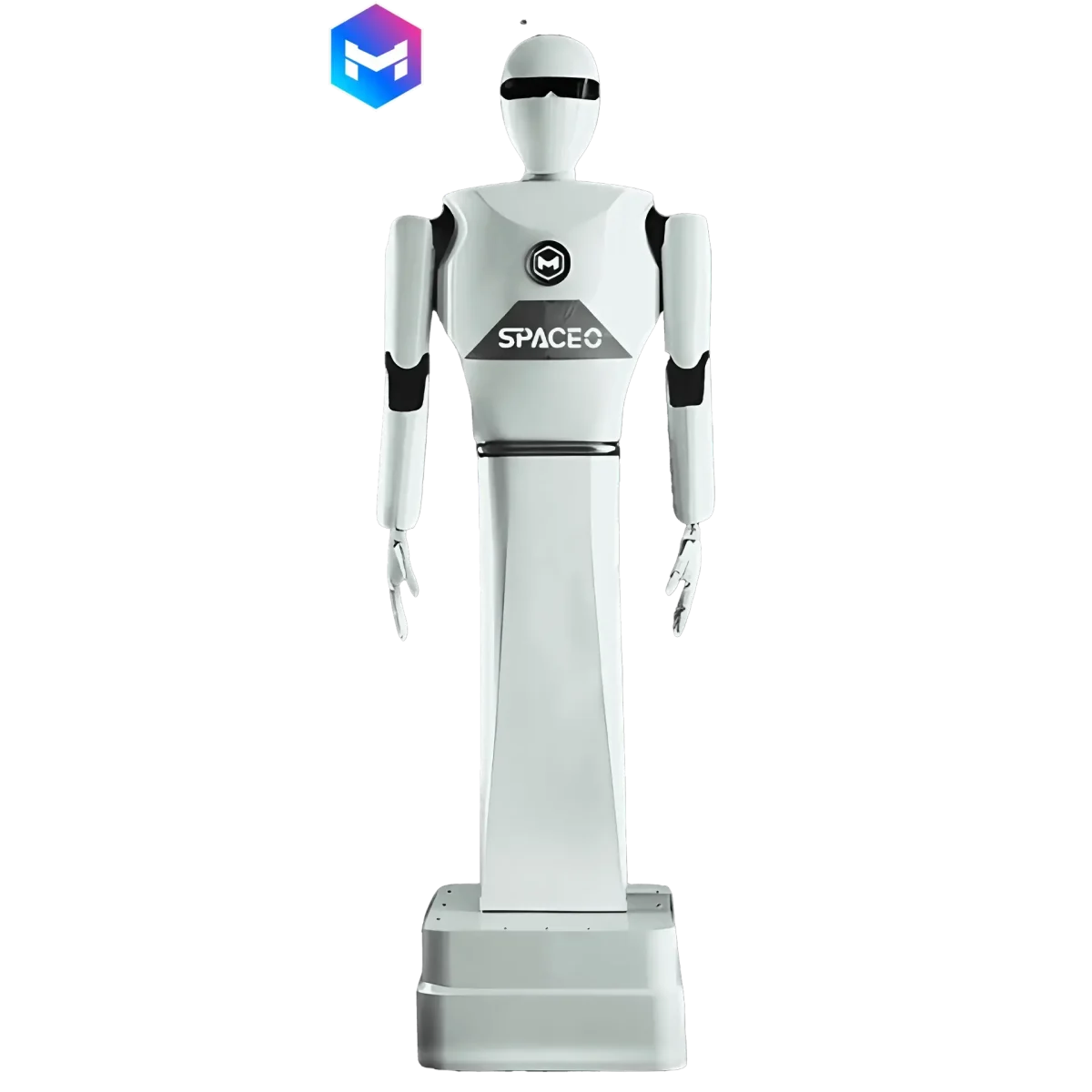
What is the Spaceo M1?
Spaceo M1 is a humanoid service robot by Muks Robotics (India). It uses a wheeled base with 16 DOF in its upper body, a 20 kg payload, and a top speed of 7.2 km/h. Equipped with an Intel Core i5, NVIDIA GPU, 3D LiDAR, and RGB camera, it navigates autonomously. Its FusionMax Omni-Modal AI stack enables multilingual conversations. Target industries: healthcare, hospitality, retail restocking. The M1 runs for 4 hours per charge and is in production, priced at $11,000. It differs from the Spaceo Pro, which has 20 DOF and is aimed at industrial automation.
Specifications
Here are the full technical specifications.
| Spec | Value |
|---|---|
| Height | 167 cm |
| Weight | 65 kg |
| Degrees of freedom | 16 |
| Battery life | 4 hours |
| Max speed | 7.2 km/h |
| Payload | 20 kg |
| Price (new) | $11,000 |
| Price (used range) | N/A (new model) |
Price & Value
New MSRP: $11,000
Used range: N/A (new model)
At $11,000, the Spaceo M1 is competitively priced for a service humanoid with 16 DOF and AI capabilities. This positions it below many Western counterparts but above entry-level educational robots. Given its early-market status, resale value is uncertain; however, the underlying Intel/NVIDIA hardware and proven FusionMax AI stack may support moderate depreciation. Total cost of ownership should factor in maintenance of electromechanical actuators and potential software licensing fees. For businesses exploring robotics-assisted customer service, the M1 offers a lower-risk investment compared to high-end industrial humanoids like the Unitree H1 or Fourier GR-1. As used units appear, prices could dip to $7,000–$9,000, but currently there is no established secondary market.
Who Is It For?
Best for: - Healthcare facilities seeking an autonomous patient greeter or wayfinding assistant (multilingual AI, safe operation around people) - Retail stores and supermarkets for inventory monitoring and customer guidance (20 kg payload can handle restocking tasks) - Hospitality venues (hotels, restaurants) requiring a durable, interactive service robot (7.2 km/h covers large indoor areas)
Not for: - Heavy industrial manufacturing (payload limited to 20 kg; no safety certifications for factory use) - Outdoor or uneven terrain applications (wheeled base cannot navigate stairs or rough ground; max speed is only 7.2 km/h)
Alternatives & Comparison
The Spaceo M1 competes in the humanoid service robot space, where buyers compare wheeled mobile manipulators with AI capabilities. Here's how it stacks up against similar options.
| Model | Price | Available | Key Difference |
|---|---|---|---|
| SoftBank Pepper | ~$10,000 (used) | yes (used only) | No arm payload for carrying items; no LiDAR navigation |
| UBTECH Cruzr | ~$15,000 (new) | yes | Lower payload (3 kg) and slower speed (3.6 km/h); narrower AI capabilities |
Verdict: For businesses needing a payload-capable, fast, and affordable humanoid service robot, the Spaceo M1 is the best option under $15,000. Its 20 kg payload and 7.2 km/h speed outperform similarly priced competitors, and its Indian manufacturing may offer regional support advantages. However, if you only need customer interaction without physical item handling, a used Pepper at a similar price remains a proven, widely-deployed alternative.
Use Cases & Capabilities
Healthcare Patient Engagement
The Spaceo M1 can greet visitors, guide patients to departments, and provide multilingual information in hospitals. Its 3D LiDAR and camera ensure safe navigation around patients and medics. The 20 kg payload allows it to carry medical records or light supplies. The 4-hour battery covers typical shift patterns, and the safe human-interaction design reduces liability concerns. With on-device AI, it can answer common questions without cloud latency, supporting HIPAA-compliant setups when needed.
Retail Restocking and Customer Assistance
In supermarkets and retail stores, the M1 autonomously patrols aisles to monitor stock levels using its RGB camera and LiDAR. It can physically restock shelves with items up to 20 kg, reducing staff workload. The multilingual FusionMax AI can answer customer queries about product locations and promotions. Its 7.2 km/h speed allows it to cover large floor areas quickly. The wheeled base is ideal for smooth retail floors, and OTA updates keep the robot's AI fresh with new product information.
Hotel and Hospitality Concierge
Hotels can deploy the M1 in lobbies to welcome guests, carry luggage (up to 20 kg), and provide room delivery service. The robot's 167 cm height and humanoid appearance make it approachable. It can interact in multiple languages, check guests in, and guide them to amenities. Its quiet electric actuation and safe collision avoidance ensure it blends into upscale environments. The 4-hour battery is sufficient for peak check-in/out periods before a quick charge.
Warehouse Light Logistics
Although not designed for heavy industry, the M1 can perform light item transport within small warehouses or distribution centers. It can autonomously move goods between packing stations or upload shelves using its 20 kg capacity. The indoor navigation system with LiDAR mapping allows it to learn warehouse layouts. Continuous operation is possible with battery swapping or charging between shifts. Its Linux-based OS and OTA updates allow integration with warehouse management software.
Education and Research
Universities and robotics labs can use the Spaceo M1 as a platform for human-robot interaction studies, AI development, or service robotics research. The open Linux OS and fusion AI stack provide a foundation for custom programming. The 16 DOF allow experimentation with dexterous manipulation tasks. At $11,000, it is more affordable than many research humanoids. Its safe-human rating makes it suitable for campus deployments. Battery life and payload are sufficient for extended experiments.
History & Background
Muks Robotics, an Indian robotics startup, emerged with the Spaceo series aiming to provide affordable humanoid automation. The Spaceo M1 was first built in 2025 as a follow-up to the earlier Spaceo Pro (released 2024), which targeted industrial automation with 20 DOF and 5 kg payload. The M1 shifted focus to service sectors, reducing arm complexity but increasing payload to 20 kg. Both models share the FusionMax Omni-Modal AI architecture and wheeled base. Production began in 2025, and the robot is currently available for purchase through distributors like MERA Robotics. Muks Robotics has not disclosed founding details publicly, but the company is based in India and has garnered attention for its competitive pricing and multilingual AI capabilities. As of 2026, the M1 remains the company's main service-oriented humanoid.
Buying Used — What to Check
Verify actual payload capacity The 20 kg rating may be total standing payload, not arm-only; test if it meets your task needs.
Inspect battery health and cycles Battery degradation could reduce the 4-hour runtime; check SOH if buying used.
Confirm software updates and AI licensing FusionMax AI may require ongoing subscriptions or OTA updates; ensure the robot's software is up to date.