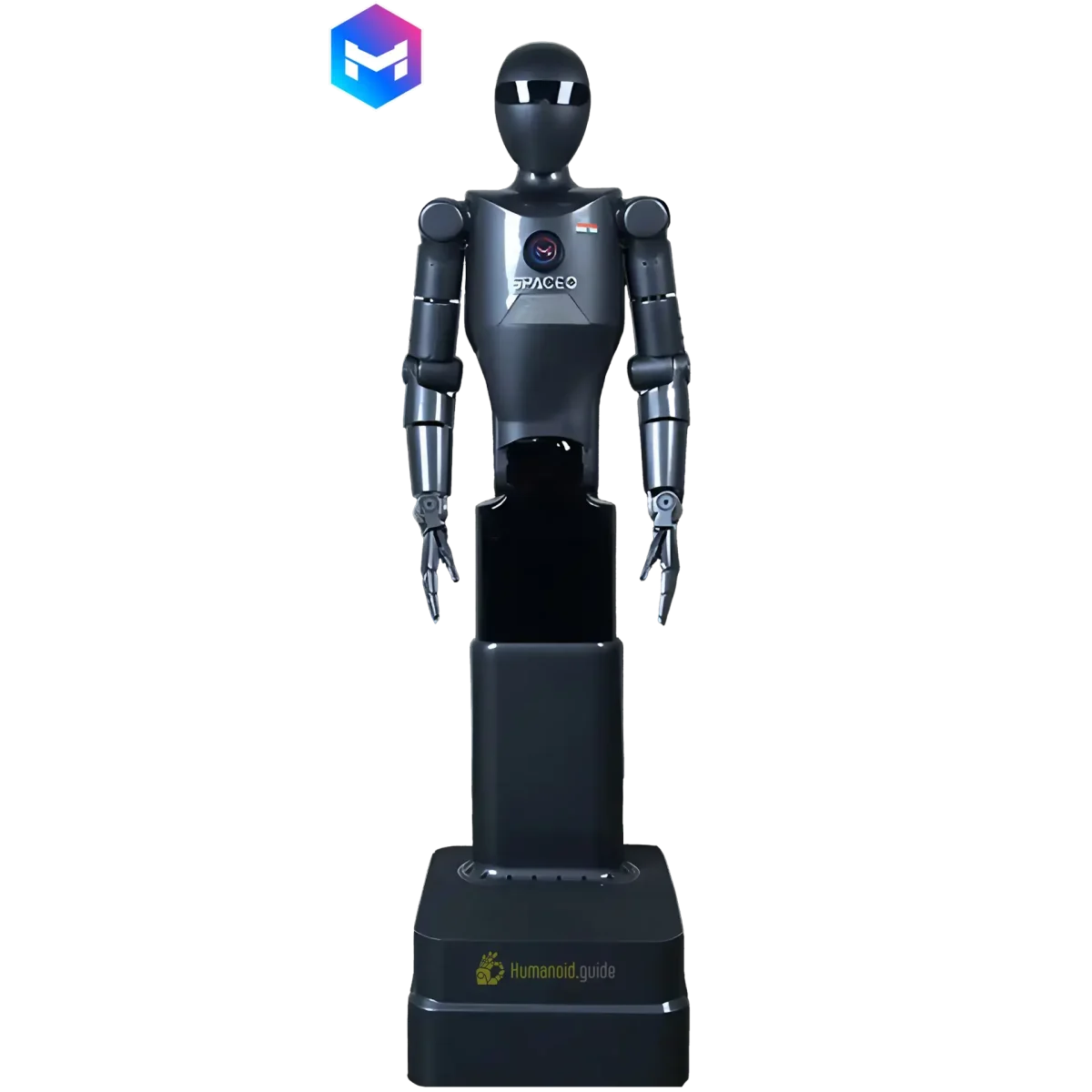
What is the Spaceo Pro?
Spaceo Pro is India's first full-scale industrial humanoid, developed by Muks Robotics (website muksrobotics.com). Standing 167 cm and weighing 65 kg, it features 20 degrees of freedom (7 in each hand) and a 5 kg manipulation payload. Powered by an Intel Core i5 with an NVIDIA GPU, it runs a custom in-house OS integrated with FusionMax Omni-Modal AI for vision, language, and task planning. Its perception relies on an Intel RealSense D435i depth camera, while motion uses electric servo actuators with harmonic drive gearboxes. Connectivity includes Bluetooth and WiFi. Designed for industrial automation, it is currently available only to enterprise customers, with no retail sales.
Specifications
Here are the full technical specifications.
| Spec | Value |
|---|---|
| Height | 167 cm |
| Weight | 65 kg |
| Degrees of freedom | 20 |
| Battery life | 4 hours |
| Max speed | 7.2 km/h |
| Payload | 5 kg |
| Price (new) | Undisclosed (contact manufacturer) |
| Price (used range) | N/A |
Price & Value
New MSRP: Undisclosed (contact manufacturer)
Used range: N/A
Pricing for the Spaceo Pro is not publicly disclosed; prospective buyers must contact Muks Robotics directly. Unverified third‑party references suggest a figure around $60,000, but this has not been confirmed and should be treated with caution. If accurate, the robot would be among the most affordable industrial humanoids available, undercutting rivals like the Unitree H1 (~$90,000) and Fourier GR‑1 (~$150,000). The total cost of ownership remains unclear due to the lack of published data on maintenance, spare parts, and software licensing fees. Buyers should also consider import duties and service contracts, which for a foreign robot can add 20–30% to the total cost, though the Spaceo Pro may benefit from local manufacturing advantages in India. For a 20‑DOF platform with a custom AI stack, the quoted price would represent strong value—provided the specifications hold up in real‑world operation. As a niche enterprise product with no secondary market yet, used units are unavailable on BotMarket24, and depreciation is impossible to estimate.
Who Is It For?
Best for: - Manufacturers seeking affordable humanoid automation for small‑component assembly (5 kg payload ideal for electronics, medical devices). - Robotics research labs that need a 20‑DOF platform with a built‑in multimodal AI stack for manipulation and navigation studies.
Not for: - Heavy payload operations exceeding 5 kg, such as palletizing, machine tending, or construction, where higher payload robots like Unitree H1 (25 kg) are required. - Outdoor or harsh environments — the robot lacks an ingress protection rating and published safety certifications for dusty or wet conditions.
Alternatives & Comparison
The industrial humanoid market is still nascent, with only a handful of models shipping to enterprises. The Spaceo Pro competes directly with China's rapidly advancing humanoid lineup, yet its Indian origin offers unique geopolitical and supply‑chain advantages for South Asian buyers.
| Model | Price | Available | Key Difference |
|---|---|---|---|
| Unitree H1 | ~$90,000 (est.) | yes | 25 kg payload, 6 km/h speed, 19 DOF, heavier at 70 kg. |
| Fourier GR‑1 | ~$150,000 (est.) | enterprise-only | 54 DOF, full dexterity, 50 kg payload capacity. |
| UBTECH Walker S | Undisclosed | enterprise-only | Home‑focused, but adaptable to light industrial, 41 DOF. |
Verdict: For companies seeking a low‑cost entry into industrial humanoids, the Spaceo Pro’s rumored $60,000 price point makes it compelling—if that price is confirmed and includes necessary software. The Unitree H1 offers better payload and proven availability but at a higher cost. For maximum dexterity, the Fourier GR‑1 is unmatched. The Spaceo Pro’s main draw is potential cost savings and local support for Indian industries. If Muks can deliver on the promised AI stack and reliability, it could become a region‑specific champion. However, until real‑world performance data and a confirmed price emerge, the more proven Unitree H1 remains the safer bet for companies that need immediate, scalable deployment.
Use Cases & Capabilities
Light Industrial Assembly
The Spaceo Pro’s 5 kg payload and 20 degrees of freedom are purpose‑built for light assembly tasks in electronics, medical device, and automotive component manufacturing. Its harmonic drive gearboxes deliver smooth, repeatable motion, crucial for placing delicate parts. The Intel RealSense D435i depth camera enables 3D vision for part alignment and quality checks. With the FusionMax Omni‑Modal AI, factory operators can reprogram the robot via natural language instructions, dramatically shortening retooling time. The 4‑hour battery supports a half‑shift before requiring a swap or recharge, though the process is not documented. As a self‑contained mobile unit, it can move between workstations, eliminating fixed‑robot line costs.
Research and AI Development
Universities and corporate R&D labs gain a versatile humanoid platform for advancing embodied AI. The Spaceo Pro’s custom in‑house OS and integrated FusionMax multimodal LLM allow researchers to test vision‑language‑action models in a real‑world setting. Its 20 DOF include 7‑DOF hands ideal for dexterous manipulation experiments, from grasping novel objects to tool use. The 7.2 km/h navigation speed permits mobile manipulation studies in lab environments mimicking warehouses. RealSense depth data aids in developing perception algorithms, although the lack of a public SDK means developers may need to work closely with Muks Robotics. Despite limited community support, its spec sheet provides a solid foundation for algorithmic breakthroughs.
Warehouse Picking and Restocking
In e‑commerce and logistics, the Spaceo Pro can autonomously traverse fulfillment centers to pick lightweight items—books, small electronics, apparel—and place them into totes. FusionMax AI processes order lists and uses the depth camera for product recognition, enabling pick‑and‑place without rigid programming. Its payload of 5 kg covers most individual items, though multi‑item picks are restricted. Top speed of 7.2 km/h allows efficient movement across large floors, but published obstacle‑avoidance latency is unknown, which may slow deployment in dynamic environments. Integration with warehouse management systems via WiFi and Bluetooth is feasible. For facilities with clean, structured floors, it offers a scalable automation entry point.
Quality Inspection
Mobile quality inspection is another strong suit: the robot can patrol production lines with its depth camera, checking part dimensions, surface finish, and assembly correctness. FusionMax AI can be trained on defect datasets, learning to flag anomalies in real time. The robot’s mobility (7.2 km/h) eliminates the need for conveyor‑mounted camera arrays, as it visits multiple stations on a schedule. Its 5 kg payload allows carrying an auxiliary sensor like a thermal imager for heat‑related checks. On‑device image processing may be limited; however, Muks Robotics hasn’t disclosed GPU specs for heavy inference. Still, for periodic spot checks, it reduces the cost of dedicated inspection hardware.
History & Background
Muks Robotics, an Indian tech startup, first gained attention with the Spaceo M1 in 2024/2025, but the Spaceo Pro represents the higher‑specification variant aimed at industrial pilot programs. The Pro debuted in 2024 with 20 DOF and a custom AI stack, targeting global competition in affordable humanoid robotics. Following the Pro, the Spaceo M1 was unveiled in 2025 with a heavier 20 kg payload for healthcare and retail. The Spaceo series showcases India's ambition in humanoid robotics. The company has remained relatively low‑profile, with technical details emerging sporadically through media releases and third‑party databases like humanoid.guide. By 2026, Muks Robotics had not publicly disclosed funding rounds or production volumes, but the Spaceo Pro is listed as 'in production' with enterprise inquiries welcome. The company maintains its base in India, contributing to the country’s growing robotics ecosystem.
Buying Used — What to Check
Confirm payload rating Payload and runtime are critical for industrial tasks; independent verification ensures the 5 kg spec holds under continuous use.
Inspect battery health After deployment, battery capacity may degrade; request charge cycle count and runtime test results.
Verify software license FusionMax AI and OS may require a transferable license; confirm it will be honored by Muks Robotics for a second owner.