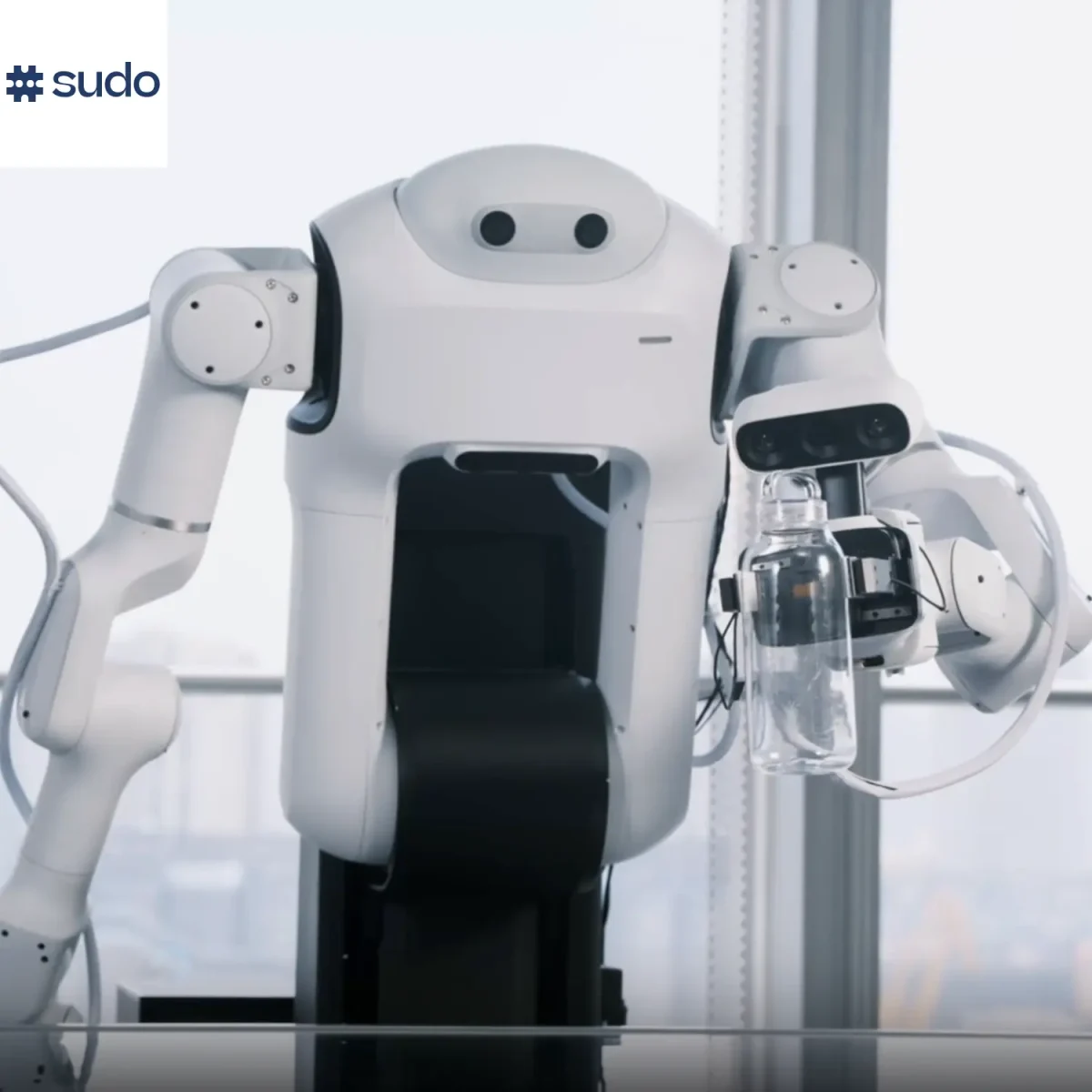
What is the Sudo R1?
The Sudo R1 is a full-size bipedal humanoid robot created by Chinese startup Sudo AI, headquartered in Beijing. Founded in 2023, the company is developing the R1 as a software-defined robotics platform for industrial automation and research. The robot features 34 degrees of freedom, stands 160 cm tall, and weighs just 0.9 kg — an unusually lightweight design suggesting use of advanced composite materials or a focus on lightweight actuation. Its top speed of 19.4 km/h (5.4 m/s) is notably fast for a humanoid, hinting at dynamic mobility capabilities. As of 2026, the R1 remains in development, with no official release date or pricing announced, and only pre-production prototypes exist.
Specifications
Here are the full technical specifications.
| Spec | Value |
|---|---|
| Height | 160 cm |
| Weight | 0.9 kg |
| Degrees of freedom | 34 |
| Battery life | Not specified |
| Max speed | 19.4 km/h |
| Payload | Not specified |
| Price (new) | Undisclosed (contact manufacturer) |
| Price (used range) | N/A |
Price & Value
New MSRP: Undisclosed (contact manufacturer)
Used range: N/A
Sudo AI has not announced pricing for the R1 as of 2026. Without a confirmed MSRP, it is impossible to assess value against competitors like the Unitree H1 (~$90,000) or Fourier GR-1 (~$150,000). The R1’s lightweight design and high speed may position it as a cost-effective platform if priced competitively, but no indicators have been given. Early-stage humanoid robots often enter the market at $100,000–$200,000 for research units, and the R1 could fall into that range. Buyers should wait for official pricing and real-world performance data before making procurement decisions. The lack of battery and payload specifications further clouds total cost of ownership estimates.
Who Is It For?
Best for: - Robotics research labs investigating high-speed bipedal locomotion and lightweight dynamic control - Software-focused R&D teams exploring embodied AI and VLA (Vision-Language-Action) foundation models on humanoid hardware - Industrial automation pilots that do not require heavy payloads and can benefit from a fast, lightweight platform
Not for: - Applications requiring payload manipulation above 6 kg (arm payload unpublished; standing payload is only 6 kg) - Outdoor or harsh-environment deployment (no IP rating or ruggedness data) - Organizations needing immediate production-ready robots with support infrastructure
Alternatives & Comparison
The Sudo R1 competes conceptually with other full-size humanoids like the Unitree H1 and Fourier GR-1, although it remains unavailable for purchase. These comparisons highlight the trade-offs a potential buyer would face once the R1 reaches market.
| Model | Price | Available | Key Difference |
|---|---|---|---|
| Unitree H1 | $90,000 | yes | Higher torque actuators and proven locomotion from an established quadrupedal manufacturer |
| Fourier GR-1 | $150,000 | preorder | Unique joint design aimed at compliant interaction and rehabilitation applications |
Verdict: For buyers ready to deploy a proven humanoid today, the Unitree H1 is the clear choice with its available hardware and real-world testing. The Sudo R1, while intriguing for its extreme speed and software-first concept, remains a prototype with no launch timeline. Unless you specifically need the R1’s unique velocity profile or are a research lab willing to wait, the H1 offers more immediate value. The Fourier GR-1 wins for rehabilitation and safe human-robot interaction, but its higher price may be hard to justify unless that specialisation is mandatory.
Use Cases & Capabilities
High-Speed Bipedal Locomotion Research
The Sudo R1’s reported top speed of 19.4 km/h makes it one of the fastest full-size humanoids announced, offering a unique platform for biomechanical and control studies. Research groups can explore dynamic running, push recovery, and real-time gait optimization. The 34-DOF body provides ample kinematic complexity to test algorithms on a lightweight frame where inertia and power requirements differ from heavier robots. However, without confirmed battery life, sustained high-speed testing may be limited by power supply.
Software-Defined Robotics R&D
Sudo AI markets the R1 as a software-defined robot, implying that its hardware is designed to be generic and modular, with core functionality delivered through advanced AI and foundation models. This makes it attractive for teams developing embodied VLA (Vision-Language-Action) systems, reinforcement learning policies, or cloud-connected robot intelligence. The lack of proprietary hardware lock-in could simplify customisation compared to more closed platforms. Actual software stack details remain undisclosed, so early adopters should verify SDK maturity before committing.
Lightweight Industrial Automation Trials
With its low weight of just 0.9 kg and fast movement, the R1 could trial in assembly or logistics tasks where speed and flexibility outweigh heavy payload needs. It could zip between workstations, read barcodes, or perform visual inspection with onboard cameras. The 34 degrees of freedom enable dexterous manipulation for small parts, though the exact arm payload remains unknown. Companies considering automation pilots should note that the R1 is not yet production-grade and may require significant engineering support for deployment.
History & Background
Sudo AI was founded in Beijing in 2023 with the goal of creating a software-defined humanoid robotics platform. The R1 was first built as a prototype in 2024, with the company highlighting its 34-DOF design and unusually high speed. Public information remains scarce, with the startup operating in stealth mode through 2025. By 2026, the R1 had not reached commercial launch, and no pricing or production timeline had been shared. Sudo AI’s website and sporadic media appearances suggest continued development, but no venture funding or partnership announcements have been made.
Buying Used — What to Check
Confirm payload capacity The standing payload of 6 kg is the only published figure; arm/hand payload is unknown and critical for any manipulation task.
Verify battery runtime No battery life data is available—high-speed operation could drain power quickly, impacting real-world usability.
Inspect joint actuators for wear The lightweight, fast-moving design may stress small joints; early-production units should be checked for play or overheating after extended use.