What is the Svaya Bimanual?
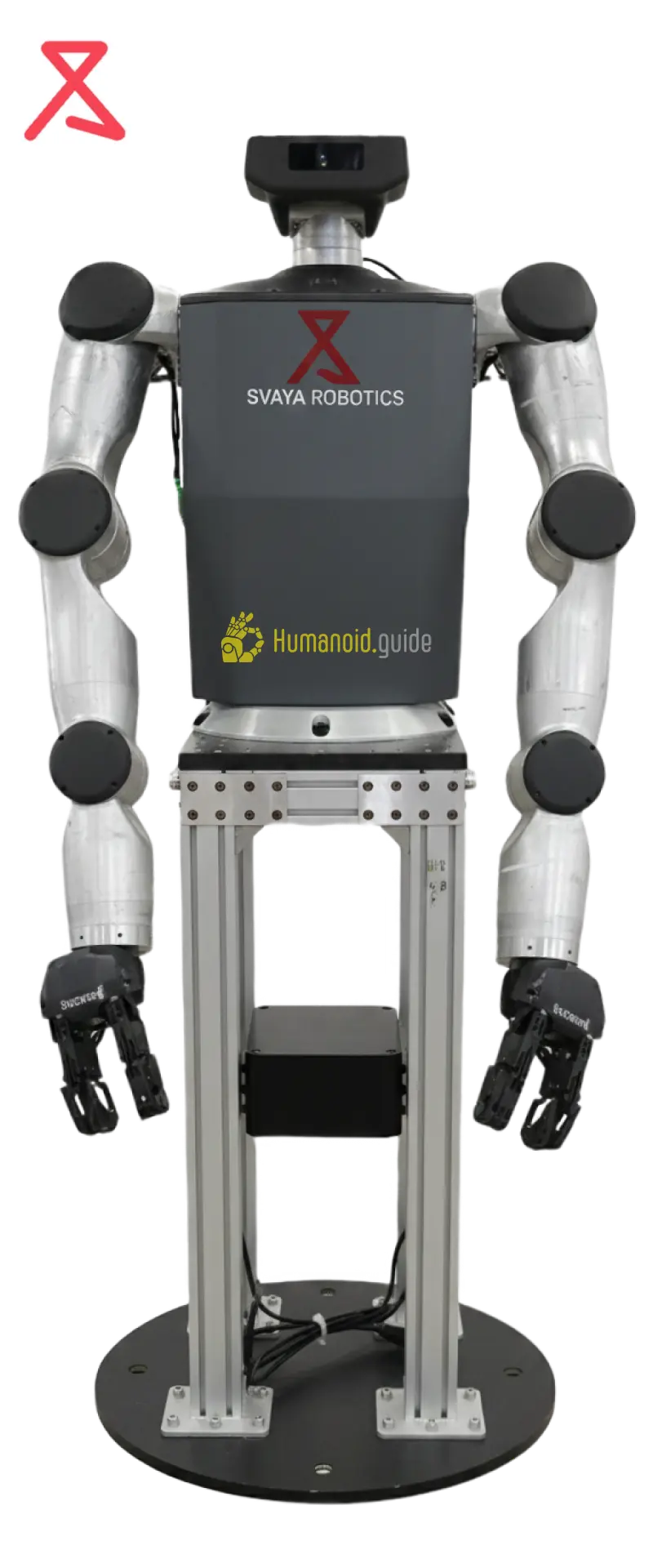
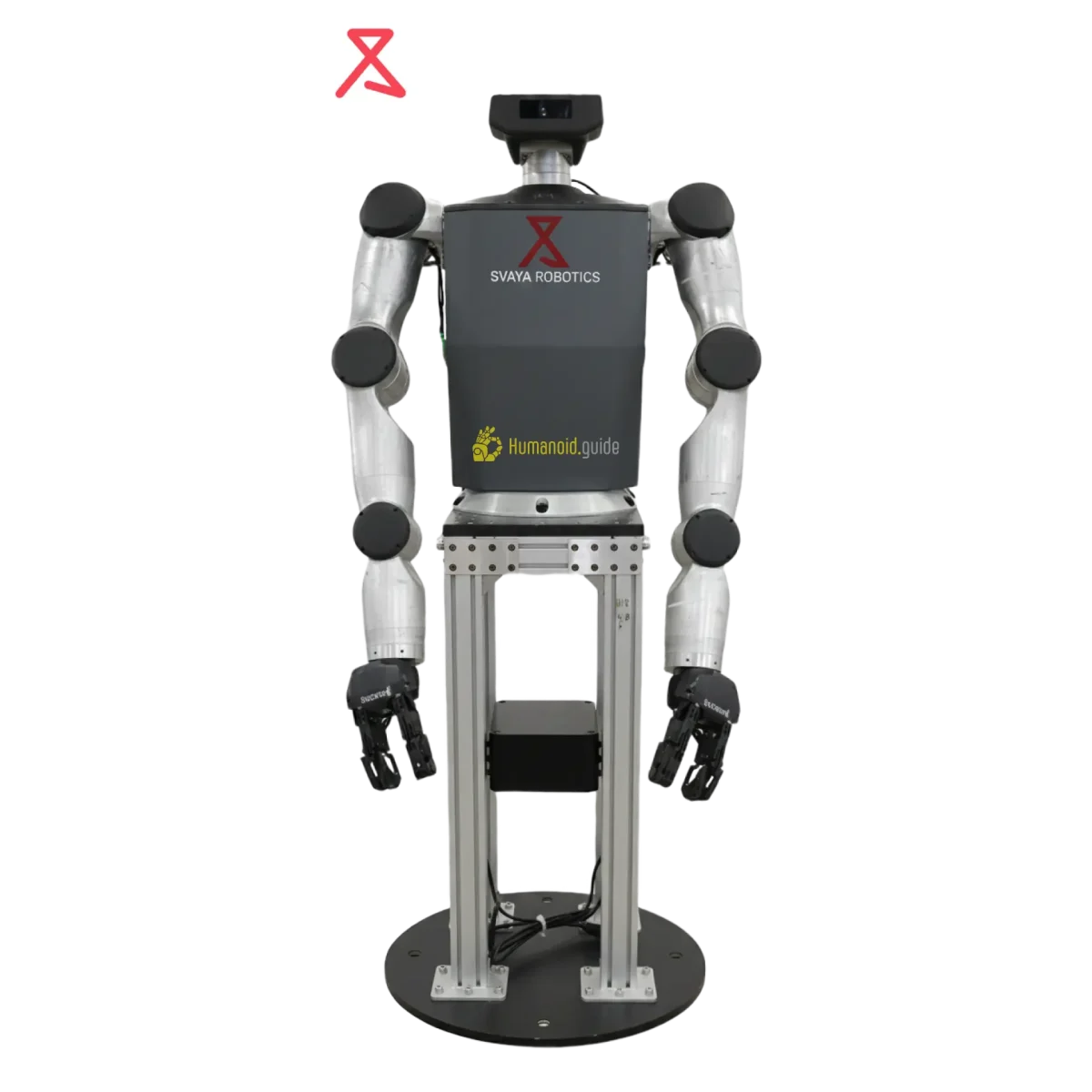
The Svaya Bimanual is a manipulation-focused humanoid upper body robot developed by Svaya Robotics, headquartered in Hyderabad, India. Rather than a full bipedal humanoid, it is a stationary bimanual torso designed for teleoperation data collection and imitation learning research. The robot features two 2-finger gripping claws on 12-DOF arms, allowing precise pick-and-place and assembly tasks. Its aluminum alloy and composite structure provides IP54 ingress protection, suitable for light industrial environments. The system runs on an industrial x86 CPU with optional NVIDIA GPU, using EtherCAT/Ethernet connectivity and a Linux-based ROS environment. Key differentiators include a high manipulation performance rating (4/5) and a glass-to-action latency of 150–250 ms, optimized for real-time teleoperation. The robot is aimed at research labs and industrial R&D exploring advanced manipulation AI.
Specifications
Here are the full technical specifications.
| Spec | Value |
|---|---|
| Height | 155 cm |
| Weight | 70 kg |
| Degrees of freedom | 12 |
| Battery life | 2 hours |
| Max speed | 0 km/h |
| Payload | 10 kg |
| Price (new) | $90,000 |
| Price (used range) | N/A |
Price & Value
New MSRP: $90,000
Used range: N/A
At $90,000, the Svaya Bimanual occupies a premium niche for a stationary upper body, reflecting its industrial-grade electric servo motors, IP54 protection, and low-latency control loop. For research labs focused on teleoperation and imitation learning, this cost is competitive against designing a custom bimanual cell, but it is significantly more expensive than open-source alternatives like Reachy (~$20k). However, the Bimanual's robust construction and real-time EtherCAT backbone should reduce integration downtime and improve data quality, potentially accelerating AI development. As a pre-commercial system, depreciation is not yet established, but early adopters may see limited resale value until broader adoption occurs. Total cost of ownership includes optional NVIDIA GPU, integration with external compute, and the need for tethered power or alternative battery setups (2-hour runtime per charge).
Who Is It For?
Best for: - Research labs building large-scale teleoperation datasets (low latency and high repeatability essential) - Industrial R&D teams validating assembly workflows with bimanual dexterity before scaling to full humanoids - Academic groups specializing in imitation learning where hardware transparency is critical
Not for: - Mobile manipulation tasks (robot is stationary, 0 km/h max speed) - Heavy-payload industrial operations (payload limited to 10 kg) - Budget-constrained educational programs (starting price $90,000)
Alternatives & Comparison
Stationary bimanual manipulation platforms range from open-source academic tools to industrial-grade research cells. The Svaya Bimanual competes mainly with the Pollen Robotics Reachy, offering a distinct trade-off between cost, build quality, and real-time performance.
| Model | Price | Available | Key Difference |
|---|---|---|---|
| Pollen Robotics Reachy | $20,000 | yes | Lower cost and fully open-source with an expressive head, but lower IP rating and payload (~3 kg) |
Verdict: For university labs needing an open, expandable platform on a tight budget, Reachy is the clear winner. However, if your work demands industrial reliability, IP54 protection, and 150–250 ms glass-to-action latency for high-fidelity teleoperation data, the Svaya Bimanual’s $90k investment is justified. Choose Reachy for prototyping and education; choose Bimanual for production-grade imitation learning pipelines.
Use Cases & Capabilities
Teleoperation Data Collection
The Bimanual is purpose-built for remote operation data pipelines. Its 12-DOF arms, 2-finger gripping claws, and 150–250 ms latency allow an operator wearing VR controllers to perform precise manipulation tasks while the system records joint positions, forces, and camera feeds. Because it runs on EtherCAT and ROS, data can be streamed directly into learning frameworks like robomimic. The stationary design eliminates locomotion complexity, letting researchers focus entirely on grasping and in-hand manipulation. However, its limited 2-hour battery life (or tethered operation) means collection runs must be scheduled carefully.
Imitation Learning Research
With a manipulation performance rating of 4/5, the robot provides repeatable, low-noise demonstrations needed for behavioral cloning and diffusion policy training. The optional NVIDIA GPU allows onboard inference, enabling real-time policy rollout verification. Its aluminum/composite body and IP54 sealing mean it can operate in mild industrial settings, bridging the gap between lab and factory floor. Researchers can rapidly iterate on network architectures without worrying about hardware variability. A limitation is the lack of finger-level dexterity (2-finger claws), which may restrict fine-grained manipulation research.
Industrial R&D for Assembly Tasks
Before deploying full humanoids, factories can use the Bimanual to validate bimanual assembly sequences—screwing, inserting, and material handling—in a controlled cell. With support for Profinet and Modbus TCP, it integrates into existing PLC-driven production lines. The 10 kg payload handles small to medium components. Its IP54 rating protects against dust and light splashes, suitable for non-harsh factory environments. The lack of mobility means parts must be presented within the fixed workspace; conveyor or rotary table integration is essential.
Academic Robotics Labs
As a research tool for embodied AI, the Svaya Bimanual offers industrial-grade kinematics and sensor reliability that consumer-grade kits cannot match. Labs can develop advanced control algorithms using its Linux ROS environment and publish results with confidence in repeatability. The $90,000 price tag, however, limits acquisition to well-funded groups or shared facilities. It is most appropriate for PhD-level work on shared autonomy, sim-to-real transfer, or learning from demonstration. The lack of an integrated camera system requires researchers to add external RGB-D sensors.
History & Background
Svaya Robotics was founded in 2019 in Hyderabad, India, initially focusing on collaborative robot arms for industrial automation. The company leveraged its experience in servo drives and motion control to enter the humanoid space. In 2024, it unveiled the Bimanual—a manipulation-first upper body humanoid designed explicitly for teleoperation and imitation learning research. This marked a strategic pivot toward embodied AI data collection, complementing the rise of large behavior models. As of 2026, the Bimanual remains in early production/limited release, with units shipped to select research partners. There are no publicly disclosed product generations or ownership changes; the platform continues to evolve with potential future sensing and end-effector upgrades.
Buying Used — What to Check
Verify payload rating Payload of 10 kg is critical for industrial tasks; confirm it can handle targeted components before purchase.
Inspect actuator condition Electric servo motors and harmonic/planetary gears wear under heavy use—check service history and noise levels if buying a used unit.
Confirm OS and SDK availability Linux ROS environment and integration libraries may require updates or licenses; ensure compatibility with your existing software stack.