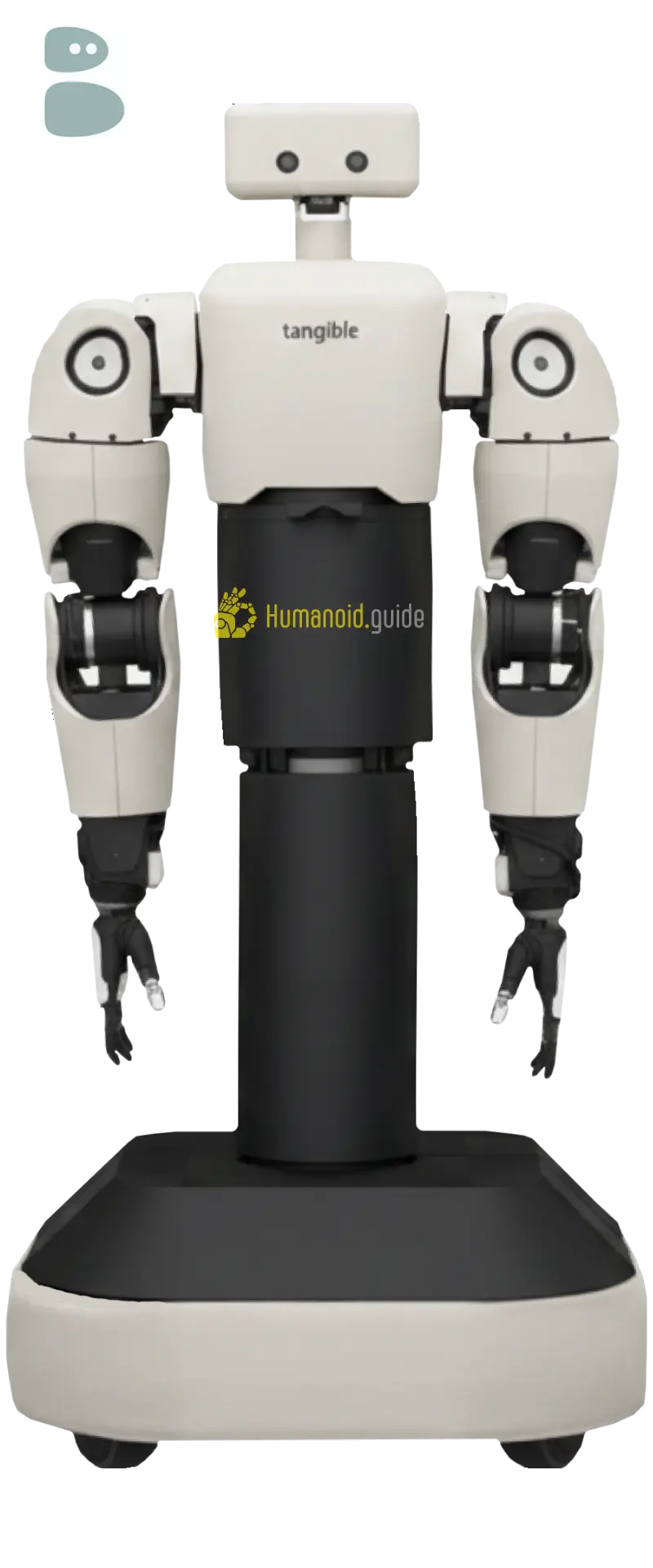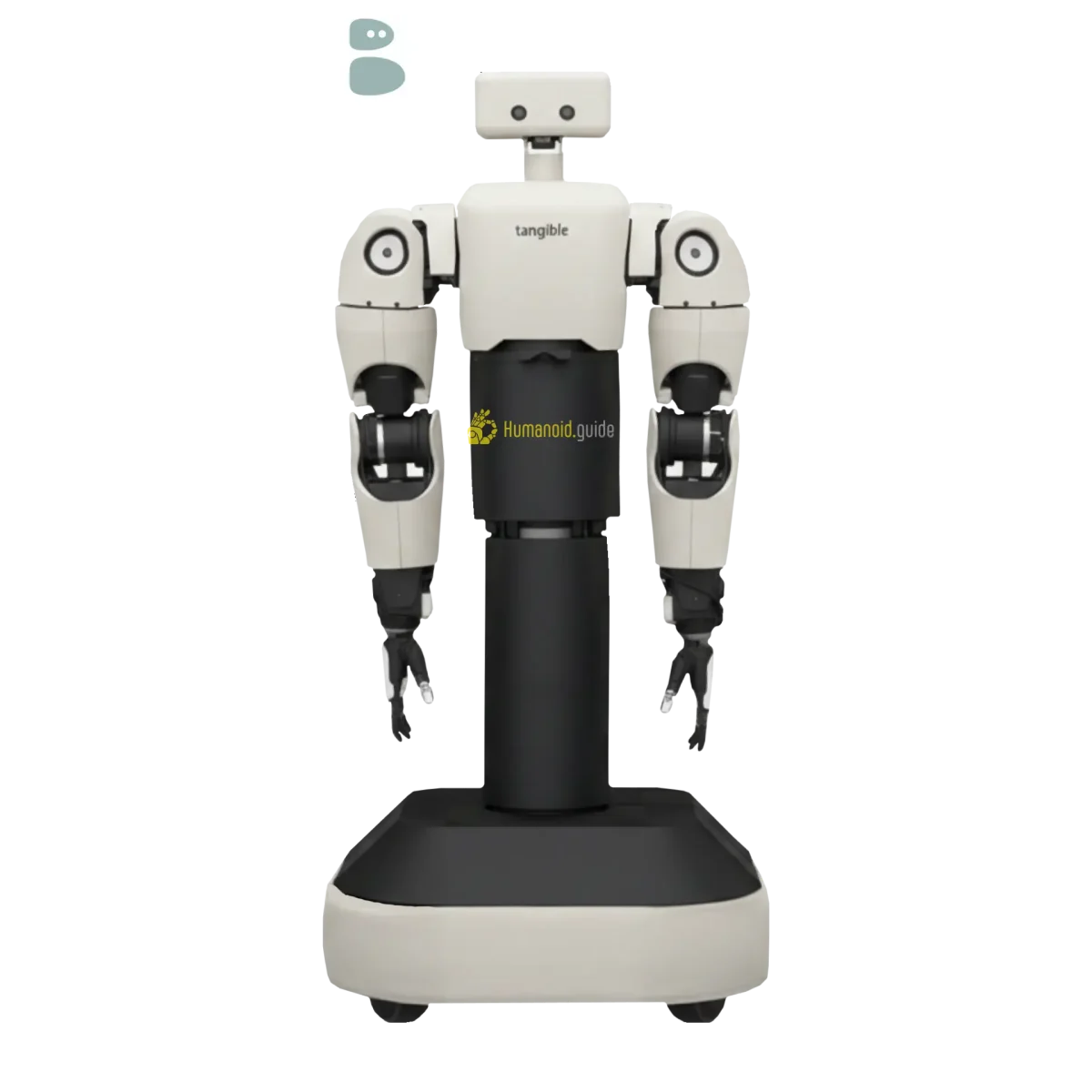
What is the Tangible Eggie?
The Tangible Eggie is a full-size humanoid robot with a distinctive egg-shaped body, engineered by Tangible Robots (US) for public-facing interaction and hospitality service. Standing 160 cm tall and weighing 45 kg, it combines an approachable design with 20 degrees of freedom, dual 1080p depth-RGB cameras, and cloud-based large language model integration for natural conversation. Built on a Linux ROS framework with NVIDIA Jetson-class compute, Eggie is intended for exhibitions, home assistance, and research & education. Its white composite shell and aluminum frame house electric servo motors with plastic gearing, yielding a safe, quiet presence in human environments. The robot remains a pre-commercial prototype as of 2026, available only through direct manufacturer inquiry.
Specifications
Here are the full technical specifications.
| Spec | Value |
|---|---|
| Height | 160 cm |
| Weight | 45 kg |
| Degrees of freedom | 20 |
| Battery life | 7 hours |
| Max speed | 3 km/h |
| Payload | 4 kg |
| Price (new) | $32,000 |
| Price (used range) | N/A (no secondary market) |
Price & Value
New MSRP: $32,000
Used range: N/A
At $32,000, the Eggie positions itself as a mid-cost humanoid alternative to far more expensive service robots like Engineered Arts Ameca or UBTECH Walker S, while offering a larger, more capable form factor than tabletop social bots like NAO. For a pre‑commercial prototype, this quoted price likely reflects a pilot program fee rather than a final volume price; real-world deployment costs may rise once production scales. Compared to a used Softbank Pepper at $15–20k, the Eggie’s bipedal (or wheeled?) stationary base and full-height presence could justify the premium for hospitality applications that demand visual impact. As a prototype, depreciation is not yet measurable, but early adopters should budget for software development and potentially higher maintenance due to unproven reliability. Overall, Eggie offers a compelling price point for an interactive humanoid, provided Tangible Robots delivers on its promised 7‑hour battery and cloud AI integration.
Who Is It For?
Best for: - Hospitality venues seeking a full-size humanoid greeter or concierge (egg-shaped design reduces intimidation, 160 cm eye-level presence). - University and corporate R&D labs needing an affordable humanoid platform for HRI and service robotics research (ROS, cloud LLM, dual cameras). - Exhibition organizers wanting a visually distinctive, conversational robot to attract visitor attention and deliver information.
Not for: - Industrial manufacturing tasks (limited to 4 kg payload, only 3 DOF hands, no ruggedization beyond IP20). - Heavy outdoor deployment (no walking capability, max speed 3 km/h, IP20 not weather-sealed). - Budget-conscious buyers seeking sub‑$10,000 solutions — a used Pepper or NAO may be more economical for basic social interaction.
Alternatives & Comparison
The Eggie competes in the small but growing market of social humanoid robots priced under $50,000. The following alternatives represent what a hospitality or education buyer might realistically evaluate.
| Model | Price | Available | Key Difference |
|---|---|---|---|
| Softbank Robotics Pepper | ~$15,000–$20,000 (used) | yes | Commercially proven but wheeled only; Eggie offers a taller bipedal/stationary design and newer LLM integration. |
| Softbank Robotics NAO6 | ~$10,000 (new) | yes | Small (58 cm) desktop social robot; Eggie’s adult height and payload make it suitable for service tasks Pepper cannot perform. |
| Engineered Arts Ameca | Estimated >$100,000 | yes | Expressive face and high dexterity, but 3× the cost; Eggie targets price-sensitive pilot programs. |
Verdict: For a hospitality pilot needing an approachable humanoid with genuine LLM-driven conversation at under $35k, the Eggie is a strong candidate — provided it reaches production. If you need a shipping product today, a used Pepper is the safer, proven choice, albeit limited to wheeled interaction. For labs that prioritize ROS and AI development, the NAO remains unbeatable for rapid prototyping, but lacks the presence and payload of the Eggie. Ultimately, the Eggie’s success hinges on Tangible Robots’ execution, but on paper it fills a clear gap between toy-sized social bots and six-figure humanoids.
Use Cases & Capabilities
Hospitality Concierge
In a hotel lobby or restaurant entrance, the Eggie can greet guests, answer common questions via its cloud-connected LLM, and provide directions using its built-in display or speech. Standing 160 cm tall, it makes eye contact with adults, creating a welcoming first impression. The robot’s white, smooth shell and gentle movements (electric servos, limited speed) prevent it from seeming threatening. Integration with Wi‑Fi and Bluetooth allows it to relay guest requests to back‑end systems, though its 3 km/h top speed and lack of walking means it is best positioned at a fixed welcome desk rather than traversing large floor plans.
Exhibition & Museum Interaction
Trade show booths and museum galleries benefit from the Eggie’s unusual egg shape, which naturally draws curiosity. Its dual 1080p depth cameras can detect visitor proximity and initiate conversation, while the LLM backend delivers tailored narratives or product information. The 7‑hour battery covers a full exhibition day without recharging, and the IP20 rating is acceptable for indoor, climate-controlled venues. Because the robot is still a prototype, exhibitors should coordinate closely with Tangible Robots for on‑site technical support, but the potential for memorable, intelligent interaction is high.
Research & Education Platform
University labs studying human-robot interaction or social service robotics will find the Eggie a cost‑effective full‑scale platform. Running Linux with ROS, it can be programmed for custom behaviors, and the likely NVIDIA Jetson compute supports on‑device AI experiments. The 20 DOF (including 3‑DOF hands) allow basic manipulation studies, and the dual depth cameras provide rich visual data. At $32,000, it is significantly cheaper than many research humanoids, though the prototype status means labs should plan for iterative hardware improvements and potentially limited repair documentation compared to a mature product like the NAO.
Home Assistance Demo
As a proof‑of‑concept for elderly or home care, the Eggie can serve as a stationary companion that sets reminders, offers media playback, and connects to smart home devices over Bluetooth/Wi‑Fi. Its safe, rounded design and 4 kg payload capability allow it to carry small objects (e.g., medication, books) on a tablet tray. However, without walking ability and with a top speed of only 3 km/h, it cannot navigate stairs or move quickly to a user in another room. This use case is more visionary than practical today, but highlights the Eggie’s potential in long‑term assisted living research.
History & Background
Tangible Robots, the US‑based developer of the Eggie, is a startup AI robotics firm with a focus on social humanoid interaction. The exact founding year has not been publicly disclosed, but the robot was first built in 2024, with initial prototype demonstrations targeting hospitality and education markets. The company’s website (tangiblerobots.ai) indicates an existing product line or research platform, though details beyond the Eggie are scarce. As of 2026, the Eggie remains in a pre‑commercial prototype phase, with no known large‑scale deployments or venture capital announcements. The robot’s egg‑shaped form factor and emphasis on cloud LLM integration suggest a design philosophy rooted in approachability and software‑driven utility, rather than heavy‑duty industrial capability. No successor model or hardware revision has been announced, so interested parties should contact Tangible Robots directly for the latest status and timeline to market readiness.
Buying Used — What to Check
Verify prototype hardware version Early pre‑commercial units may differ significantly from the final production spec; confirm DOF, compute board, and battery capacity match your needs.
Assess software support maturity Prototype status means limited documentation and community; ensure you can access ROS packages and LLM API keys for your application.
Confirm battery health and runtime Li‑ion cells degrade over time even in storage. Request a battery discharge test to verify the claimed 7‑hour endurance.