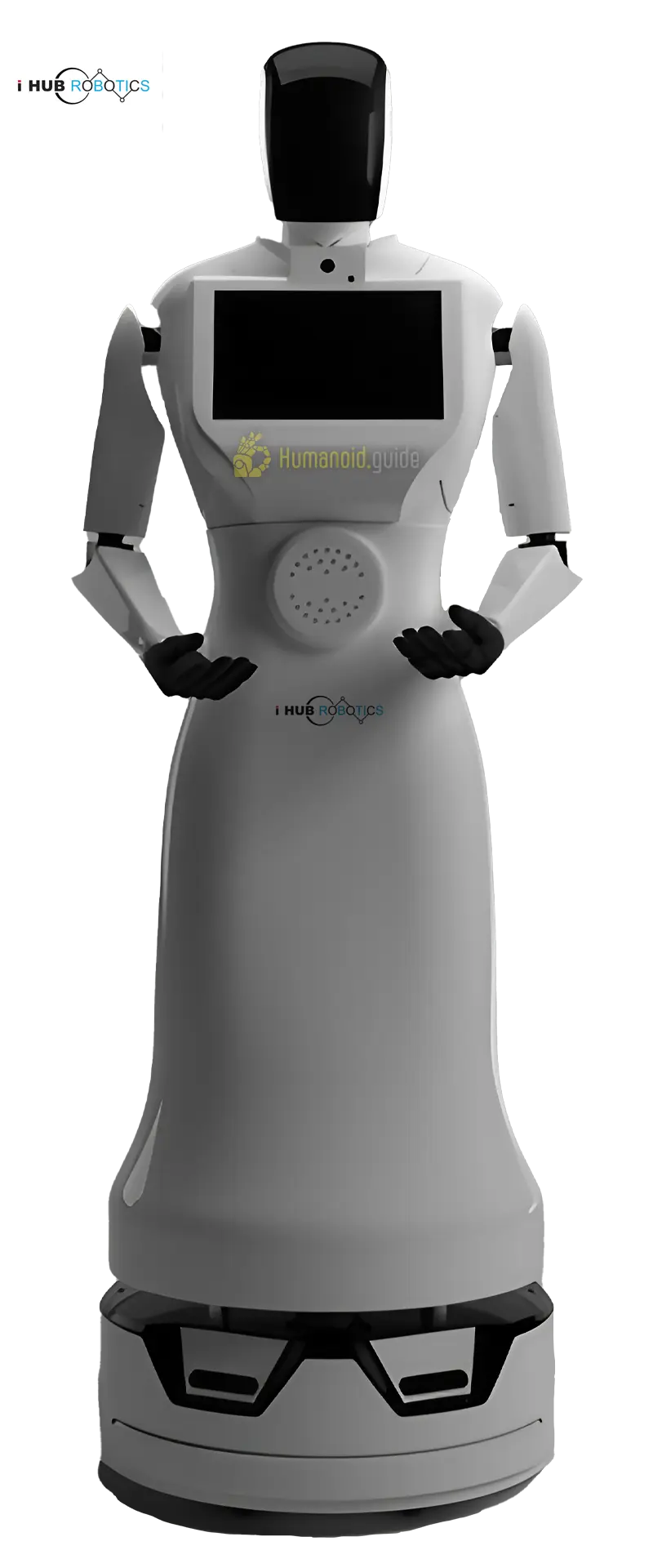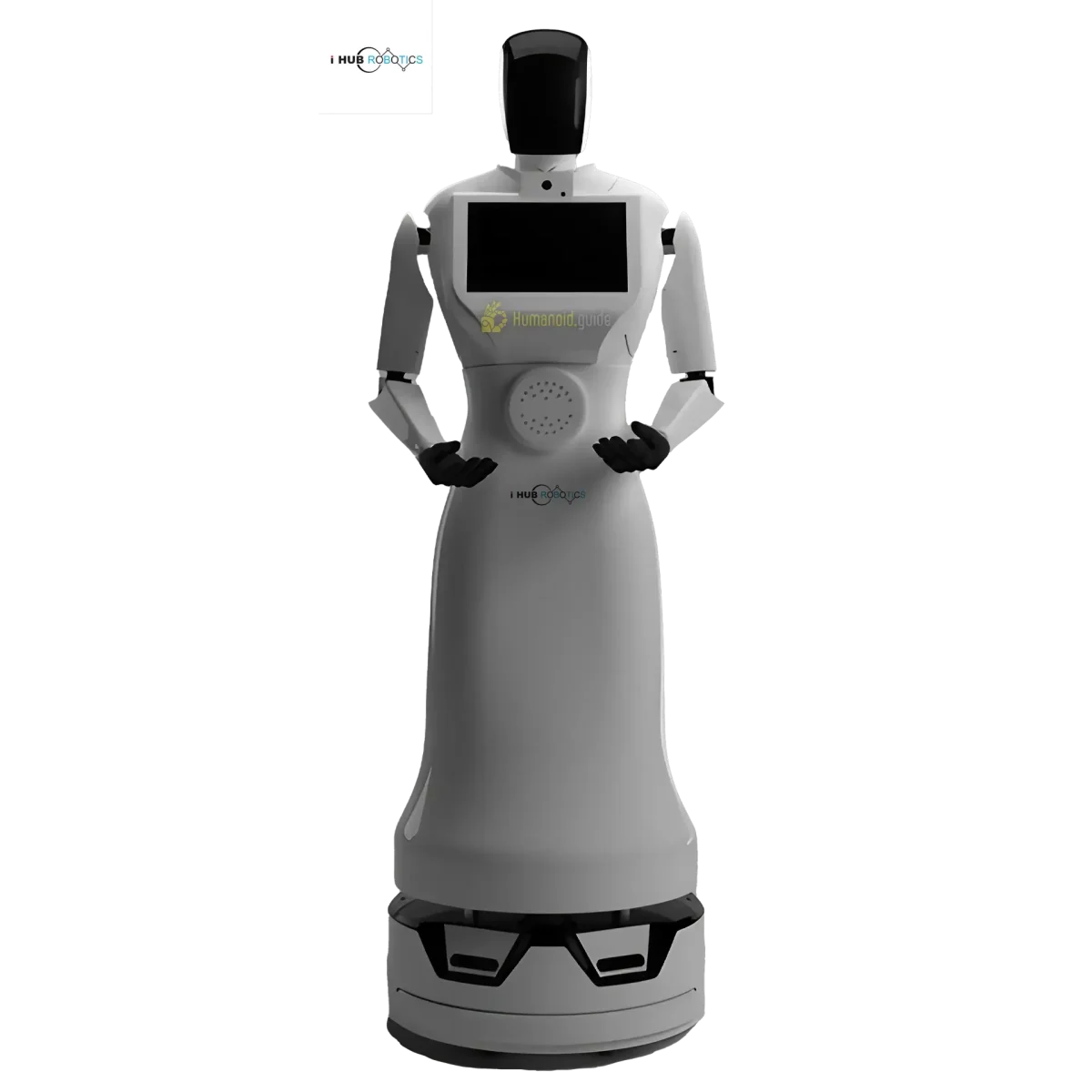
What is the Tara Gen1?
The TARA Gen1 is a humanoid robot designed and manufactured by iHub Robotics, an Indian automation company. It represents one of the country's first indigenous humanoid platforms, targeting service roles in airports, banks, education, and logistics. Standing 163 cm tall and weighing 75 kg, the robot features a 3‑DOF configuration (head and arms) with gripper-equipped hands, a 4K camera, and an NVIDIA Ampere GPU running Ubuntu with LLama 3 integration for natural interaction. Its 8‑hour battery life and IP53 ingress protection make it suitable for indoor semi-public environments. The TARA Gen1 is offered at a price of $13,998, placing it among the most affordable full‑size humanoids, though it remains in pre‑commercial development as of 2026.
Specifications
Here are the full technical specifications.
| Spec | Value |
|---|---|
| Height | 163 cm |
| Weight | 75 kg |
| Degrees of freedom | 3 |
| Battery life | 8 hours |
| Max speed | 2.52 km/h |
| Payload | 2 kg |
| Price (new) | $13,998 |
| Price (used range) | N/A (pre-commercial) |
Price & Value
New MSRP: $13,998
Used range: N/A (no used units yet)
At $13,998, the TARA Gen1 is one of the cheapest full‑size humanoid robots ever announced, undercutting even the $16,000 Unitree G1. This aggressive pricing targets Indian institutions and SMEs that cannot afford the typical $100,000+ humanoids. The value proposition is modest: it offers a 3‑DOF upper body, basic onboard AI, and decent battery life for simple reception and guidance tasks. Depreciation is difficult to predict, as no used market exists, but the low entry price may limit resale value unless the robot proves reliable. Total cost of ownership will depend on spare parts availability and software support, which remain unconfirmed. For early adopters willing to accept limited manipulation and no autonomous locomotion, the TARA Gen1 provides a budget-friendly platform for service automation.
Who Is It For?
Best for: - Airport information desks (3 DOF enables basic gesturing and brochure handling) - Bank reception lobbies (humanoid form factor engages customers for queue management) - Edutech demonstration labs (affordable platform for teaching robotics and AI interaction) - Logistics front‑office tasks (greeting visitors, scanning IDs under supervision)
Not for: - Heavy industrial tasks (no published payload beyond 2 kg) - Dynamic mobile manipulation (3 DOF limits arm dexterity; no bipedal walking) - Outdoor deployments without shelter (IP53 is insufficient for rain or dust) - Research requiring high‑DOF hand control (only 3 DOF total body movement)
Alternatives & Comparison
The TARA Gen1 competes in the ultra‑affordable humanoid segment, where few full‑size robots exist. Below is its closest realistic alternative.
| Model | Price | Available | Key Difference |
|---|---|---|---|
| Unitree G1 | ~$16,000 (est.) | preorder | 23 DOF and bipedal locomotion vs TARA Gen1's 3 DOF and stationary base |
Verdict: If your project demands any form of autonomous walking, dexterous manipulation, or AI research beyond a conversational agent, save for the Unitree G1 — it offers dramatically more capability for only $2,000 more. The TARA Gen1 wins only when the absolute lowest price is paramount and tasks are limited to scripted upper‑body movements in a single location. For most buyers, the G1's 23 DOF and mobile base justify the small premium.
Use Cases & Capabilities
Airport Customer Assistance
Stations the TARA Gen1 at information kiosks to answer frequent flyer questions, show directions on its integrated screen, and hand out maps with its 2‑DOF arms. The robot's 4K camera can read boarding passes, while LLama 3 integration provides multilingual support. Its IP53 rating is sufficient for the semi‑outdoor airport environment, and 8‑hour battery life covers a full shift. However, the 3‑DOF design restricts it to stationary tasks — it cannot escort passengers to gates.
Banking Reception & Queue Management
Places the humanoid in a bank lobby to greet customers, issue token numbers, and guide them to available counters. The anthropomorphic presence increases customer engagement in financial institutions. With 2‑kg arm payload, it can lift brochures and small forms, but cannot handle cash securely. LLM integration allows it to answer basic account queries, reducing staff workload. Relying on WiFi connectivity, it must remain within the bank's network area.
Educational Technology Demonstrations
Uses the TARA Gen1 as a teaching tool in universities and technical institutes. Its low cost makes it accessible for classroom purchases, enabling students to program simple pick‑and‑place routines and conversational AI on real hardware. The Ubuntu 22.04 OS and 1024‑core NVIDIA GPU support ROS‑based experimentation. However, the 3‑DOF limitation means it cannot demonstrate advanced manipulation or locomotion algorithms, restricting its use to introductory robotics courses.
History & Background
iHub Robotics, an Indian firm, revealed the TARA Gen1 in 2024 as one of the nation's first commercial humanoid attempts. The company designed it to fill a gap in affordable service robots for domestic markets like banking and airports. Early prototypes were shown at trade events, running a 1024‑core NVIDIA Ampere GPU and Llama 3 AI models. As of 2026, the robot is still in pre‑production, with a listed price of $13,998 but no confirmed units shipping to general customers. iHub Robotics has not announced a definite release date or pilot deployment results. The TARA Gen1 remains a one‑off generation with no known variants, and its development status leans toward a work‑in‑progress rather than a mature product.
Buying Used — What to Check
Verify battery health Eight hours of runtime is central to service shifts; a degraded battery may need early replacement.
Inspect arm actuators and harmonic drives The 3‑DOF closed‑loop stepper system is a cost‑cutting choice; wear or miscalibration could cause jerky movements.
Confirm software license transfer Llama 3 integration and Ubuntu support may require a paid license tied to the original owner.