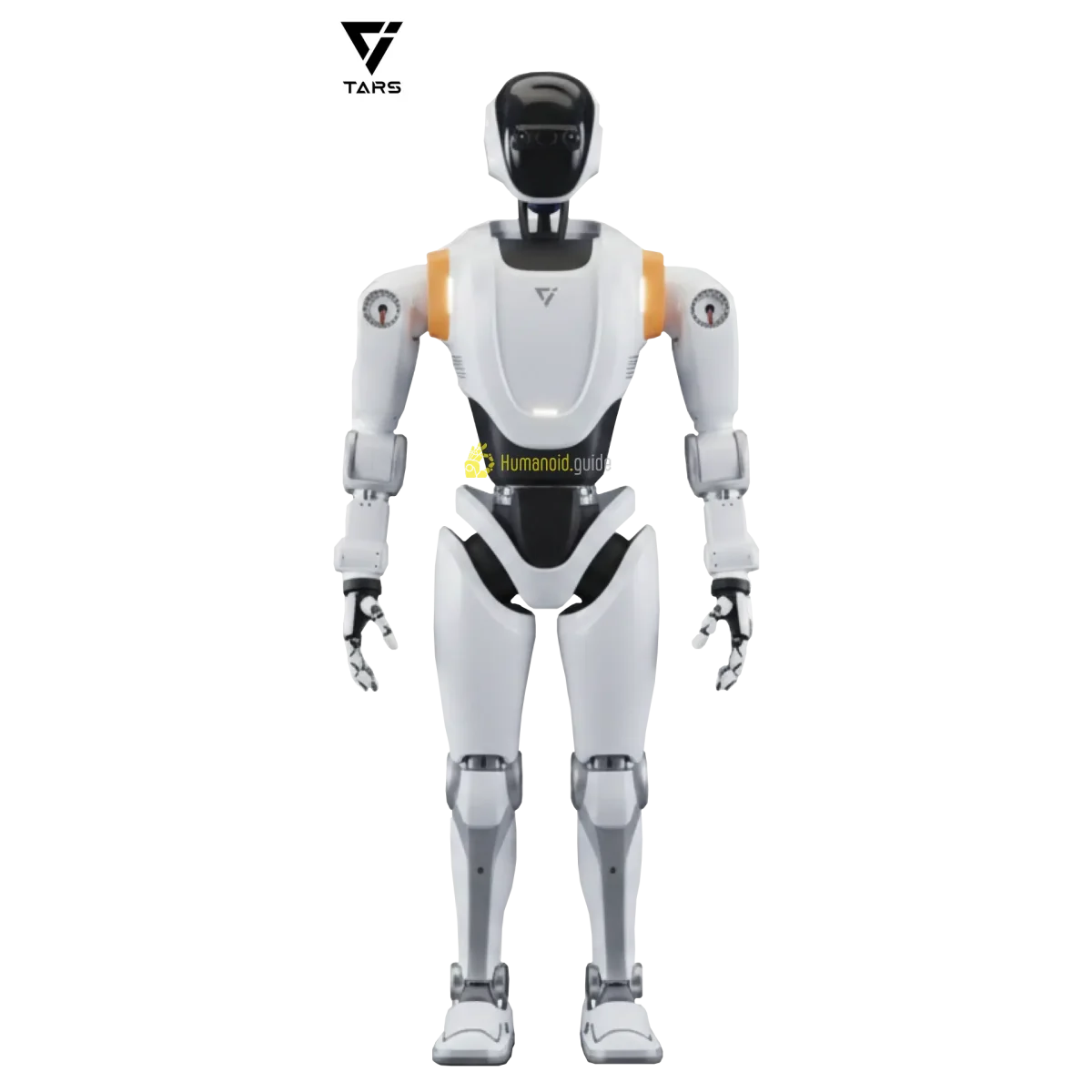
What is the Tars Humanoid?
TARS Humanoid is a bipedal humanoid robot developed by TARS Robotics, a Shanghai-based embodied AI startup founded around 2025. Designed for extreme-precision manufacturing, the robot is inspired by the fictional TARS from Interstellar and engineered to perform sub-millimeter tasks such as needle threading, wire harness assembly, and embroidery. Standing approximately 160 cm tall and weighing 80 kg, the TARS integrates advanced electric servo actuators and AI-accelerated compute for dexterous bi-manual manipulation. With 30 degrees of freedom and 3-hour battery life, it is a research platform aimed at validating ultra-fine motor skills in industrial automation, logistics, and manufacturing. As of 2026, it remains a prototype with no commercial pricing.
Specifications
Here are the full technical specifications.
| Spec | Value |
|---|---|
| Height | 160 cm |
| Weight | 80 kg |
| Degrees of freedom | 30 |
| Battery life | 3 hours |
| Max speed | 4 km/h |
| Payload | Not published (ultra-precision, no heavy carrying) |
| Price (new) | Undisclosed (contact manufacturer) |
| Price (used range) | N/A |
Price & Value
New MSRP: Undisclosed (contact manufacturer)
Used range: N/A
TARS Robotics has not disclosed a purchase price for the TARS humanoid, and it is not yet available for commercial sale. Given its specialized focus on sub-millimeter precision tasks, the robot’s value proposition is unique: no other humanoid platform currently claims such fine manipulation capabilities. When compared to general-purpose industrial humanoids like Fourier GR-2 or UBTECH Walker S, the TARS may command a premium for its precision, but potential buyers should expect a research-phase pricing model that covers hardware, software integration, and ongoing co-development. As a prototype, there is no depreciation track record; if it reaches production, residual values will depend on task-specific utility and reliability. Total cost of ownership will likely include specialized work cell integration and frequent recalibration to maintain micron-level accuracy.
Who Is It For?
Best for: - Manufacturing R&D labs exploring robotic solutions for ultra-fine tasks (sub-0.5 mm accuracy) like threading, micro-assembly, or wire routing - Academic research groups developing dexterous manipulation algorithms with force-feedback and visual servoing - Companies prototyping lights-out micro-manufacturing cells where human-level fine motor skills must be replicated
Not for: - Heavy industrial lifting or palletizing — payload is not rated and design prioritizes precision over strength - Outdoor or harsh environments (IP20 rating limits use to clean, dry indoor spaces) - High-volume production lines requiring proven cycle times and industrial reliability
Alternatives & Comparison
As a pre-commercial precision-specialist humanoid, the TARS occupies a niche with no direct competitor; however, organizations considering humanoid robotics for manufacturing will also evaluate general-purpose bipedal platforms and dexterous mobile manipulators.
| Model | Price | Available | Key Difference |
|---|---|---|---|
| Fourier GR-2 | ~$150,000 (est.) | preorder | Higher payload (5 kg/arm) for general assembly, but coarser manipulation resolution |
| UBTECH Walker S | ~$150,000 (est.) | preorder | Full bipedal walking at similar speed, with more mature walking algorithm, but hands not built for sub-mm tasks |
| Sanctuary AI Phoenix | ~$120,000 (est.) | preorder | Teleoperated fine manipulation with human-like hands, but not autonomous and uses a wheeled base, not legs |
Verdict: For labs needing extreme sub-millimeter precision in stationary bench-top tasks, the TARS is unmatched but unavailable. For commercial deployment, the Fourier GR-2 offers a more mature platform with higher payload and broader sensor suite, making it the pragmatic choice for manufacturing pilots.
Use Cases & Capabilities
Precision Wire Harness Assembly
The TARS humanoid can route and insert delicate wires into connectors requiring sub-millimeter accuracy, a task that currently demands highly skilled human technicians. Its dexterous hands and AI-driven control loop allow it to align and seat wires without damaging insulation. The robot’s 3-hour battery supports continuous work in a workcell, and its 5G-A connectivity enables remote supervision. However, because it is still a prototype, the speed and reliability in a full production line are unproven, and integration with automated feeding systems requires custom engineering.
Needle Threading and Fine Sewing
In textile and composite manufacturing, the TARS demonstrates the ability to pass a thread through a needle eye repeatedly with consistent orientation. This capability could extend to suturing in medical training simulations. The humanoid’s camera-based visual servoing compensates for slight thread variations, maintaining success rates that the manufacturer claims are over 99% in lab settings. While impressive in demos, the lack of published independent test data and environmental ruggedness limits immediate adoption. The robot is not rated for cleanroom use, restricting it to conventional manufacturing environments.
Micro-Parts Insertion and Assembly
For electronics manufacturing, the TARS is being explored as a platform for inserting tiny components into PCBs or mechanical assemblies with force feedback. Its assumed harmonic gear actuators provide the fine positional control needed for pick-and-place operations with tight tolerances. Payload is extremely low, so heavy insertion forces or pressing operations are not possible. The robot’s IP20 rating restricts use to clean, dry environments, ruling out dusty assembly floors or wet processes. Real-world throughput depends on integration with external part feeders, which remains an open research challenge.
Extreme Environment R&D
Although designed for industrial tasks, the TARS’s sci-fi-inspired design attracts research projects aiming to test humanoid platforms in simulated extreme environments—such as disaster response staging—where fine manipulation under teleoperation is studied. The robot’s onboard AI computing and 5G-A connectivity enable low-latency control from remote operators, and its bipedal form factor could navigate uneven terrain in future iterations. However, it lacks any ingress protection beyond IP20, so exposure to water, dust, or extreme temperatures would void its operational limits. Therefore, its use is confined to controlled testbeds and simulation.
History & Background
TARS Robotics was founded in Beijing in 2025, though its Shanghai operations serve as the primary development hub. The TARS humanoid robot was first revealed in 2024 as a research prototype, drawing aesthetic inspiration from the fictional robot in the film Interstellar. The company positions itself at the intersection of embodied AI and precision manufacturing, claiming to achieve repeatable accuracy below 0.5 mm in tasks like threading needles and routing flexible cables. While no commercial release date has been announced, interest from manufacturing pilot programs is driving iterative development. As of early 2026, the robot remains in the development stage, with occasional public demonstrations at tech expos and academic events.
Buying Used — What to Check
Verify precision calibration records Sub-millimeter tasks demand that actuators and vision alignment have not drifted out of factory spec.
Inspect actuator wear Electric servo actuators used for high-precision motion may degrade and lose repeatability over time.
Confirm software update history AI control policies improve rapidly; an unpatched unit may lack critical stability or safety fixes.