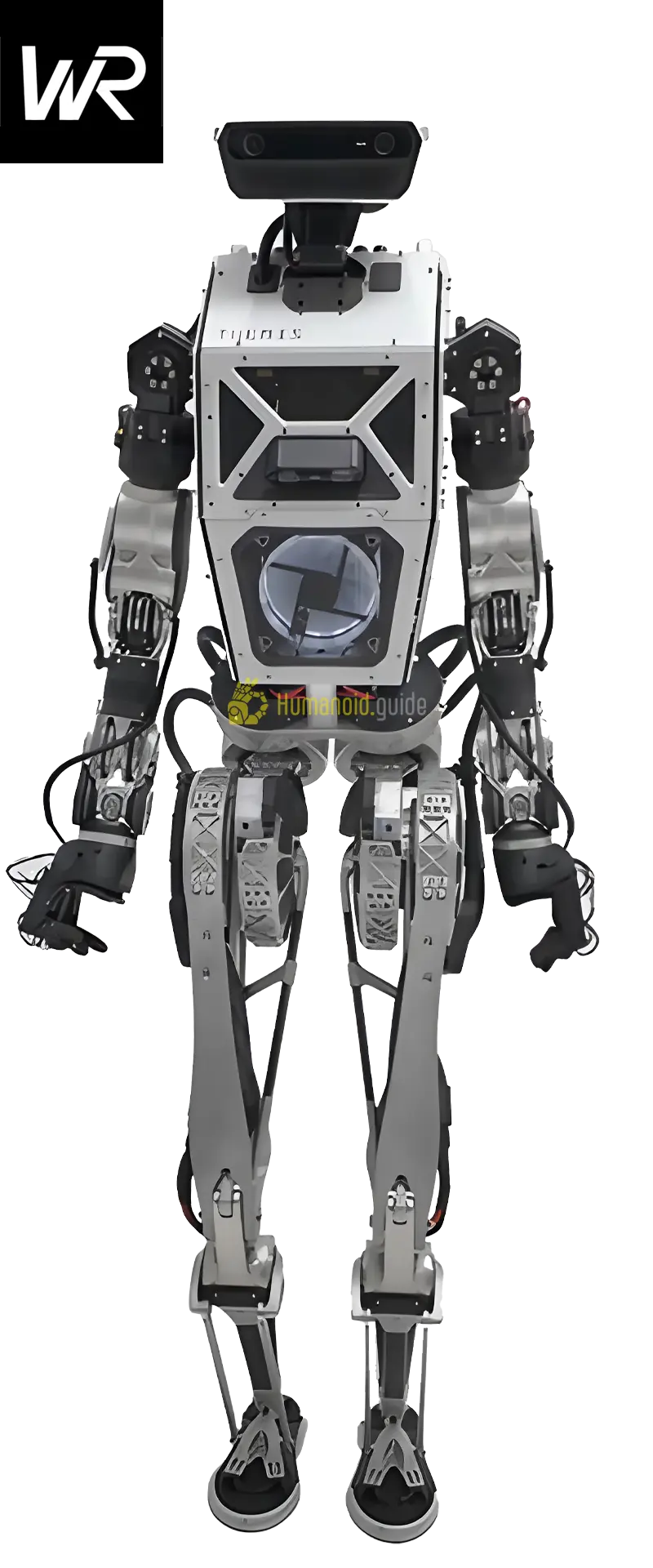
What is the Themis V2?
The Robotnik THEMIS V2 is a compact autonomous mobile robot (AMR) designed for indoor material transport in logistics, manufacturing, and healthcare settings. Manufactured by Robotnik Automation in Valencia, Spain, the THEMIS V2 differentiates itself with a 100 kg payload capacity in a 660×550×350 mm footprint—one of the highest payload-to-size ratios in its class. It navigates autonomously using SLAM, laser scanners, and depth cameras, and runs on Robotnik’s ROS-based software stack for easy integration. The robot’s differential drive and LiFePO4 battery deliver 8-hour runtime, making it a cost-effective alternative to larger AGVs for point-to-point delivery tasks.
Specifications
Here are the full technical specifications.
| Spec | Value |
|---|---|
| Height | 350 mm |
| Weight | 60 kg |
| Degrees of freedom | 2 |
| Battery life | 8 hours |
| Max speed | 5.4 km/h |
| Payload | 100 kg |
| Price (new) | €69,890 (~$75,000 USD) |
| Price (used range) | ~$40,000–$55,000 USD (estimated) |
Price & Value
New MSRP: €69,890
Used range: ≈ $40,000–$55,000 USD
At €69,890, the THEMIS V2 sits in the mid-range for industrial AMRs with 100 kg payload, directly competing with models like the MiR100 and Omron LD-90 that often retail higher without offering a significant advantage in core specs. Its value proposition is strong for small-to-medium enterprises needing reliable point-to-point transport without the overhead of complex fleet software. Depreciation is moderate—used units typically trade between $40,000 and $55,000 after 2–3 years, thanks to modular design and replaceable batteries that extend service life. Total cost of ownership includes a LiFePO4 battery pack (expected replacement every 4–5 years at roughly $2,000) and minimal maintenance on brushless drive motors. While Robotnik does not publicly advertise leasing, many European integrators offer rental options, and the robot’s ROS architecture keeps integration costs low.
Who Is It For?
Best for: - Manufacturing plants needing high-density material transport—the THEMIS V2’s 100 kg payload and compact 660×550 mm footprint fit narrow aisles. - Healthcare facilities requiring sterile supply delivery with 8-hour shift endurance and gentle acceleration for sensitive cargo. - Warehouses integrating AMRs without infrastructure changes, thanks to SLAM-based navigation and ROS compatibility for custom fleet apps.
Not for: - Outdoor or wet environments (carries no IP rating, only CE certification for indoor industrial use). - Applications requiring autonomous towing or tugging—the THEMIS V2 is designed for onboard payload, not pulling trailers. - Operations demanding pre-loaded fleet management ecosystems like MiR’s integrated software; the THEMIS relies on user-customized ROS nodes.
Alternatives & Comparison
The THEMIS V2 competes in the crowded 100 kg-class AMR market. Below we compare it to three widely adopted alternatives that buyers often evaluate for indoor goods transport.
| Model | Price | Available | Key Difference |
|---|---|---|---|
| MiR100 | Undisclosed (typical range $50,000–$70,000) | yes | More mature fleet management ecosystem with global support network. |
| Fetch Freight | Undisclosed | yes | Deep integration with FetchCore WMS software for large warehouses, similar payload. |
| Omron LD-90 | Undisclosed (est. $60,000–$75,000) | yes | Lower payload (90 kg) but uses natural feature navigation for quicker deployment without mapping beacons. |
Verdict: For budget-conscious operators who need every kilo of payload in a compact frame and already have ROS expertise, the THEMIS V2 delivers the best price-to-performance ratio. If fleet management simplicity or out-of-the-box software integration is critical, the MiR100’s ecosystem justifies its higher cost. The Omron LD-90 appeals when fast deployment without SLAM mapping is a priority, though it sacrifices payload.
Use Cases & Capabilities
Manufacturing Line-Side Delivery
The THEMIS V2 transports raw materials, components, and tooling directly to assembly stations, reducing forklift traffic and operator walking. Its 100 kg capacity handles typical parts bins, while the differential drive allows tight 360° turns at line-side. The 8-hour battery supports a full shift, and the robot can be programmed to recharge during breaks. Integration with MES via ROS enables just-in-time delivery triggers. The low deck height simplifies manual loading and unloading, and optional tablet interface lets operators summon or redirect the robot on the fly.
Warehouse Goods-to-Person Transport
In e-commerce fulfillment centers, the THEMIS V2 moves totes from picking stations to packing areas autonomously. It can follow dynamic paths using SLAM, avoiding obstacles and re-routing in real time, which is critical in busy warehouse environments. The robot’s compact size allows it to pass under conveyors or through narrow rack aisles where larger AGVs cannot. Multiple THEMIS units can be coordinated via a central fleet manager (user-developed in ROS), and each robot’s status is monitored over WiFi. This reduces walking distance for warehouse associates by up to 60% in pilot deployments.
Healthcare Logistics
Hospitals deploy the THEMIS V2 for delivering linens, meals, medications, and lab samples between departments. Its quiet, rubber-tired motion and slow acceleration ensure safe operation near patients and staff. The robot navigates using ceiling-depth cameras and laser scanners, so it does not rely on floor markings that could conflict with hospital cleaning protocols. A 3-hour charge time minimizes downtime between shifts. Payload capacity is ample for multiple meal trays or a linen cart, and the robot can be integrated into hospital communication systems for task dispatching.
Cleanroom Automated Cart Transport
The THEMIS V2’s sealed drive train and smooth surfaces make it suitable for ISO 7 cleanrooms in semiconductor or pharmaceutical manufacturing. It can carry wafer carriers or chemical containers up to 100 kg, reducing human contamination. Navigation relies on lasers and cameras that do not generate particulate emissions, and the robot can be programmed to follow strict traffic rules. Battery and electronics are enclosed, and the robot can be wiped down with cleaning agents. CE certification ensures compliance with EU machinery safety standards, and the optional emergency stop bumper adds an extra layer of protection.
History & Background
Robotnik Automation was founded in 2002 in Valencia, Spain, initially focusing on research platforms and mobile manipulation. The company launched its first THEMIS AMR around 2015 as a compact logistics robot for European factories. The V2 generation, introduced post-2020, upgraded to LiFePO4 batteries for longer cycle life, improved SLAM algorithms using onboard depth cameras, and increased payload to 100 kg while maintaining the same small footprint. Robotnik’s commitment to open-source ROS software made the THEMIS popular among integrators and universities. As of 2026, the THEMIS V2 remains in production, with hundreds of units deployed across 20 countries, supported by a growing network of certified partners. No acquisitions or major ownership changes have occurred; the company remains independent.
Buying Used — What to Check
Battery cycle count LiFePO4 batteries degrade with cycles; high cycle counts shorten remaining life, and replacements cost ~$2,000.
ROS driver version Ensure the robot's onboard PC runs a recent ROS distribution compatible with your software; outdated drivers may require paid upgrades.
Drive wheel wear Inspect rubber treads and casters—excessive wear indicates high mileage and potential upcoming motor maintenance.