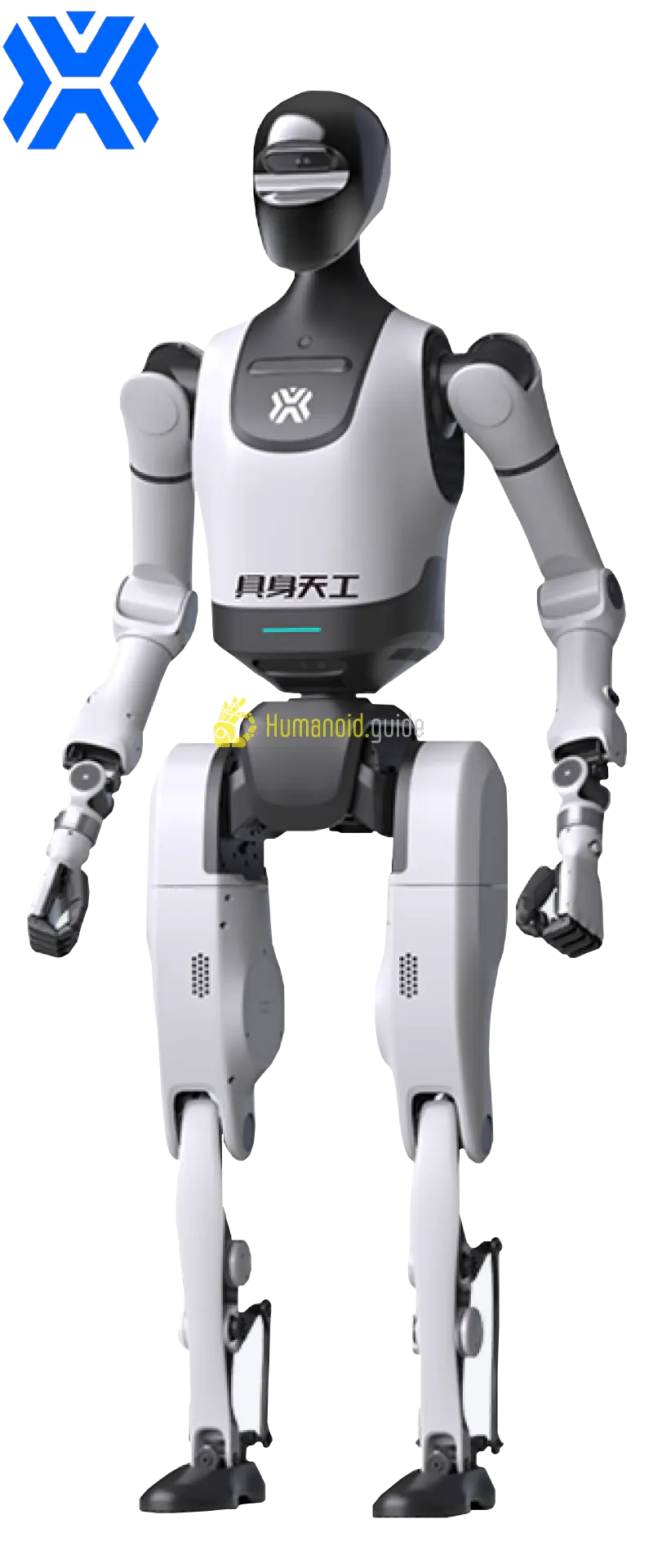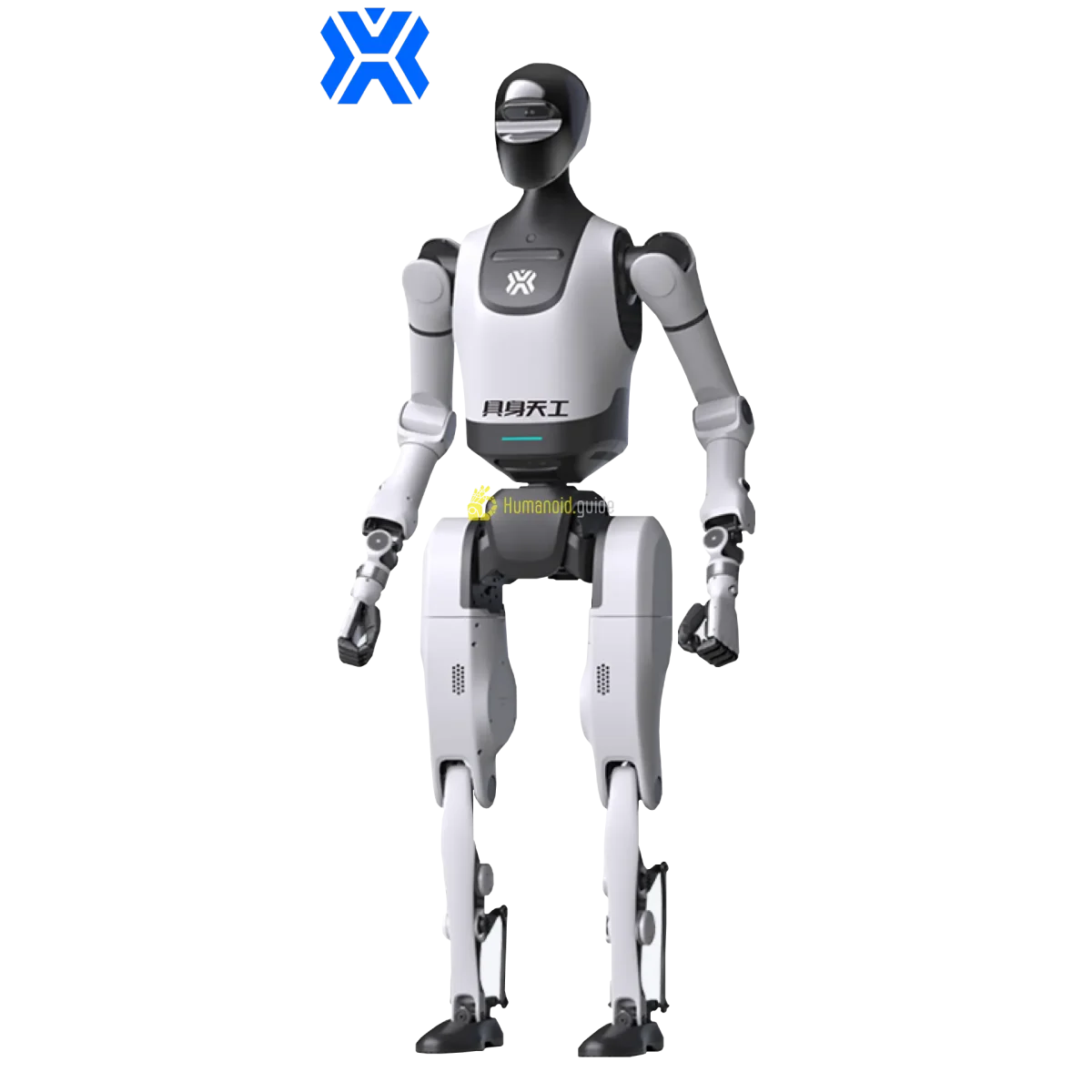
What is the Tien Kung 2?
The X-Humanoid Tien Kung 2.0 is a bipedal humanoid robot developed in China for research and industrial R&D. It serves as an open platform for embodied AI, integrating NVIDIA Jetson Orin hardware and the Hui Si Kai Wu software stack. With 20 degrees of freedom, a 12 kg payload, and a top speed of 10 km/h, it targets labs developing locomotion, manipulation, and human-robot interaction algorithms. The robot features dual swappable batteries and an alloy frame, prioritizing runtime flexibility and durability.
Specifications
Here are the full technical specifications.
| Spec | Value |
|---|---|
| Height | 1700 mm |
| Weight | 90 kg |
| Degrees of freedom | 20 |
| Battery life | Not published (dual swappable) |
| Max speed | 10 km/h |
| Payload | 12 kg |
| Price (new) | Undisclosed |
| Price (used range) | N/A (pre-commercial) |
Price & Value
New MSRP: Undisclosed (contact manufacturer)
Used range: N/A
No official pricing for the Tien Kung 2.0 has been published; X-Humanoid provides the platform through research partnerships rather than direct sales. This model likely follows enterprise pricing, where costs are negotiated based on project scope and support requirements. Compared to the mass-produced Unitree G1 at around $16,000, the Tien Kung 2.0 may carry a premium due to its open-source AI stack and specialized hardware. Depreciation potential is unknown given the absence of a secondary market, but costs will ultimately depend on software licensing and future upgrades. For labs with budget flexibility, the platform’s open architecture could deliver long-term value through customization and community-driven innovation.
Who Is It For?
Best for: - Robotics research labs requiring an open-source control stack for bipedal locomotion algorithms - Industrial R&D teams developing embodied AI applications with NVIDIA Jetson edge compute - University partners exploring dynamic humanoid mobility and human-robot interaction
Not for: - Hobbyists or individual buyers (only available through institutional partnerships) - Deployment in heavy industrial lifting (payload limited to 12 kg) - Operations needing all-day autonomy (battery runtime figures are not published, limiting planning)
Alternatives & Comparison
The Tien Kung 2.0 competes with other research-focused bipedal platforms like the Unitree G1 and the Fourier GR-2, each offering different trade-offs between openness, cost, and performance.
| Model | Price | Available | Key Difference |
|---|---|---|---|
| Unitree G1 | ~$16,000 (est.) | yes | Mass-produced, lower cost, but less open AI stack. |
| Fourier GR-2 | Undisclosed | enterprise-only | Higher payload (30+ kg), but heavier and with a more closed ecosystem. |
Verdict: For budget-conscious labs that need a ready-to-use humanoid with manipulation, the Unitree G1 is the best choice. However, if your research prioritizes custom AI behaviors and you can negotiate a partnership, the Tien Kung 2.0’s open platform gives you more control over the entire stack.
Use Cases & Capabilities
Locomotion Research
The Tien Kung 2.0 is designed for pushing the limits of bipedal walking and running. Its 10 km/h top speed and dynamic balance capabilities allow researchers to test terrain adaptation, push recovery, and energy-efficient gaits. The open-source control stack enables algorithm modification at every level, from low-level motor control to high-level path planning. Labs can integrate custom sensors and compare their methods directly with the built-in baseline. However, the lack of published battery runtime may constrain long-duration trials.
Embodied AI Development
Equipped with an NVIDIA Jetson Orin and the Hui Si Kai Wu platform, the robot serves as a testbed for vision-language navigation, LLM-driven task planning, and interactive decision-making. Researchers can deploy neural network models for object recognition and natural language commands, then observe physical execution. The platform's open architecture simplifies integration of custom AI stacks, from perception to action. Its dual swappable batteries mitigate downtime during compute-heavy experiments. Yet the computational ceiling may limit extremely large models compared to cloud-offloaded solutions.
Industrial R&D Demonstrations
Companies exploring humanoid deployment in factories can use the Tien Kung 2.0 to validate picking, carrying, and light assembly tasks. The 12 kg payload is adequate for moving small components, while the 10 km/h speed permits fast relocations between stations. Its safe design and human-aware navigation allow trials in proximity to workers. The open platform enables quick prototyping of custom grippers and vision systems. Nonetheless, the robot's research-grade nature means reliability and certification for production environments are yet to be proven.
Multi-modal Human-Robot Interaction
With app and voice interfaces, plus 5G, Ethernet, and Wi‑Fi connectivity, the Tien Kung 2.0 can be used to study natural communication between humans and machines. It can recognize gestures, respond to spoken commands, and display contextual behaviors through its embodied AI. The platform’s open stack facilitates experiments in turn-taking, emotional expression, and long-term interaction learning. Researchers can log rich sensorimotor data for social robotics studies. Limited battery information may require careful scheduling for lengthy user studies.
Academic Curriculum and Collaboration
University partners can integrate the robot into graduate courses on robotics, AI, and mechatronics. Its open-source nature allows students to modify and extend the entire system, from firmware to high-level cognition. The dual swappable batteries support back-to-back lab sessions without long recharge pauses. Collaborative projects across institutions can leverage the shared Hui Si Kai Wu platform to exchange models and gait libraries. However, availability is restricted to partnered universities, which may exclude smaller programs from access.
History & Background
X-Humanoid, a Chinese robotics company emerging around 2023, developed the Tien Kung series to advance embodied AI. The original Tien Kung was demonstrated in 2024 with basic bipedal locomotion, drawing early interest from academic labs. The Tien Kung 2.0 followed in early 2025, bringing a major upgrade: the open-source Hui Si Kai Wu AI platform, NVIDIA Jetson Orin compute, a lightweight alloy frame, and dual swappable batteries. Its top speed jumped to 10 km/h, and payload increased to 12 kg, making it a credible research tool. That same year, X-Humanoid announced the Tien Kung 3.0 with 43 degrees of freedom, signaling a rapid cycle of improvement. As of 2026, the 2.0 remains the primary platform for external research partnerships, while the company builds toward commercial deployment.
Buying Used — What to Check
Verify hardware version Early evaluation units may have different sensor suites or weaker actuators than later refinements.
Confirm AI platform updates Access to the Hui Si Kai Wu software stack and future LLM patches may depend on partnership status, affecting long-term usability.
Inspect battery health Dual swappable batteries degrade over cycles; replacement costs and availability are unknown for a pre-commercial platform.