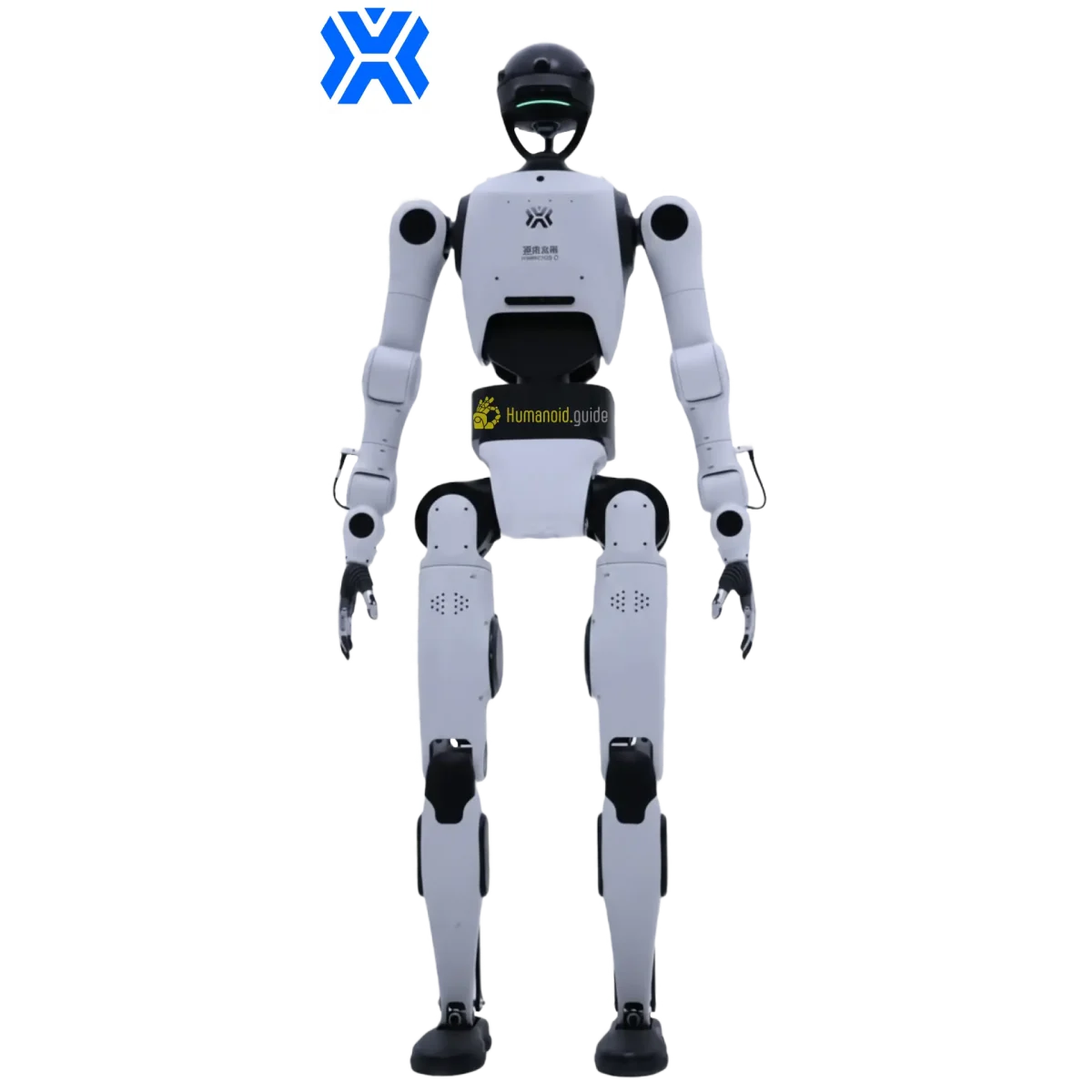
What is the Tien Kung 3?
The X-HUMANOID Tien Kung 3.0 is a full-scale humanoid robot developed by the Beijing Innovation Center of Humanoid Robotics (operating under the X-HUMANOID brand) in Beijing, China. Built as an open research platform, it is designed for bipedal locomotion research, whole-body manipulation, and embodied AI development. The robot features 43 degrees of freedom (including 12-DOF dexterous hands), harmonic-drive actuators, Nvidia Jetson Orin compute, and an Ubuntu/ROS 2 software stack. With a top walking speed of 6 km/h, 15 kg payload capacity, and 1.5–2 hour battery life, it targets academic labs, R&D centers, and industrial research partnerships. The platform supports LLM integration through the Hui Si Kai Wu embodied AI framework and real-time motion planning.
Specifications
Here are the full technical specifications.
| Spec | Value |
|---|---|
| Height | 169 cm |
| Weight | 62 kg |
| Degrees of freedom | 43 |
| Battery life | 2 hours |
| Max speed | 6 km/h |
| Payload | 15 kg |
| Price (new) | Undisclosed (contact manufacturer) |
| Price (used range) | N/A |
Price & Value
New MSRP: Undisclosed (direct enterprise sales)
Used range: N/A
Tien Kung 3.0 does not have a public list price; acquisition is handled through direct enterprise agreements, likely involving research partnerships or volume leasing. While no official figure is available, comparable humanoid platforms such as the Fourier GR-2 (~$100,000) and Unitree G1 ($16,000) suggest a wide possible range depending on configuration and support level. As a pre-commercial research platform, Tien Kung 3.0’s value lies in its open software stack, advanced mobility benchmarks (6 km/h, 15 kg payload), and integration with the Hui Si Kai Wu AI ecosystem, justifying premium pricing for labs needing cutting-edge locomotion research. The lack of a used market means no depreciation data exists; however, given the rapid pace of humanoid development, early units may lose value quickly as later versions or competitors arrive. Total cost of ownership will include ongoing software maintenance, actuator wear, and likely annual support contracts. For labs already invested in the X-HUMANOID ecosystem, the robot offers a streamlined path to embodied AI experiments.
Who Is It For?
Best for: - Advanced bipedal locomotion research labs that need an open-source, high-DOF platform with 43 degrees of freedom and 15 kg payload capacity for dexterous manipulation studies. - Embodied AI developers looking to integrate LLMs and whole-body control into a real humanoid hardware platform.
Not for: - Cost-sensitive education programs (no public pricing, likely high enterprise cost). - Rapid commercial deployments (enterprise-only sales, long lead times).
Alternatives & Comparison
In the 2026 humanoid research market, Tien Kung 3.0 competes against cost-effective education bots, high-DOF industrial research platforms, and mass-production designs.
| Model | Price | Available | Key Difference |
|---|---|---|---|
| Unitree G1 | $16,000 | yes | Lower cost, more compact, primarily for education and light research; limited payload (3 kg) and no dexterous hands. |
| Fourier GR-2 | $100,000 (est.) | yes | Higher payload (5.5 kg), advanced 12-DOF hand dexterity, industrial focus. |
| Tesla Optimus | ~$20,000 (est.) | preorder | Mass-production intent, Tesla ecosystem, expected low cost but not yet available for independent purchase. |
Verdict: For labs needing a fully open humanoid research platform with top-tier locomotion performance, Tien Kung 3.0 is the most capable option—but its enterprise-only availability and undisclosed pricing make it inaccessible to many. The Unitree G1 wins for budget-conscious programs, while the Fourier GR-2 offers a premium alternative with proven industrial hand dexterity. Tesla Optimus remains a wildcard with potential cost disruption but no confirmed specs or delivery timeline.
Use Cases & Capabilities
Bipedal Locomotion Research
The Tien Kung 3.0’s 6 km/h walking speed, high dynamic balancing, and open-source whole-body control stack make it ideal for studying bipedal gait, push recovery, and running gaits. Its 43 DOF, including 12 DOF in the legs, allow complex walking patterns and stair climbing. Researchers can integrate custom control algorithms via ROS 2 and modify the motion planning pipeline. The platform’s 15 kg payload capability also enables carrying sensor payloads during locomotion experiments, pushing the envelope of dynamic stability studies.
Whole-Body Manipulation
With 12-DOF dexterous hands and 14 DOF in the arms plus a 2-DOF waist, the robot can perform multi-step pick-and-place tasks, tool use, and collaborative assembly. The 6-axis force/torque sensors enable compliant object handling, and the 15 kg payload per arm allows manipulation of moderate-weight items. Its open software lets labs program complex task sequences and integrate with external sensors, making it a versatile platform for advanced manipulation research.
Embodied AI Development
Tien Kung 3.0 integrates with the Hui Si Kai Wu embodied AI platform, supporting large language model-driven task planning and vision-language action. Developers can deploy vision models on the built-in Nvidia Jetson Orin and experiment with zero-shot instruction following. The open Ubuntu/ROS 2 environment simplifies integration with modern AI frameworks, making it suitable for cutting-edge robotics and AI research where embodiment is key.
Industrial R&D Concept Validation
Manufacturers and logistics companies can use Tien Kung 3.0 to explore humanoid robot deployment for tasks like light assembly, kitting, and warehouse transport. The robot’s 15 kg payload and 6 km/h speed mirror many light industrial cycles. The open platform allows rapid prototyping of custom end-of-arm tooling and integration of enterprise software, giving R&D teams a realistic testbed before investing in fully commercial systems.
History & Background
The Tien Kung series emerged from the Beijing Innovation Center of Humanoid Robotics, founded in 2023 as a state-backed initiative to advance bipedal robotics. A first-generation prototype was built in 2024, followed by the 20-DOF Tien Kung 2.0 in early 2025, which demonstrated 10 km/h walking and was used primarily for academic research. The Tien Kung 3.0, launched on February 16, 2026, marked a generational leap with 43 DOF, an open-source whole-body control stack, and the embodied AI platform Hui Si Kai Wu. It is now sold directly to enterprises through X-HUMANOID, the commercial arm of the center, positioning it as China’s flagship research humanoid.
Buying Used — What to Check
Verify transferability of enterprise license Tien Kung 3.0 is sold under enterprise agreements; ensure software and support licenses can be transferred to second owner.
Inspect actuator and battery health Harmonic drive actuators degrade with heavy use, and lithium-ion battery capacity can drop to 80% after 500 cycles, affecting runtime.
Confirm open-source software version Future updates may alter capabilities or licensing; an older OS or ROS 2 version might not receive security patches.