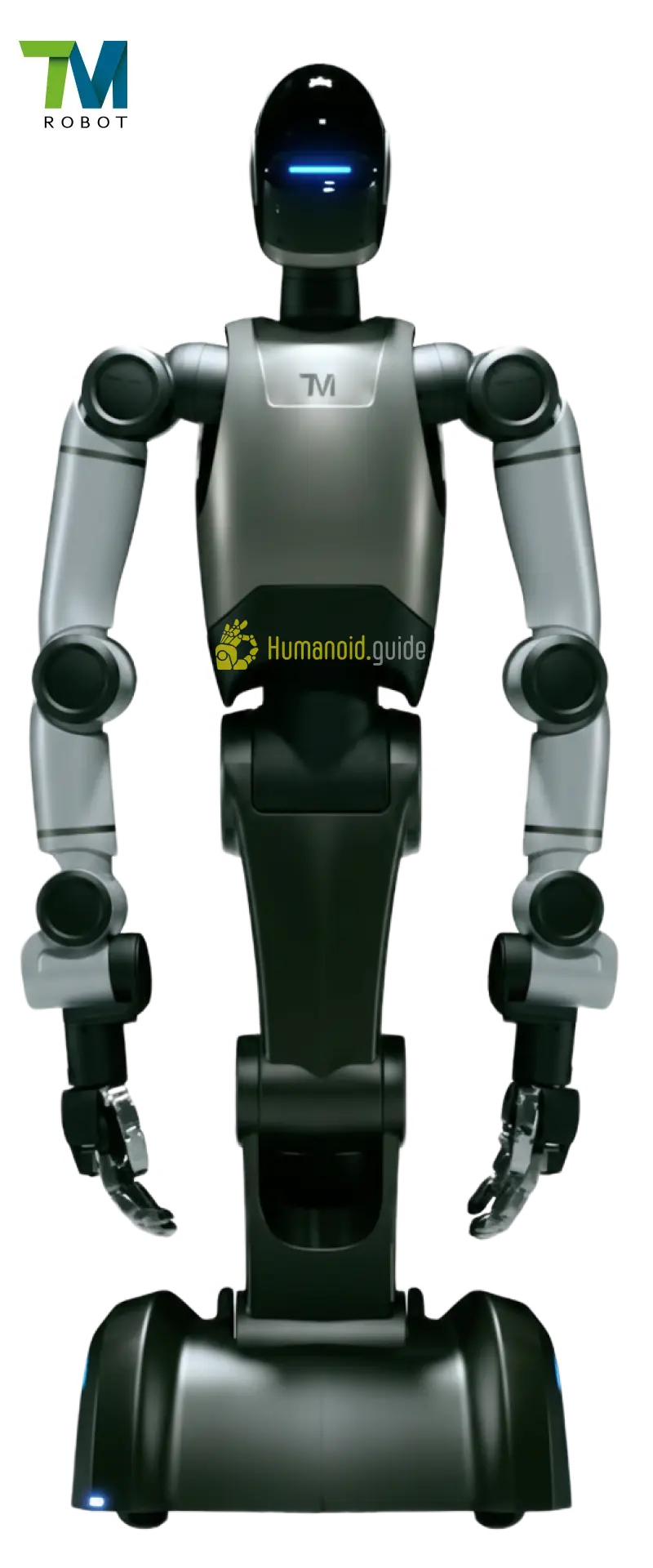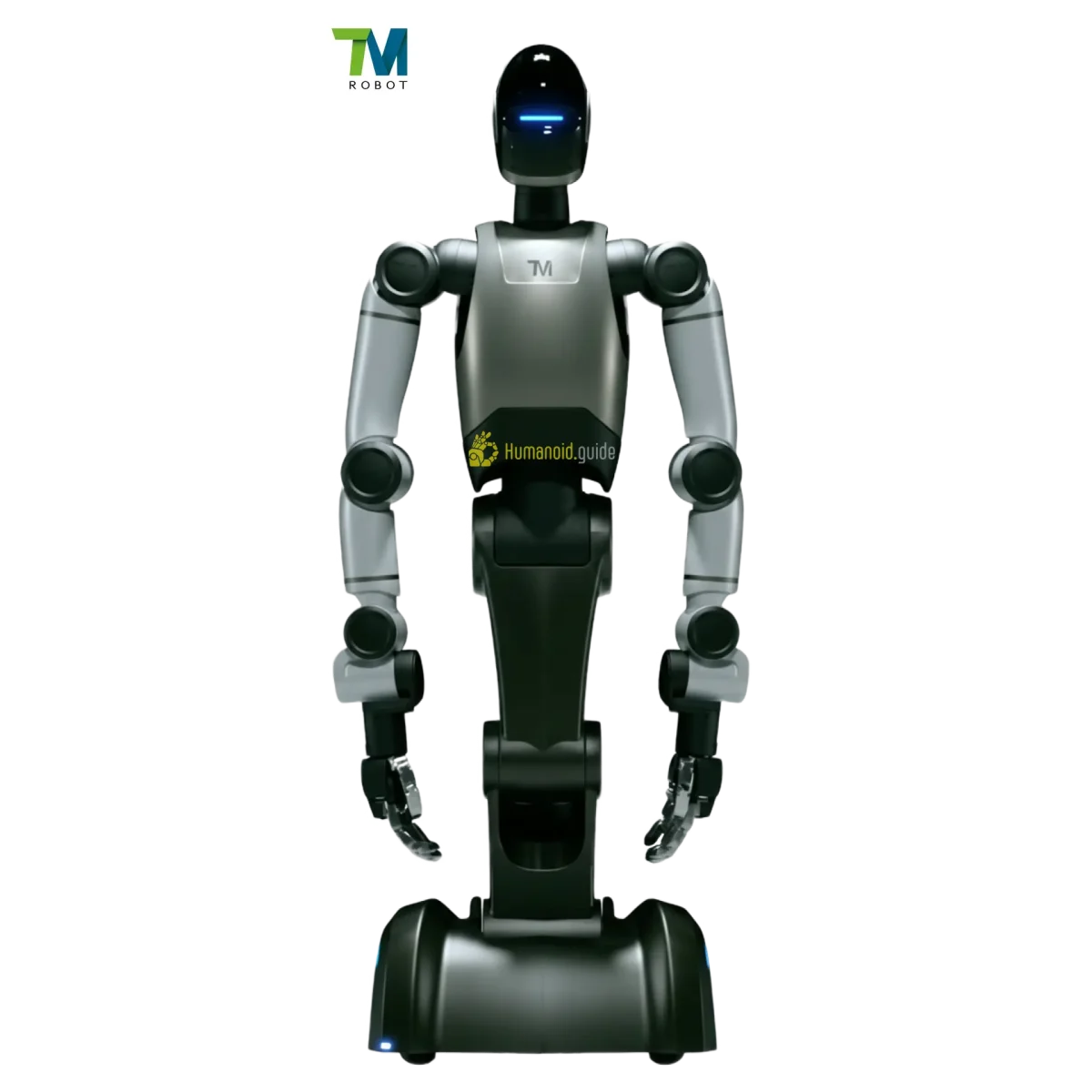
What is the Tm Xplore 1 Techman?
The Techman Robot TM Xplore 1 is a wheeled humanoid research platform designed for industrial automation, semiconductor fabs, and logistics. Built by Taiwan’s Techman Robot (a subsidiary of Quanta Computer, founded 2015), the TM Xplore 1 stands 167 cm tall and combines an AI-driven torso with 22 articulated joints mounted on a wheeled base. Its NVIDIA Jetson Orin edge AI engine powers machine vision and large language model integration, enabling autonomous inspection, material handling, and human-robot collaboration. Unlike bipedal humanoids, the wheeled design prioritizes speed (up to 3 km/h) and stability on factory floors. Unveiled in March 2026, it is Techman's first humanoid robot, extending its proven collaborative arm technology into a mobile, torso-mounted form factor.
Specifications
Here are the full technical specifications.
| Spec | Value |
|---|---|
| Height | 167 cm |
| Weight | Not disclosed |
| Degrees of freedom | 22 |
| Battery life | 2 hours |
| Max speed | 3 km/h |
| Payload | 6 kg |
| Price (new) | Undisclosed |
| Price (used range) | N/A (pre-commercial) |
Price & Value
New MSRP: Undisclosed (contact manufacturer)
Used range: N/A
As a pre-commercial prototype, Techman Robot has not released pricing for the TM Xplore 1. Given Techman’s parent company Quanta Computer’s deep manufacturing ties and the robot’s industrial target, market estimates place the eventual cost between $100,000 and $250,000 when sales launch in late 2026. The wheeled design eliminates the high-cost leg actuators and balancing systems of bipedal robots, potentially reducing both purchase price and maintenance. Compared to Apptronik Apollo’s expected $120,000–$200,000 range, the TM Xplore 1 may offer a more factory-optimized AI stack at a similar price point. Depreciation for such first-generation humanoids is uncertain, but Techman’s 10-year cobot history suggests solid resale value for the industrial user base. Buyers should confirm warranty and service agreements directly with Techman before committing.
Who Is It For?
Best for: - Semiconductor cleanrooms and electronics assembly lines that need mobile AI inspection with dexterous manipulation (22 DOF upper body, integrated vision). - R&D labs exploring wheeled humanoid AI integration on a ROS-based platform with NVIDIA Jetson Orin.
Not for: - Heavy payload tasks exceeding the 6 kg arm payload — designed for light inspection and part handling only. - Bipedal locomotion testing or outdoor rough-terrain deployments (wheeled base limited to smooth indoor floors).
Alternatives & Comparison
The TM Xplore 1 competes in the emerging category of wheeled humanoids with upper-body manipulation and AI. Its closest rivals are Apptronik Apollo (wheeled config), Sanctuary AI Phoenix, and the bipedal UBTech Walker S.
| Model | Price | Available | Key Difference |
|---|---|---|---|
| Apptronik Apollo (wheeled) | ~$150,000 (est.) | preorder | Apollo offers swappable lower bodies; TM Xplore 1 is factory-optimized with embedded vision and AI from day one. |
| Sanctuary AI Phoenix | Undisclosed | preorder | Phoenix focuses on teleoperation with full-body dexterity; TM Xplore 1 is designed for autonomous factory inspection. |
| UBTech Walker S | ~$150,000 (est.) | available | Walker S is bipedal and can climb stairs; TM Xplore 1 is faster on flat floors and less mechanically complex. |
Verdict: For electronics manufacturers seeking an AI-embedded wheeled inspector, the TM Xplore 1 is the most purpose-built option. If the application demands stair navigation, the UBTech Walker S is the better fit. The TM Xplore 1’s factory-focused design and Techman’s cobot heritage make it the most reliable choice for cleanroom and assembly-line roles.
Use Cases & Capabilities
Semiconductor Cleanroom Inspection
The TM Xplore 1 navigates cleanroom aisles on its wheeled base, using AI vision to detect particle defects or equipment anomalies. Its 22-DOF upper body allows it to manipulate cleanroom tools and open mini-environment doors without contaminating wafers. The integrated NVIDIA Jetson processes high-res inspection images locally, flagging issues in real time. With 2 hours of battery life, it can cover a large bay on a single charge and dock autonomously. The robot’s sealed joints and smooth exterior suit ISO class requirements.
Electronics Assembly Quality Control
At electronics production lines, the TM Xplore 1 uses its 6 kg payload arm to pick and place components for visual inspection, comparing against CAD models with its advanced cameras. It performs repetitive pick-and-place quality checks at human-like speeds (0.83 m/s base travel, arm articulation) without fatigue. The LLM integration allows operators to ask for specific defect types in natural language and receive immediate reports. As a collaborative robot, it works safely alongside workers, reducing manual inspection cycles.
Light Warehouse Logistics
In warehouses, the TM Xplore 1 can autonomously navigate rack aisles, scan barcodes, and retrieve small parts or samples up to 6 kg. Its wheeled platform maintains stability while carrying payloads, and the ROS-based architecture integrates with existing warehouse management systems. The robot’s AI vision identifies mis-picks and damaged packaging, triggering alerts. Although not designed for palletizing, it excels at kitting, returns processing, and buffer inventory checks in medium-light logistics operations.
AI-Driven Human-Robot Collaboration Research
Research institutions can use the TM Xplore 1 as an embodied AI platform, thanks to its NVIDIA Jetson Orin and Linux ROS environment. The robot supports custom LLM applications, reinforcement learning for dual-arm manipulation, and multi-modal sensor fusion. Its wheeled base simplifies navigation research while the 22-DOF torso allows dexterous experiments. With a standard ROS toolkit, labs can quickly prototype collaborative behaviors and test vision-language-action models without building hardware from scratch.
Factory Floor Monitoring and Anomaly Detection
The TM Xplore 1 patrols factory floor perimeters, using thermal and RGB cameras to monitor machine temperatures, vibration, and anomalies. Its LLM integration enables it to interpret maintenance logs and verbally report findings to engineers. The wheeled mobility covers large flat areas efficiently at 3 km/h, and the 2‑hour runtime is sufficient for scheduled rounds. When not patrolling, it docks and serves as a stationary AI assistant for shift handover, analyzing production data on a large display.
History & Background
Techman Robot was founded in 2015 in Taoyuan City, Taiwan, as a subsidiary of Quanta Computer, one of the world’s largest laptop manufacturers. The company quickly became known for its TM series of collaborative industrial robots, which integrated embedded vision into the end effector. The TM Xplore 1 represents its first step into humanoid robotics, unveiled to the public in March 2026. Early development began in 2024, with internal testing focusing on wheeled mobility and AI integration using NVIDIA’s Jetson platform. The robot leverages Techman’s in-house joint modules, which are derived from its cobot arms, giving it a distinct advantage in precision and reliability for factory environments. Techman plans to scale production in the second half of 2026, aiming to serve its existing electronics and semiconductor customers. The TM Xplore 1 is currently a prototype, and pricing and full specifications have not been finalized.
Buying Used — What to Check
Verify payload rating Payload may degrade with joint wear; real-world operation may not match the 6 kg spec after heavy use.
Inspect joint & drivetrain wear 22 DOF joints and wheel motors are critical; repair costs could be high without official Techman parts.
Confirm software & AI updates Ensure ROS framework and NVIDIA Jetson firmware are current; locked or outdated software limits LLM and feature updates.