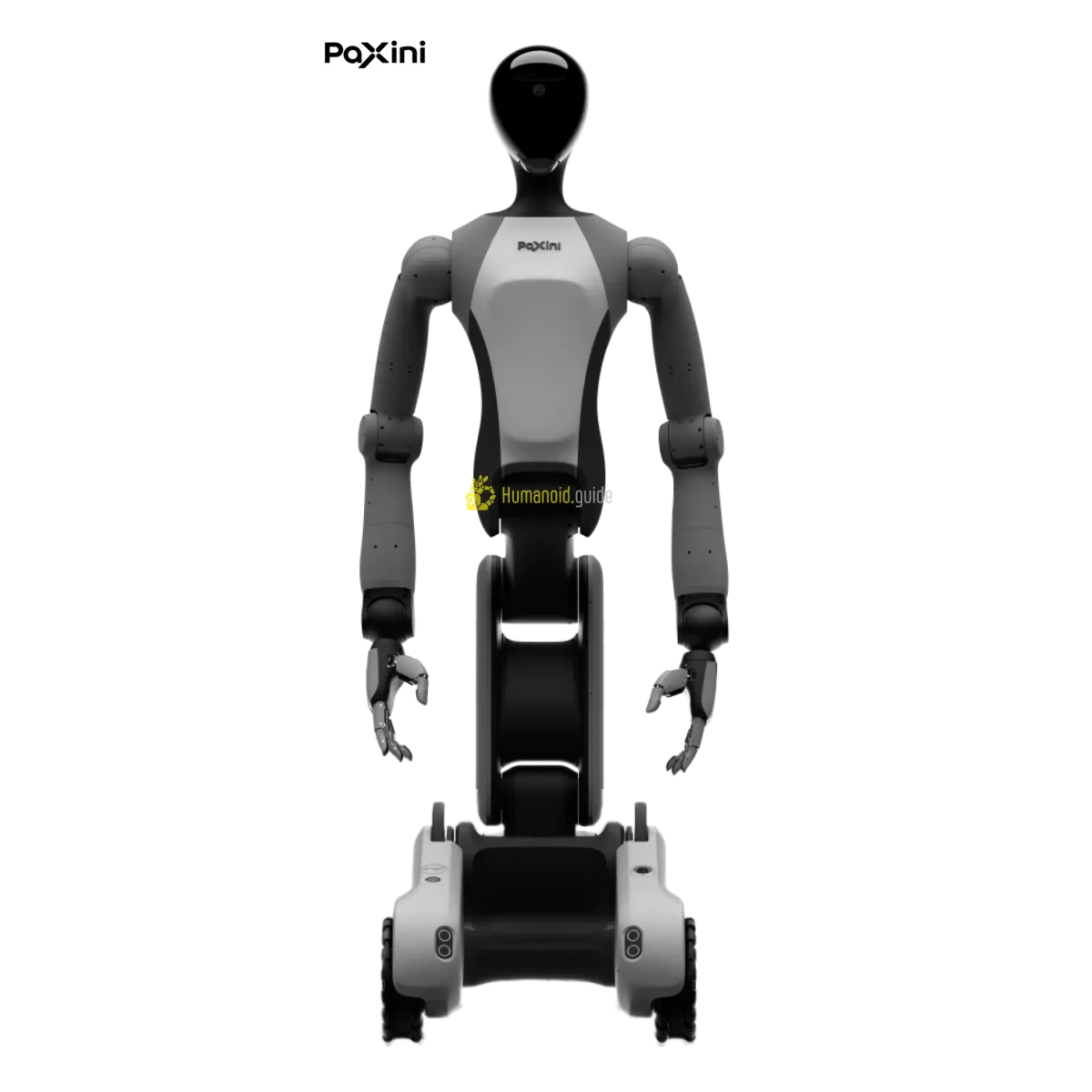
What is the Tora Doubleone?
The Paxini Tora DoubleOne is a full-sized humanoid robot developed by PaXini Tech in China, designed for industrial, logistics, and service robotics tasks. Standing 168 cm tall and weighing 70 kg, it features 58 degrees of freedom — including 18 in its five-fingered hands — for dexterous manipulation and bipedal mobility. The robot is powered by an NVIDIA Jetson AGX Orin and an x86 real-time controller, enabling onboard perception and motion planning. It runs a custom Linux-based robotics OS and supports Wi-Fi, Bluetooth, and 5G connectivity. With a payload capacity of 6.5 kg and a top walking speed of 6.5 km/h, the DoubleOne is positioned as a versatile automation platform for warehouses and factories. It is currently available for pre-order.
Specifications
Here are the full technical specifications.
| Spec | Value |
|---|---|
| Height | 1680 mm |
| Weight | 70 kg |
| Degrees of freedom | 58 |
| Battery life | 6 hours |
| Max speed | 6.5 km/h |
| Payload | 6.5 kg |
| Price (new) | Undisclosed |
| Price (used range) | N/A |
Price & Value
New MSRP: Undisclosed (contact manufacturer)
Used range: N/A
Paxini has not publicly disclosed the official MSRP for the Tora DoubleOne. Unofficial sources have cited a price of approximately $45,000, but this figure remains unverified and should not be used for budgeting without manufacturer confirmation. If the $45k price is accurate, the DoubleOne would sit in the mid-range of humanoid robots — significantly more than the $16k Unitree G1 but far below the estimated six-figure cost of full-capability models like the Fourier GR-2. Given the pre-order status and lack of a used market, depreciation is impossible to estimate, and total cost of ownership remains speculative. Buyers should factor in integration, maintenance, and potential software licensing costs, which are also undisclosed. Early adopters might face higher service costs and limited support until volume sales begin.
Who Is It For?
Best for: - Industrial manufacturers seeking a mid-payload humanoid for light assembly, pick-and-place, and kitting tasks. - Logistics operators wanting a bipedal robot for dynamic warehouse material handling and order fulfillment. - Service robotics developers requiring a dexterous, full-sized platform for R&D in customer-facing or institutional automation.
Not for: - Heavy lifting applications (payload limited to 6.5 kg). - Outdoor or rugged environments (no ingress protection rating, uncertain weather resistance). - Budget-constrained projects (expected pricing above $40,000, plus integration costs).
Alternatives & Comparison
In the emerging humanoid robot market, the Tora DoubleOne competes with several platforms aimed at industrial and logistics automation. Here's how it stacks up against three notable alternatives in terms of specs and availability.
| Model | Price | Available | Key Difference |
|---|---|---|---|
| Unitree G1 | $16,000 | yes | Lower cost and lighter build, but significantly lower DOF (23) and payload (2 kg). |
| Fourier GR-2 | ~$120,000 (est.) | preorder | More powerful payload and patented actuators, but at a much higher price point. |
| Tesla Optimus (Gen 2) | Undisclosed | no | Tesla's full proprietary stack and potential mass production, not yet available for purchase. |
Verdict: For buyers who need high dexterity (58 DOF) on a mid-range budget, the Tora DoubleOne presents a compelling middle ground — if the rumored $45k pricing holds true and production scales. However, those prioritizing reliability and a proven ecosystem may lean toward the more established Fourier GR-2 or wait for Tesla Optimus. The Unitree G1 remains the best choice for lightweight tasks at a fraction of the cost, but it cannot match the DoubleOne's manipulation fidelity.
Use Cases & Capabilities
Industrial Manufacturing
The Tora DoubleOne is engineered for light assembly and machine-tending tasks on factory floors. With 58 DOF and 6.5 kg payload, it can pick, orient, and place small to medium components with precision, leveraging its dexterous five-fingered hands. Its bipedal locomotion allows it to navigate around conveyor belts, workstations, and human coworkers without dedicated tracks or fixed automation. The robot's onboard NVIDIA Jetson AGX Orin enables real-time object detection and task planning, reducing the need for constant cloud connectivity. However, the 6.5 kg payload limits it to sub-assembly processes and lighter materials, making it unsuitable for heavy stamping or large-part transfer.
Logistics and Warehousing
In logistics, the DoubleOne can move autonomously through warehouse aisles to pick orders, sort packages, and transport items between zones. Its humanoid form factor enables it to reach high and low shelves, manipulate boxes of varying sizes, and work alongside human pickers without safety cages, thanks to its claimed safe-human interaction design. The 6.5 km/h top speed is adequate for covering large floor areas efficiently. With Wi-Fi, Bluetooth, and 5G connectivity, it can integrate into existing warehouse management systems for real-time inventory updates. Still, the lack of a published ingress protection rating suggests it may not be ideal for dusty or chilled warehouse environments without additional protective measures.
Service Robotics
The DoubleOne's dexterity and human-like proportions make it a candidate for public-facing roles such as concierge, retail assistance, or hospital logistics. Its 58 DOF allow natural gestures and interaction, enhancing user acceptance, while the NVIDIA Orin module supports voice and vision processing for customer queries. The robot's Linux-based OS is customizable for various service workflows, and its compact 168 cm height and 70 kg weight make it less intimidating than some larger humanoids. However, as a pre-order product with no track record in continuous public operation, its long-term reliability and service software ecosystem are unproven. Deployment may require significant custom development for each application.
History & Background
Paxini (PaXini Tech) is a Chinese robotics company whose founding date remains unpublicized. It emerged in the humanoid space in 2024 when it introduced the Tora DoubleOne as a pre-production prototype targeting industrial automation. The robot was designed from the start for high degrees of freedom and tactile dexterity, setting it apart from many competitors that initially focused on locomotion. The DoubleOne was displayed as a working prototype in 2024, and by 2026, it had entered pre-order status, with the company taking orders but not yet publicly disclosing delivery timelines or production volumes. No acquisitions or corporate changes have been reported. Paxini's technical choices — NVIDIA Orin compute, harmonic drive actuators, and a custom Linux OS — align with state-of-the-art humanoid development, though its market presence remains niche compared to larger players like Unitree or Fourier.
Buying Used — What to Check
Verify payload rating The 6.5 kg payload is critical for task suitability; ensure no degradation or misreporting in any used unit.
Check battery health Battery endurance may degrade over time; confirm runtime still meets the 6-hour spec and whether spares are available.
Confirm DOF and hand dexterity The 58-DOF claim is a primary differentiator — verify that all joints, especially the 18-DOF hands, are fully operational without excessive wear.