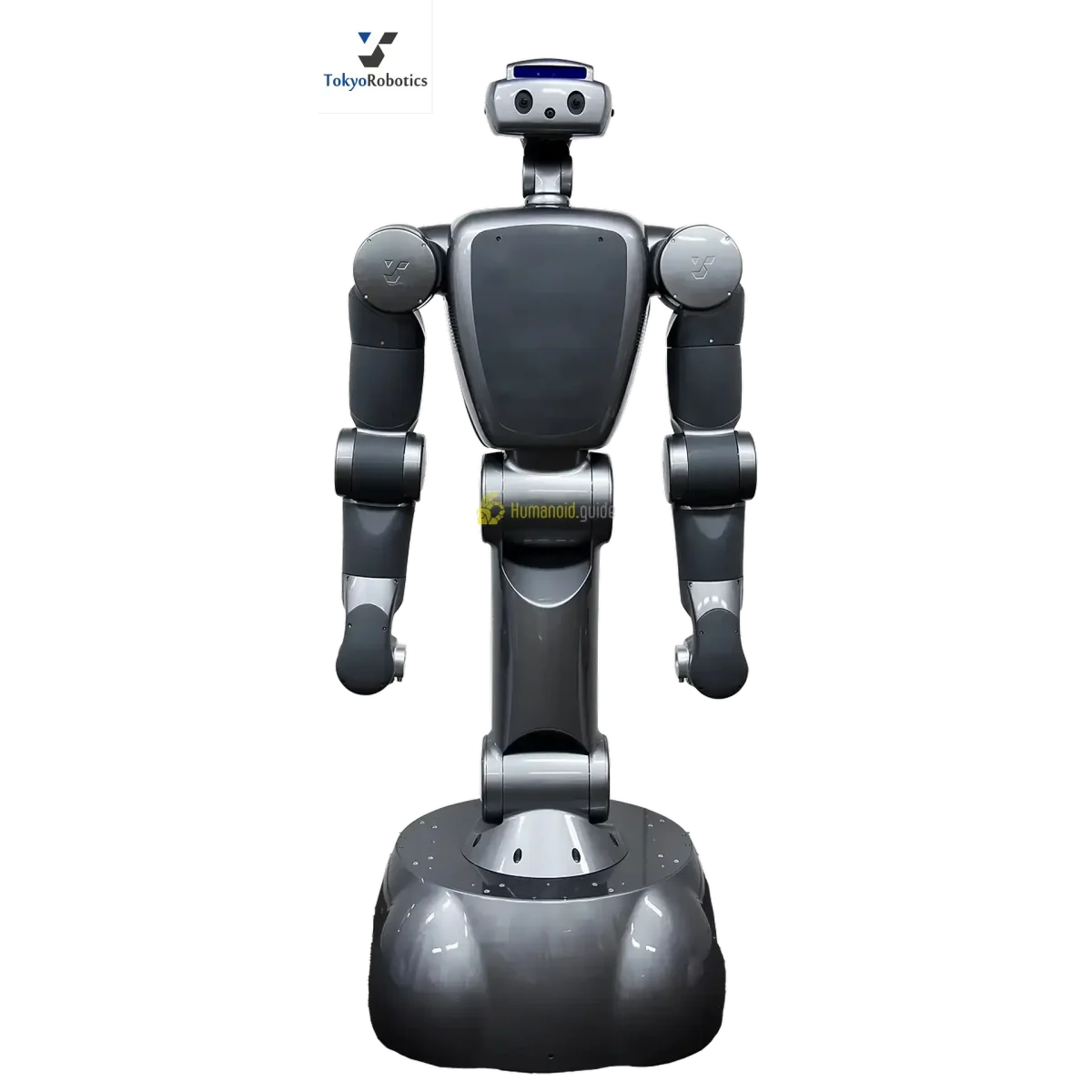
What is the Torobo?
The Tokyo Robotics Torobo is a humanoid research robot consisting of a dual-arm upper body with 7-axis torque-controlled manipulators, a sensorized head, and an omnidirectional wheeled base. Designed for advanced human-robot interaction and force-sensitive manipulation studies, it offers 24 degrees of freedom and joint torque feedback on all axes. Manufactured by Tokyo Robotics (founded in 2015, Tokyo, Japan), the Torobo platform integrates ROS-based control, optional 3D vision, and a 7 kg payload per arm to enable applications in assembly, polishing, and collaborative tasks. Its wheeled mobility provides a 5 km/h navigation speed, making it suitable for laboratory and light industrial settings.
Specifications
Here are the full technical specifications.
| Spec | Value |
|---|---|
| Height | 166 cm |
| Weight | 160 kg |
| Degrees of freedom | 24 |
| Battery life | 3 hours |
| Max speed | 5 km/h |
| Payload | 7 kg per arm |
| Price (new) | Undisclosed (contact manufacturer) |
| Price (used range) | N/A |
Price & Value
New MSRP: Undisclosed (contact manufacturer)
Used range: N/A (no established secondary market)
Tokyo Robotics does not publicly list a price for the full Torobo humanoid — prospective buyers must contact the manufacturer directly. Based on the cost of the individual Torobo arm, which ranges from $15,000 to $25,000, a complete dual-arm mobile system is likely a significant investment, likely exceeding $60,000. When compared to assembling a similar setup with multiple Panda arms and a mobile base, the Torobo may offer a more integrated solution but at a premium. As a specialized research tool, its resale value is uncertain, but early adopters may find a small secondary market among universities. Maintenance and software support costs should be factored into the total cost of ownership.
Who Is It For?
Best for: - University robotics labs researching force‑sensitive manipulation and whole‑body control with a mobile manipulator - R&D departments testing adaptive assembly and polishing applications - Human‑robot interaction researchers needing compliant dual‑arm hardware
Not for: - Budget‑constrained academic groups (full system cost exceeds $60,000) - Heavy industrial lifting tasks (payload limited to 7 kg per arm, no leg mobility) - Outdoor or rugged environments (no IP rating, wheeled base struggles on uneven terrain)
Alternatives & Comparison
While few full humanoid torsos are commercially available, researchers often compare the Torobo arm against other torque-controlled manipulators like the Franka Emika Panda and Kinova Gen3, or even industrial cobots such as the UR5e, when building custom mobile manipulation setups.
| Model | Price | Available | Key Difference |
|---|---|---|---|
| Universal Robots UR5e | ~$35,000 | yes | UR5e is a plug-and-play industrial cobot with 5 kg payload and no torque feedback, while Torobo provides joint torque sensors for research-grade force control. |
| Franka Emika Panda | ~$25,000 | yes | Panda is another torque-controlled arm but with lower payload (3 kg) and shorter reach, while Torobo offers 7 kg payload and longer reach for heavier tasks. |
| Kinova Gen3 | ~$30,000 | yes | Kinova Gen3 provides integrated vision and a 4 kg payload, whereas Torobo focuses on pure torque control and higher payload (7 kg) with no vision‑by‑default. |
Verdict: For labs needing a ready‑to‑use, mobile dual‑arm humanoid, Torobo is the most integrated option, avoiding the complexity of integrating separate arms and a base. However, if budget and community support are top priorities, coupling a Panda arm with an off‑the‑shelf mobile platform may provide a more cost‑effective and documented path.
Use Cases & Capabilities
Force‑sensitive assembly research
The Torobo’s joint torque sensors enable real‑time force feedback, allowing researchers to develop algorithms for delicate assembly tasks such as PCB insertion or connector mating. Its 7 kg payload and 844 mm reach (per arm) provide sufficient workspace for benchtop experiments. The ROS compatibility simplifies integration with force‑control libraries, making it a popular choice for publishing studies on compliant manipulation. However, the wheeled base can limit the ability to assemble large structures unless the workspace is rearranged.
Human‑robot interaction studies
With dual torque‑controlled arms and a 3D‑vision‑ready head, Torobo is well suited for HRI experiments where safe physical contact is essential. Researchers can program collaborative tasks like handovers, co‑carrying, or shared assembly. The omnidirectional base allows the robot to follow a human partner around the lab. The high cost and weight (160 kg) make it less suitable for home‑environment deployments.
Light manufacturing polishing and finishing
Torobo’s force control excels in surface finishing tasks where consistent contact pressure is critical. In industrial pilot projects, it has been used for polishing metallic parts with adaptive force to compensate for part variance. The arm’s 0.03 mm repeatability ensures path accuracy, while the torque control prevents over‑sanding. However, the 3‑hour battery life may require tethering for continuous operation.
Education and robotics curriculum
For advanced university courses, the Torobo provides a hands‑on platform for teaching force control, forward‑inverse kinematics, and ROS programming. Its dual‑arm configuration enables studies in bimanual coordination. The high entry price limits its adoption to well‑funded programmes, but for those that can afford it, students gain experience with industry‑grade torque‑controlled hardware.
History & Background
Tokyo Robotics was founded in 2015 in Tokyo, Japan, with a focus on force-controlled robotic arms. The Torobo arm debuted in 2017 as a 7-axis torque-sensing manipulator for research, quickly gaining traction in academic labs for force-guided tasks like polishing and assembly. Around 2022, the company extended the platform to a full humanoid torso with dual arms and an omnidirectional wheeled base, aiming to serve as a comprehensive mobile manipulation research testbed. No major hardware generations have followed, though software updates continue to enhance ROS compatibility and sensor integration. As of 2026, Torobo remains a niche product sold directly to universities and industrial R&D centers.
Buying Used — What to Check
Verify total operating hours and battery health Lithium batteries degrade after prolonged use, potentially reducing runtime below the original 3 hours.
Test all joint torque sensors for drift or damage Accurate torque sensing is crucial for research results; recalibration may be needed.
Inspect omnidirectional wheels and base motors Replacement parts are only available through Tokyo Robotics; excessive wear can be costly to repair.