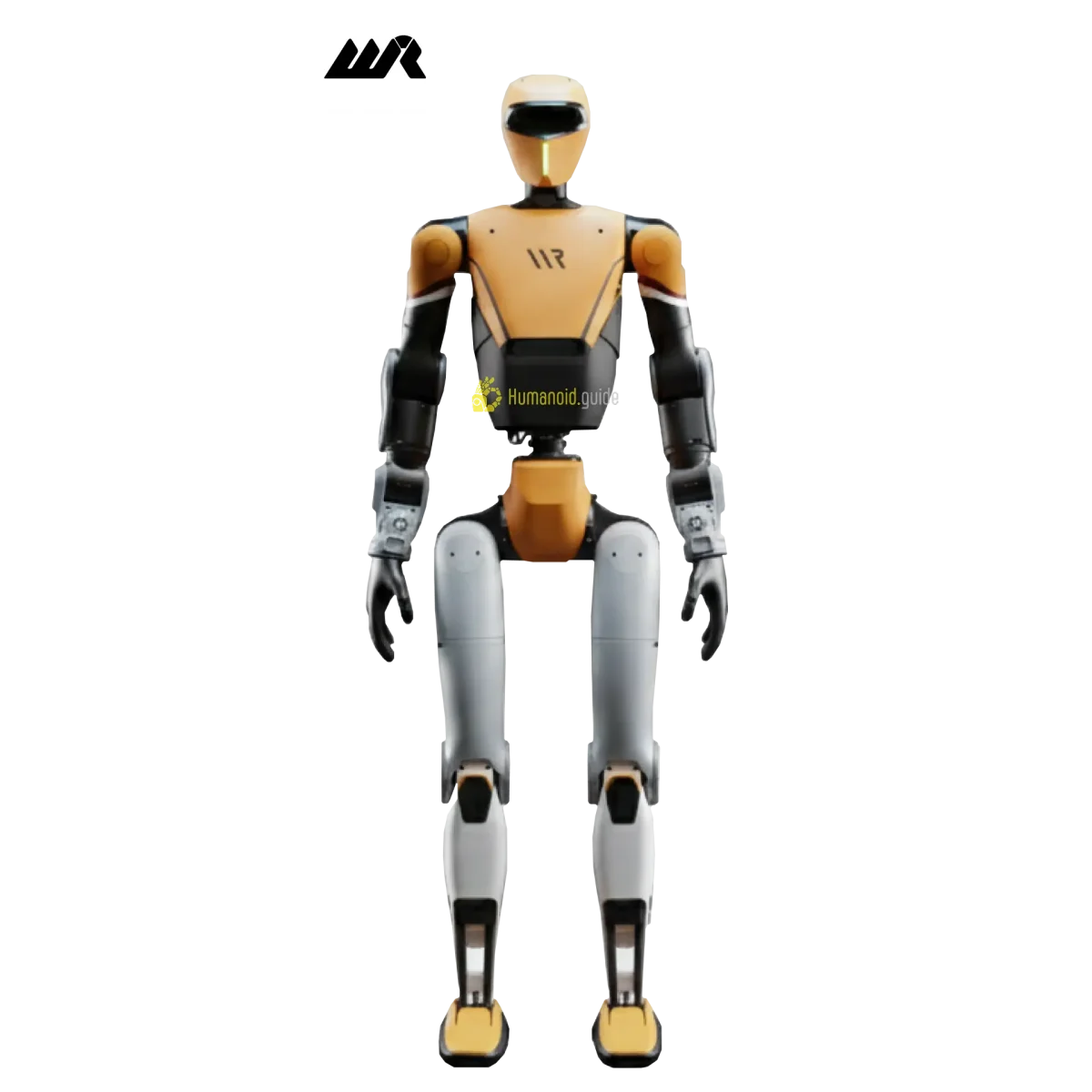
What is the Totan O1?
The WL Robotics Totan O1 is an in-development humanoid robot built by WL Robotics (WL Robo), a Chinese robotics company. Unveiled in 2024, it stands 134 cm tall and weighs 34 kg, with 30 degrees of freedom and dexterous 5-fingered hands (~6–7 DOF per hand). Designed as a research platform for AI and robotics labs, it offers a 10 kg arm payload, 4 km/h walking speed, and stereo depth camera system. The Totan O1 runs on an Intel i7/NVIDIA Jetson compute stack with ROS integration, supporting AI-driven autonomy. Its high-torque servo or BLDC actuators with harmonic drive/planetary gears enable precise motion, while Ethernet and Wi‑Fi connectivity support remote operation and cloud AI. Its orange-and-gray aluminum alloy frame and IP20 indoor rating reflect its role as a development-stage humanoid aimed at universities and education. Shipping size: 150×60×50 cm.
Specifications
Here are the full technical specifications.
| Spec | Value |
|---|---|
| Height | 134 cm |
| Weight | 34 kg |
| Degrees of freedom | 30 |
| Battery life | 2.5 hours |
| Max speed | 4 km/h |
| Payload | 10 kg |
| Price (new) | Undisclosed |
| Price (used range) | N/A |
Price & Value
New MSRP: Undisclosed (contact manufacturer)
Used range: N/A
As of 2026, WL Robotics has not publicly disclosed pricing for the Totan O1. Contact the manufacturer directly for quotes. Given its 2024 reveal and IN DEVELOPMENT status, the Totan O1 is targeted at university labs and AI research teams, likely priced competitively against other research humanoids like the UBTECH Walker S (~$150,000) or Fourier GR-2 (estimated $100,000–150,000). Early adopters may benefit from pilot program pricing. With no commercial release date confirmed, used units are not yet available, so total cost of ownership remains undefined. Institutions should budget for integration costs, potential lab infrastructure upgrades, and technical support overhead.
Who Is It For?
Best for: - AI research teams seeking a 30-DOF humanoid platform for locomotion and manipulation studies - University robotics labs needing a compact (134 cm) bipedal robot for teaching and algorithm development - Educational institutions exploring humanoid robotics with ROS integration and external AI stack potential
Not for: - Industrial deployment (limited to IP20 indoor use, no certified ruggedness) - Heavy lifting tasks (10 kg arm payload restricts manipulation) - Organizations requiring an immediate commercially available product (still in development)
Alternatives & Comparison
The Totan O1 competes in the emerging market of research-oriented humanoid robots priced for academic and lab budgets.
| Model | Price | Available | Key Difference |
|---|---|---|---|
| Unitree H1 | $90,000 | yes | Higher speed (5.4 km/h) and stronger legs, but lower arm payload (5 kg) and less hand dexterity. |
| UBTECH Walker S | ~$150,000 (est.) | preorder | Enterprise-focused with full-body navigation, larger payload, but heavier at 63 kg and pricier. |
| Fourier GR-2 | Undisclosed | preorder | Advanced sensor suite and AI integration, but unverified commercial release. |
Verdict: For labs prioritizing low cost and compact size, the Totan O1 could be a viable alternative if its price falls below the Unitree H1's $90k mark. However, Unitree H1 offers a more mature ecosystem and proven locomotion, making it the safer bet at this stage. The Totan O1's appeal hinges on an eventual competitive price and confirmed dexterity advantages.
Use Cases & Capabilities
AI Locomotion Research
The Totan O1's 30 DOF and bipedal design make it suitable for reinforcement learning and dynamic walking experiments. Researchers can train gait generation and stabilization algorithms using its ROS-based stack, with a 4 km/h walking speed providing a useful benchmark for navigation. The robot's height (134 cm) and weight (34 kg) allow for safe indoor testing while still representing human-like proportions. Its Intel i7/Jetson compute system can handle onboard processing for sensorimotor controllers, and the stereo depth camera aids in terrain perception. However, the limited battery life (2.5 hours) may constrain extended training sessions, so labs should plan for efficient data collection runs.
Manipulation Studies
With 5-fingered dexterous hands (~6–7 DOF per hand) and a 10 kg arm payload, the Totan O1 enables pick-and-place and precision grip research. The stereo depth camera provides visual feedback for hand-eye coordination tasks, while Ethernet or Wi‑Fi allows remote teleoperation or integration with external AI pipelines. Its compact size simplifies setup in constrained lab spaces compared to larger humanoids. The high-torque actuators deliver sufficient force for basic tool use and object manipulation, though the payload limits heavy objects. Researchers can explore grasp planning and fine motor control, benefiting from the open ROS architecture.
Educational Robotics Programs
University robotics curricula can use the Totan O1 as a hands-on platform for teaching ROS, kinematics, and control theory. The robot's orange-and-gray aluminum frame is approachable for students, and its ROS integration aligns with standard academic toolchains. The 30-DOF structure offers a comprehensive teaching model for both lower-body locomotion and upper-body manipulation. While the robot is not yet commercially available, early pilot programs may provide access for universities. Institutions should plan for the technical support needed to maintain an in-development platform and may collaborate with WL Robotics for custom curriculum materials.
Human-Robot Interaction (HRI) Research
The Totan O1’s human-like proportions and 5-fingered hands make it a candidate for HRI studies, such as gesture imitation or social robotics experiments. Its 134 cm height and friendly orange-gray color scheme can reduce participant apprehension during face-to-face interaction. Researchers can leverage the stereo camera and ROS interface for real-time face detection and behavior tracking. However, the IP20 indoor-only rating limits HRI scenarios to controlled lab environments. Integration with an external AI stack allows for natural language processing modules, though native LLM support is not onboard.
History & Background
WL Robotics (WL Robo), a Chinese robotics firm, unveiled the Totan O1 humanoid in 2024 as a research platform. The company's background prior to this reveal is not publicly documented, suggesting it is a relatively new entrant in the humanoid space. The Totan O1 was shown in prototype form with a 134 cm bipedal design and 30 total degrees of freedom. The prototype featured an Intel i7/NVIDIA Jetson compute stack, stereo depth cameras, and ROS integration. Early specifications emphasized its compatibility with ROS and potential for AI integration. WL Robotics has not announced any generations or variants. The Totan O1 is marketed as a platform for AI locomotion and manipulation research, with a target audience of university labs and AI teams. First pilot units were reportedly shown to early adopters in 2024–2025, but no wide-scale distribution has commenced. As of 2026, the robot remains in development with no official commercial release date, and it is primarily promoted through channels like MERA Robotics and Humanoid.guide for pilot deployments to research labs and universities.
Buying Used — What to Check
Verify payload rating The 10 kg payload may vary in final production units; confirm arm vs standing payload.
Confirm ROS version ROS integration is central; ensure compatibility with your lab's ROS2 setup.
Request battery specs Battery life of 2.5 hours may differ in practice; verify swappable batteries or continuous operation capability.