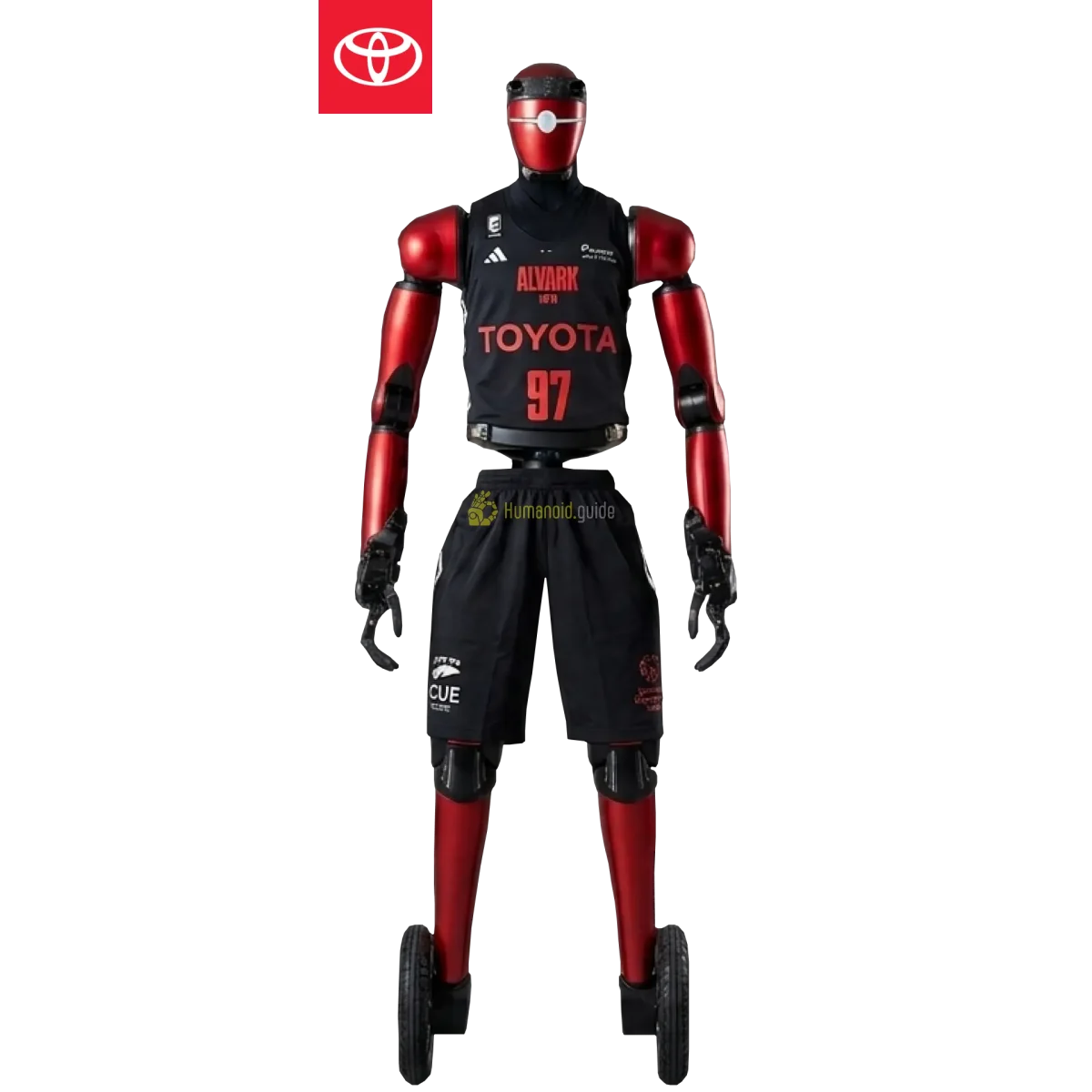
What is the Toyota Cue7?
The Toyota CUE 7 is the seventh generation of Toyota's research humanoid, built primarily to demonstrate extraordinary motion precision and AI-driven shooting in basketball. Standing 200 cm tall and weighing approximately 74 kg, it uses 24 electric joints to calculate trajectory, aim, and release the ball with consistency that rivals professional humans. Unlike general-purpose humanoids like Atlas or ASIMO, CUE 7 focuses on a single athletic task — making shots from over 5 metres — and serves as a platform for exploring real-time sensor feedback and motor control. It was developed by Toyota's Frontier Research Center in Japan and remains a pure R&D project with no commercial product plans.
Specifications
Here are the full technical specifications.
| Spec | Value |
|---|---|
| Height | 200 cm |
| Weight | ~74 kg |
| Degrees of freedom | 24 |
| Battery life | 0 h (tethered) |
| Max speed | 0 km/h |
| Payload | N/A |
| Price (new) | Undisclosed |
| Price (used range) | N/A |
Price & Value
New MSRP: Undisclosed
Used range: N/A
Because CUE 7 operates entirely as a Toyota-internal research project, there is no purchase price, lease option, or MSRP. The robot was built to demonstrate precision athletic motion, not to generate revenue. Its value to the robotics community is as a benchmark for real-time sensor-to-motor control loops. No depreciation schedule or total cost of ownership model exists, since the robot is not transferable. Research groups seeking a comparable level of shooting precision would likely need to develop custom hardware, making cost comparisons impossible. Toyota has never offered CUE for sale, and there are no plans to do so.
Who Is It For?
Best for: - Sports engineering R&D teams needing to analyze shooting biomechanics and control algorithms - University robotics labs studying real-time AI-driven motor tasks - Entertainment and event organizations looking for a crowd-pleasing tech showcase (if accessible through collaboration)
Not for: - Production lines – CUE has no payload rating or manipulation capability - Logistics centers – stationary design with no mobility - Home assistance – specialized for a single task with tethered power supply
Alternatives & Comparison
CUE 7 occupies a unique niche: a task-specific sports humanoid. Here's how it stacks up against other famous research humanoids.
| Model | Price | Available | Key Difference |
|---|---|---|---|
| Boston Dynamics Atlas | Undisclosed | no | General-purpose humanoid for dynamic whole-body tasks (parkour, manipulation), not specialized for basketball |
| Honda ASIMO | Undisclosed | no | General-purpose humanoid, discontinued, never sports-focused |
Verdict: For labs studying extreme end-effector precision and real-time trajectory calculation, CUE 7's shooting mechanism is unmatched. Boston Dynamics Atlas offers broader whole-body dynamics research, while ASIMO is a retired platform. Neither is purchasable, but the IP and engineering lessons from CUE could inform future sports or service robotics.
Use Cases & Capabilities
Basketball Shooting Research
CUE 7 is purpose-built to study the physics and AI of shooting a basketball from distance. It uses stereo vision to locate the hoop, calculates trajectory in real time, and actuates its arm to release the ball with precise spin and velocity. The robot can sink shots from over 5 metres, pushing research in sensor fusion and motor control. Its stationary base limits full-court scenarios, but the focused design allows researchers to isolate and refine the shooting motion without confounding variables. Multiple generations have incrementally improved shot distance and accuracy through better AI training.
Precision Motion Control Development
The CUE platform serves as a testbed for high-precision actuation and feedback loops. Because the entire task is a closed-loop sequence — see-hoop, compute-trajectory, throw — it stresses both low-latency vision processing and fine motor commands. Researchers can study how varying joint stiffness, release timing, and ball spin affect outcome. The absence of walking or balance challenges isolates control complexity to the upper limbs. This makes CUE 7 especially valuable for teams developing algorithms for surgical robots or other systems where micron-level precision matters.
AI and Sensor Fusion Testing
CUE 7 integrates RGB cameras and stereo vision to locate a moving target (the basketball hoop) in 3D space, then fuses that data with proprioceptive feedback from its 24 joints. This pipeline is a simplified but demanding test of machine learning models that must operate in real time. Engineers can experiment with different neural network architectures to predict optimal shot parameters under varying lighting and distance conditions. Successes here translate directly to industrial quality-inspection robots that need to adapt to part position and orientation on the fly.
Entertainment and Public Demos
When Toyota takes CUE 7 to live basketball games or tech exhibitions, it becomes a marketing asset that humanizes robotics. The robot's courtside free-throw attempts generate massive social media engagement and spark public interest in AI and engineering. Event organizers value the 'wow factor' of a 200 cm tall machine swishing a three-pointer. While entertainment is not CUE's primary design goal, its showmanship has proven effective at communicating Toyota's broader R&D ambitions to non-technical audiences without the intimidation of a full-body dynamic humanoid.
History & Background
Toyota, founded in 1937 and headquartered in Toyota City, Japan, launched the CUE project in 2017 as a passion project within its Frontier Research Center. The goal was simple: build a humanoid that could sink basketball free throws consistently. The first generation, CUE, shot with moderate accuracy. Over successive versions, the team improved AI prediction, motor control, and weight reduction. CUE 3 gained fame by shooting at halftime of an Alvark Tokyo basketball game in 2019. By CUE7, unveiled in 2026, the robot stood 200 cm tall, weighed ~74 kg (a 38% drop from the ~120 kg CUE6), and could score from beyond 5 metres. Toyota has no plans to productize CUE; it remains a research ambassador for precision robotics.
Buying Used — What to Check
Verify generation version CUE 7 is the latest; earlier models (CUE1-6) exist but have lower accuracy. Any listing claiming a CUE 7 is likely a scam or mislabeled earlier build.
Confirm operational condition As a tethered research platform, any unit would need Toyota's proprietary compute stack and field support to function. Without it, the robot is unlikely to work.
Check authenticity Toyota has never sold a CUE unit. Any 'CUE 7 for sale' ad should be treated as non-genuine unless accompanied by official documentation from Toyota's Frontier Research Center.