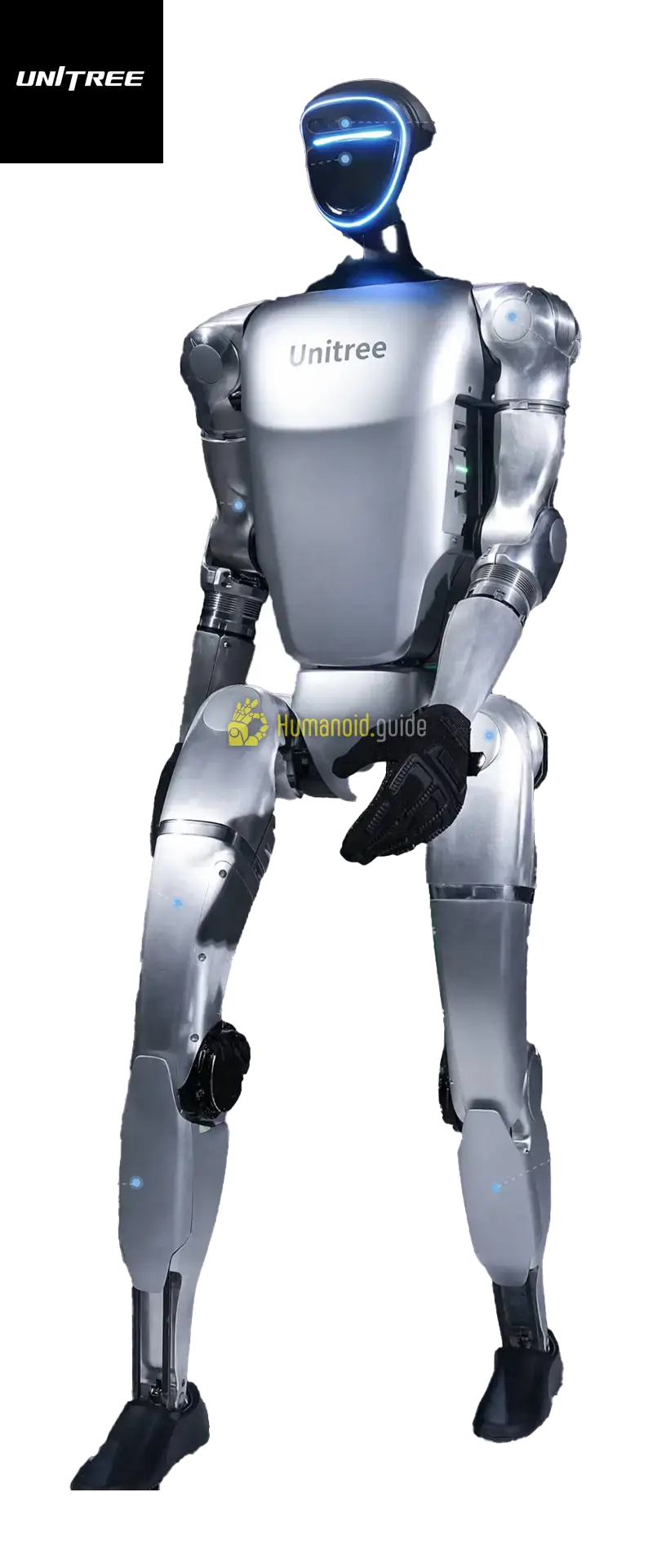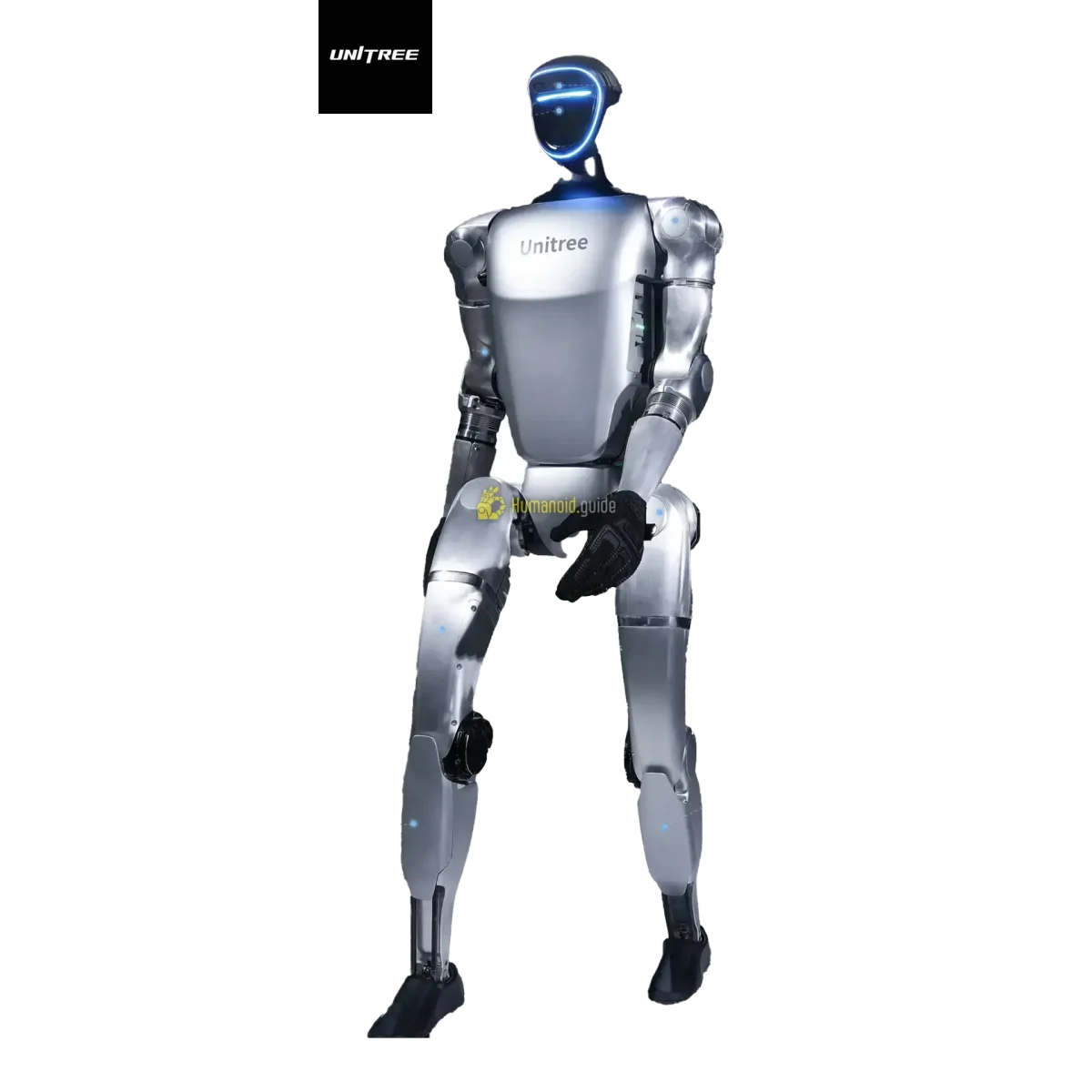
What is the Unitree G1?
The Unitree G1 is a compact humanoid robot developed by Unitree Robotics, founded in 2016 and headquartered in Hangzhou, China. It stands 127–132 cm tall, weighs 35 kg, and offers 23–43 degrees of freedom depending on the configuration. Three variants cater to different needs: the Base model for research and education, the EDU with 29 DOF and 40 TOPS compute, and the Ultimate with 43 DOF and 100 TOPS. It can walk at up to 7.2 km/h, climb obstacles, and run. Built on an open platform for secondary development, the G1 is popular in entertainment demonstrations and academic labs. Its low entry price makes it one of the cheapest commercially available humanoids.
Specifications
Here are the full technical specifications.
| Spec | Value |
|---|---|
| Height | 127–132 cm |
| Weight | 35 kg |
| Degrees of freedom | 23–43 (config dependent) |
| Battery life | 2 hours |
| Max speed | 7.2 km/h (walking 4.5 km/h) |
| Payload | 3 kg (arm), 12 kg (standing) |
| Price (new) | $13,500–$73,900 |
| Price (used range) | ~$10,000–$60,000 (estimated) |
Price & Value
New MSRP: $13,500–$73,900
Used range: ~$10,000–$60,000 (estimated)
At $13,500, the Unitree G1 is the cheapest humanoid robot on the market, offering an accessible entry point for research and education. The price scales significantly with added compute and dexterity in the EDU and Ultimate configurations, but remains competitive with alternatives like the Fourier GR-1 ($150,000) and Unitree’s own H1 ($90,000). Depreciation on used units is likely moderate given the high demand for affordable humanoids, but buyers should verify hardware conditions carefully. The G1 delivers strong value for labs that don’t need heavy industrial payloads.
Who Is It For?
Best for: - University robotics labs seeking an affordable, open-development humanoid platform (23–43 DOF enables dexterous manipulation and locomotion research) - Entertainment and demonstration teams needing a compact, fast, 7.2 km/h humanoid that can perform acrobatic movements - Educational institutions wanting a sub-$20,000 robot for teaching AI, control systems, and robotics concepts
Not for: - Heavy industrial manipulation tasks (arm payload limited to 3 kg) - Continuous 24/7 operation (2-hour battery runtime) - Buyers requiring CE/FDA certifications — G1 lacks disclosed compliance certifications
Alternatives & Comparison
The Unitree G1 competes in the budget humanoid segment, undercutting most rivals while offering competitive basic mobility. Here’s how it stacks up against two alternatives.
| Model | Price | Available | Key Difference |
|---|---|---|---|
| Unitree H1 | $90,000 | yes | Larger (180 cm), higher payload (~20 kg), but 5x price |
| Fourier GR-1 | ~$150,000 (est.) | yes | 171 cm, 55 kg, stronger payload for industrial use, significantly more expensive |
Verdict: The G1 is the clear winner for budget-conscious labs and educational programs; its $13,500 entry price is unmatched. The H1 is better for bipedal load-carrying research, and the GR-1 suits light industrial tasks, but both cost over 6x the G1’s base price. For most non-industrial humanoid applications, the G1 offers the best value.
Use Cases & Capabilities
Research & Development
The G1’s open platform with OTA updates and secondary development support (EDU variants with Jetson Orin) makes it ideal for locomotion algorithms, vision-based navigation, and manipulation studies. Its 23–43 DOF enable testing of balance, whole-body control, and hand dexterity. The onboard depth camera and LiDAR provide rich sensor data for SLAM and obstacle avoidance research.
Education Platform
Affordable enough for classroom use, the G1 allows students to program humanoid kinematics with real hardware. The EDU version’s 40 TOPS compute can run simulated neural networks, making it suitable for AI and robotics courses. The platform supports ROS and custom code, reducing setup time for lab exercises.
Entertainment Demonstrations
With a top speed of 7.2 km/h and obstacle-climbing capability, the G1 can perform choreographed dances, promotional tasks, and interactive exhibits. Its small size and safe 35 kg weight make it suitable for close-quarters demos. The robot’s ability to recover from falls and run adds visual excitement for audiences.
History & Background
Unitree Robotics was founded in 2016 by Wang Xingxing, initially achieving fame with quadruped robots like Laikago. The company launched its first full-size humanoid, the H1, in 2023, targeting industrial and research markets. The G1 debuted in 2024 as a smaller, more affordable humanoid, leveraging Unitree’s high-torque actuator expertise. With three configurations—Base, EDU, and Ultimate—it became the cheapest commercially available humanoid, starting at $13,500. As of 2026, it is Unitree’s latest humanoid and continues in production.
Buying Used — What to Check
Verify DOF configuration Used units may be Base, EDU, or Ultimate with different capabilities; exact DOF and compute affect value significantly.
Check battery health The 2-hour battery degrades over time; replacement packs cost extra.
Inspect actuator wear Frequent high-speed running can stress leg actuators; look for noise or reduced performance.