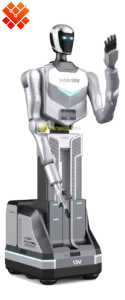
What is the Vb2 Lanxin?
Lanxin Robotics VB2 is a second-generation humanoid robot developed by Lanxin Robotics in Hangzhou, China. Designed for embodied AI, industrial research, and logistics pilots, the VB2 features 45 degrees of freedom, a 170 cm height, 65 kg weight, and a 5 kg manipulation payload. It runs on an industrial PC with AI accelerator, stereo RGB vision, and a Linux-based robotics OS with ROS 2 support, enabling flexible integration of LLMs and external software. High-torque electric servo motors with harmonic reducers provide dexterous manipulation for research tasks. Unlike commercial humanoids, the VB2 is primarily a development platform, not yet sold directly — interested parties must contact Lanxin for trials.
Specifications
Here are the full technical specifications.
| Spec | Value |
|---|---|
| Height | 170 cm |
| Weight | 65 kg |
| Degrees of freedom | 45 |
| Battery life | 6 hours |
| Max speed | 7 km/h |
| Payload | 5 kg |
| Price (new) | Not for sale (research platform) |
| Price (used range) | N/A |
Price & Value
New MSRP: Not commercially available
Used range: N/A
The VB2 is not listed for public sale and has no disclosed price; interested parties must contact Lanxin directly. As a pre-commercial platform, it avoids direct price competition but may be compared to research humanoids like Unitree H1 (~$150,000) or Fourier GR-1 (~$150,000). Its true cost likely depends on the configuration and support package — typical for such systems. Without a used market, potential depreciation is irrelevant. For organizations needing an open, ROS 2-compatible humanoid for AI development, the VB2 could offer strong value if priced competitively, but the lack of availability and transparency makes budgeting difficult. Buyers should view it as an R&D investment rather than a production tool.
Who Is It For?
Best for: - University robotics labs (45 DOF and ROS 2 enable dexterous manipulation research and AI stack integration) - Industrial automation R&D teams testing humanoid form factor for logistics and assembly tasks - Embodied AI startups needing a hardware platform with stereo vision and external LLM connectivity
Not for: - Heavy industrial tasks (5 kg payload is limited for many factory use cases) - Immediate production deployment — the robot is not sold commercially and has no proven field reliability - Price-sensitive buyers — no pricing exists, and bespoke arrangements likely involve significant cost
Alternatives & Comparison
The VB2 competes with other bipedal humanoids targeting research and industrial trials, though its limited commercial availability sets it apart.
| Model | Price | Available | Key Difference |
|---|---|---|---|
| Unitree H1 | ~$150,000 | yes | Higher payload (15 kg) and fully calibrated force control |
| Fourier GR-1 | ~$150,000 | yes | Broader humanoid ecosystem and active learning platforms |
| Agility Digit | ~$250,000 | enterprise-only | Proven logistics deployments with warehouse integration |
Verdict: For research labs prioritizing high-DOF manipulation and AI integration, the VB2's 45 DOF and ROS 2 stack are appealing — but you can't buy one. Unitree H1 offers purchase and strong locomotion, while Digit is best for real-world logistics if budget allows. As of 2026, we recommend waiting until the VB2 becomes commercially available or choosing an existing platform to start work immediately.
Use Cases & Capabilities
Embodied AI Research
The VB2 provides a full-body humanoid platform for training and deploying AI models that require physical interaction. Its 45 degrees of freedom and stereo RGB vision allow researchers to collect diverse sensor data for imitation learning, reinforcement learning, and LLM-guided task planning. The ROS 2 native stack and AI accelerator facilitate off-board model integration, reducing latency. However, the lack of commercial availability means researchers must negotiate partnerships with Lanxin, limiting accessibility.
Industrial Manipulation Testing
With a 5 kg arm payload and 7 arm joints per arm, the VB2 can simulate assembly, sorting, and machine-tending tasks in a lab setting. The robot’s harmonic reducers and high-torque servos provide the precision needed for research on fine manipulation, while the safe-collaboration design allows proximity to human testers. Its limited runtime of 6 hours and unknown ingress protection curtail heavy-shift use, but it serves as a testbed before scaling to ruggedized industrial variants.
Logistics and Warehousing Pilots
Lanxin targets logistics as a key sector, and the VB2’s bipedal mobility (7 km/h) and 170 cm height make it suitable for trials in human-scale warehouse aisles. The robot can handle parcel picking at 5 kg, though its manipulation payload falls short of heavier box handling common in distribution centers. Real-world deployment data is absent, so pilots would primarily demonstrate feasibility and inform future autonomous mobile manipulation offerings.
History & Background
Lanxin Robotics was founded in 2014 in Hangzhou, China, originally focusing on autonomous mobile robots (AMRs) and service robots. In 2024, the company unveiled its first humanoid, the VersaBot VB1, a modular research platform with ROS 2 integration. The VB1 spawned an industrial variant, the VB1-I, with reinforced joints for factory tasks. The VB2, announced in 2025, is the second-generation humanoid, featuring improved manipulation with a 5 kg payload, 45 DOF, and enhanced AI acceleration. Although promotional material suggests it is 'in production,' the VB2 has not been commercially released; units are available only for research partnerships and industrial trials as of early 2026.
Buying Used — What to Check
Verify battery health Long research cycles may degrade the 6-hour battery, and replacements are not listed as consumer items.
Inspect joint backlash 45 DOF with harmonic reducers can develop play if overloaded; tight joints are critical for dexterous tasks.
Confirm ROS 2 stack version Future software updates may require specific ROS distributions; an outdated stack could limit AI integration.