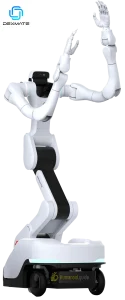
What is the Vega Robot?
The Vega Humanoid is a wheeled mobile manipulation platform developed by Dexmate, a California-based startup founded by PhDs from MIT, UCSD, and CMU. Unveiled in 2024, Vega is a 171 cm tall humanoid torso mounted on an omnidirectional wheeled base, eliminating the balancing challenges of bipedal robots while retaining dual-arm dexterity. It features 36 degrees of freedom, including 12 per hand, enabling precise object sorting, assembly, and lab automation tasks. Powered by an Intel x86 CPU and NVIDIA Jetson GPU, it runs Linux and integrates large language models for natural interaction. With a 20-hour runtime and 15 kg payload, Vega targets industrial automation and R&D environments requiring long-shift reliability and safe human collaboration.
Specifications
Here are the full technical specifications.
| Spec | Value |
|---|---|
| Height | 171 cm |
| Weight | 135 kg |
| Degrees of freedom | 36 |
| Battery life | 20 hours |
| Max speed | 4 km/h |
| Payload | 15 kg |
| Price (new) | $89,999 |
| Price (used range) | Est. $80,000–$100,000 |
Price & Value
New MSRP: $89,999
Used range: Est. $80,000–$100,000
At $89,999, Vega sits at the sweet spot for a dual-arm humanoid with dexterous hands—pricing below most legged humanoids like UBTECH Walker S ($150k+ estimated) and Fourier GR-2 ($100k+). The wheeled base reduces mechanical complexity and cost while providing reliable omni-directional locomotion suited for factory floors. With a 20-hour runtime, it’s one of the few humanoid robots capable of handling full shifts without battery changes. As pre-orders transition to a secondary market, we expect used Vega units to trade between $80,000 and $100,000, reflecting robust demand and relatively slow depreciation given its unique form factor. Total cost of ownership must account for maintenance of harmonic gear drives and sensor calibration, but the open Linux platform allows in-house support, lowering long-term service contracts.
Who Is It For?
Best for: - Manufacturers needing long-shift, dual-arm automation on flat floors (20-hour runtime, omni-directional wheels) - Industrial R&D teams prototyping assembly or sortation with dexterous hands (12 DOF per hand, LLM integration) - Labs seeking a safe, human-safe collaborative robot with high payload and open OS (Linux, NVIDIA Jetson)
Not for: - Outdoor or multi-floor operations (wheeled base can't climb stairs, no IP rating for weather) - High-speed pick-and-place requiring sub-second cycles (max 4 km/h and harmonic drives limit acceleration) - Budget-restricted research without funding for dexterous hands (starting price $89,999)
Alternatives & Comparison
Vega competes in the emerging market of dual-arm mobile manipulators, where buyers evaluate speed, payload, runtime, and cost.
| Model | Price | Available | Key Difference |
|---|---|---|---|
| UBTECH Walker S | ~$150,000 (est.) | enterprise-only | Bipedal mobility for stairs and outdoor terrain, but higher cost and lower runtime. |
| Fourier GR-2 | ~$150,000 (est.) | preorder | Full legged humanoid with 55 DOF, but heavier and more expensive without the runtime advantage. |
| AgileX LIMO Pro + dual UR5e | ~$70,000 | yes | Cost-effective mobile manipulator for research, but lacks integrated humanoid form factor and 12-DOF hands. |
Verdict: For industrial automation requiring long shifts and safe collaboration on flat floors, Vega’s wheeled design and 20-hour battery deliver the best value. If your tasks require stair climbing, a legged humanoid like the GR-2 is justified, but at over $150k. For budget-conscious labs needing less dexterity, an AgileX mobile manipulator is a viable entry point.
Use Cases & Capabilities
Industrial Assembly Line Support
Vega can work alongside human operators in electronics or automotive assembly, performing repetitive tasks like screw driving, part insertion, and quality checks. The 15 kg payload and 20-hour runtime let it operate across multiple shifts without battery swaps. Its omnidirectional wheels allow it to navigate tight factory aisles, and the dual 12-DOF hands provide the dexterity needed for small component handling. Safe human collaboration is enabled by brushless motor control and integrated safety sensors, though speed is limited to 4 km/h for safety.
R&D and University Robotics Labs
With an open Linux OS, NVIDIA Jetson GPU, and LLM integration, Vega is an ideal platform for human-robot interaction studies and advanced manipulation research. The 36 total DOF and harmonic gear actuators allow precise motion profiling, while the ten-finger design enables grasping experiments with a wide range of objects. Preorder availability with a 3-month lead time accelerates research timelines compared to custom-built platforms. The $89,999 price point is competitive with other high-DOF research humanoids, and the active support from the NAC program by NVIDIA Inception adds value for academic partners.
Sortation and Logistics
In e-commerce warehousing, Vega can identify, pick, and sort items from bins or conveyors using computer vision and LLM-based planning. The wheeled base moves rapidly across warehouse floors at walking speed, while the 15 kg payload handles a wide range of packaged goods. The 20-hour battery ensures uninterrupted operation during peak seasons. However, the lack of stair climbing limits deployment to single-level facilities, and the harmonic gears may not match the throughput of high-speed delta robots for simple sortation.
Inspection and Maintenance
Vega’s torso-mounted sensors and two hands allow it to perform visual inspections, leak detection, and simple maintenance tasks in industrial plants. The wheeled base can roam autonomously through workshops, while the dual arms position cameras or tools precisely. The 20-hour runtime suits full-shift patrols, and the Linux OS can integrate existing inspection software. Payload is sufficient for carrying tool kits, but the robot’s 135 kg weight may limit operation on some mezzanines or fragile floors.
Healthcare and Lab Automation
In research laboratories or biotech facilities, Vega can handle delicate labware, transport hazardous materials, and assist with ELISA or PCR prep. The 12-DOF hands are gentle enough for fragile glassware, and the wheeled base navigates crowded lab benches without tripping hazards. The 20-hour runtime covers overnight experiments, and LLM integration allows natural language instruction for non-expert operators. Cleanroom compliance would require additional certifications, but the base robot can be easily enclosed.
History & Background
Dexmate was founded in 2023 by a team of roboticists from MIT, UCSD, and CMU, aiming to accelerate the deployment of capable humanoid robots. The Vega project was initiated and completed in under six months, with the robot unveiled in 2024. The startup quickly joined NVIDIA Inception, gaining access to GPU computing and go-to-market support. In 2025, Dexmate opened preorders for Vega at $89,999 with a $999 non‑refundable deposit, promising delivery within three months. By 2026, the robot is actively shipping to industrial automation and R&D facilities, with no generational updates yet announced. The company continues to refine the platform, focusing on software-defined features and broader LLM integration.
Buying Used — What to Check
Verify actuator health High-cycle harmonic gear drives may need replacement after extensive use; check for smooth motion and backlash.
Confirm LLM licensing transfer Some NVIDIA and LLM software licenses may not be transferable, requiring new subscriptions or support fees.
Battery capacity test The 20-hour runtime can degrade with deep cycling; verify it still meets your shift-length requirements under typical payload.