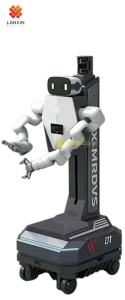
What is the Versabot Vb1?
The Lanxin Robotics VersaBot VB-1 is a full-sized humanoid robot developed by Chinese automation company Lanxin Robotics, headquartered in Hangzhou. Unveiled in 2024, the VB-1 is designed as a modular research platform for applied humanoid R&D, education, and industrial concept validation. Standing 165 cm tall and weighing 75 kg, the robot features 38 degrees of freedom, including 12 in its dexterous 5-finger hands, enabling complex manipulation tasks. Powered by electric servo motors with harmonic gear transmissions, it supports vision-based SLAM navigation via 3D cameras and lidar, and runs on a Linux-based ROS2 stack for seamless integration with external AI accelerators. The VB-1 is primarily aimed at goods transportation and material handling use cases in warehousing and logistics, though it remains in limited pilot deployments.
Specifications
Here are the full technical specifications.
| Spec | Value |
|---|---|
| Height | 165 cm |
| Weight | 75 kg |
| Degrees of freedom | 38 |
| Battery life | 5 hours |
| Max speed | 4.5 km/h |
| Payload | ~5 kg (est.) |
| Price (new) | Undisclosed (contact manufacturer) |
| Price (used range) | N/A |
Price & Value
New MSRP: Undisclosed (contact manufacturer)
Used range: N/A
As a pre-commercial research platform, Lanxin Robotics has not disclosed a public price for the VersaBot VB-1. Prospective buyers—typically university labs and R&D departments—must contact the manufacturer directly to negotiate a lease or pilot agreement. Comparable humanoid research robots, such as the Fourier GR-2 or UBTECH Walker S, range between $100,000 and $300,000, so the VB-1 is likely positioned in a similar bracket. Given its modular design and native ROS2 ecosystem, the robot offers strong value for institutions looking to customize hardware without heavy integration overhead. As no used market exists yet, depreciation is speculative, but the rapid pace of humanoid development suggests early models may lose value quickly once more refined successors arrive. Overall, the total cost of ownership will depend heavily on service contracts and software licensing, both of which remain unclear; organizations should budget for an industrial CPU and optional AI accelerator, which may add to base costs.
Who Is It For?
Best for: - University robotics labs (38 DOF and ROS2 enable dexterous manipulation research and custom software development) - Industrial R&D teams prototyping goods transportation workflows in light logistics environments - Educational institutions seeking a full-scale humanoid for advanced robotics courses
Not for: - Heavy industrial tasks (payload limited to ~5 kg, unsuitable for lifting heavy objects) - Field deployment or outdoor operation (no IP rating, designed for controlled indoor use) - Organizations needing a turnkey solution (requires significant integration and programming, not a plug-and-play system)
Alternatives & Comparison
The VersaBot VB-1 competes with other modular humanoid research platforms in the $100k–$300k range, though its limited availability differentiates it from commercial alternatives.
| Model | Price | Available | Key Difference |
|---|---|---|---|
| Fourier GR-2 | ~$150,000 (est.) | preorder | Higher payload capacity (30 kg) and longer runtime (6 hrs) |
| UBTECH Walker S | ~$120,000 (est.) | preorder | Stronger leg-based locomotion and integrated teleoperation |
| Unitree H1 | $90,000 | preorder | Lighter and faster (max 18 km/h) but fewer hand DOFs |
Verdict: For labs prioritizing modularity and ROS2 nativity, the VersaBot VB-1 holds unique appeal, but its scarce availability and lower payload may steer buyers toward the Fourier GR-2 if they need proven industrial support. The Unitree H1 offers better locomotion at a lower advertised price, though with fewer manipulation degrees of freedom. Overall, the GR-2 is the most balanced alternative for research centers seeking commercial reliability.
Use Cases & Capabilities
Research & Education
The VB-1 is designed as a modular humanoid research platform, allowing labs to test manipulation, navigation, and AI perception algorithms on a full-scale bipedal robot. With its 38 DOF body and 12 DOF hands, researchers can explore grasping, pick-and-place, and force-controlled interactions. The native ROS2 environment and optional AI accelerator enable integration with vision-language models and reinforcement learning frameworks. Its 5-hour battery life supports extended experimental sessions without frequent recharging, and the automatic charging dock minimizes downtime. The robot's aluminum alloy structure is durable enough for indoor lab use, though the lack of IP rating restricts it to clean environments.
Warehouse Goods Transportation
In pilot deployments, the VB-1 is used to transport goods between warehouse zones. The robot navigates autonomously using lidar and 3D cameras with a max speed of 4.5 km/h, carrying items up to 5 kg on its arms. Its vision-based SLAM allows it to operate in dynamic environments with moving obstacles. However, the limited payload means it can only handle small parcels, not heavy bins. Automatic charging and Ethernet/Wi-Fi connectivity make it suitable for continuous shift operations in controlled indoor logistics trials.
Light Manufacturing Material Handling
For manufacturing R&D, the VB-1 can be programmed to fetch and deliver components from assembly lines. Its dual 5-finger hands with harmonic gears enable precision gripping of delicate items, and the 38 DOF body allows reaching into shelves. The robot's 150–250 ms latency is adequate for most slow-paced industrial tasks, though not for high-speed pick-and-place. Integration with ROS2 allows easy communication with existing factory management systems. The lack of payload for heavy tools and no official ISO safety certification limit its use to research-grade cells.
History & Background
Lanxin Robotics was founded in 2016 in Hangzhou, China, specializing in automation solutions for warehousing and logistics. The company developed a range of mobile robots before venturing into humanoid robotics in the early 2020s. The VersaBot VB-1 was first unveiled in 2024 as a flagship research humanoid, alongside a smaller VB2 model aimed at lighter tasks. It entered limited production and pilot deployments with select university and industrial partners the same year. The VB-1 is built on a modular architecture allowing end-users to swap effectors and integrate custom sensors. As of 2026, the robot remains in early adopter programs with no public sales channel, reflecting Lanxin's cautious approach to commercialization. The company continues to refine the platform based on feedback, with no official announcement of a consumer version.
Buying Used — What to Check
Verify payload rating Payload data is borrowed from sibling VB2; actual VB-1 arm payload may differ. Confirm with manufacturer directly.
Check battery health As a research platform with extensive charging cycles, the battery may degrade to under 3 hours. Request cycle count and remaining capacity.
Confirm ROS2 version and software licenses Early units may run beta software; ensure compatibility with your intended AI stack and that all drivers and middleware are properly licensed.